

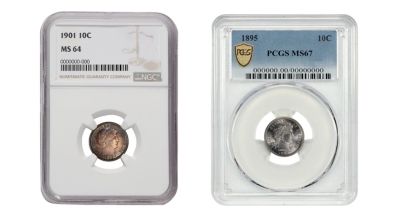
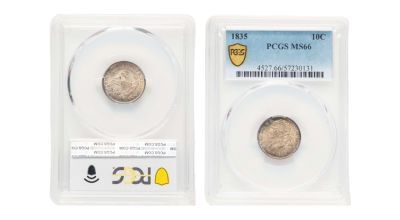
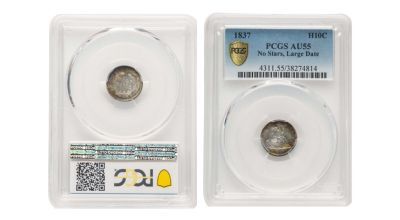
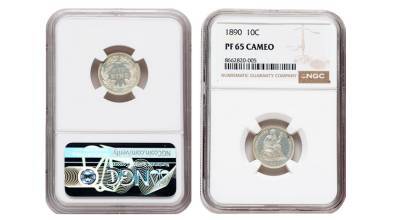

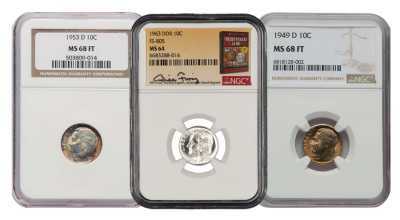
Certified Dimes For Sale
For collectors who want confidence, liquidity, and long-term value, certified dimes sit in a sweet spot of U.S. numismatics. They’re small, widely collected, historically rich, and, when professionally graded, easy to buy, sell, insure, and build into a coherent set. On Bullion Shark’s Certified Dimes category page, you’ll find professionally graded examples across major series (including Certified Barber Dimes, Certified Seated Liberty Dimes, Certified Mercury Dimes, and Certified Roosevelt Dimes, with additional dime-related subcategories appearing in the broader navigation).
Below is a collector-focused overview of the history, types, key dates, low-mintage standouts, and the real-world significance of third-party certification and signature labels, written to help you shop smarter and build a higher-quality set.
History of the U.S. dime: from early silver to modern issues
The U.S. Mint struck the first dimes in 1796, beginning a long-running denomination that mirrors America’s artistic, economic, and technological evolution. Early dimes (1796–1837) typically featured Liberty on the obverse and an eagle on the reverse, reflecting the young nation’s identity and symbolism. In 1837, the reverse design shifted away from the eagle to a wreath motif, and Liberty, in changing forms, remained the central obverse theme until 1946.
Several milestone eras matter to dime collectors:
-
1796: First U.S. dimes minted.
-
1837: Design and metal standards modernize; this period also aligns with a broader fineness shift for U.S. silver coinage.
-
1916–1945: The iconic “Mercury” dime era (actually Liberty wearing a winged cap, symbolizing freedom of thought).
-
1946: The Roosevelt dime begins, honoring Franklin D. Roosevelt.
-
1965: A pivotal composition change, U.S. dimes shift away from circulating silver content as part of broader coinage changes.
This timeline helps explain why collectors often split dime collecting into classic silver (earlier types and pre-1965 silver issues) and modern (clad circulation, proofs, and notable errors/varieties).
Types of certified dimes collectors pursue most
Even within a single denomination, dime collecting offers multiple “lanes,” each with its own rarity profile:
1) Seated Liberty Dimes (and related 19th-century issues)
Seated Liberty issues represent a major chapter of U.S. silver coinage and are especially popular in higher grades and in scarce mintmarked dates. Bullion Shark’s Certified Dimes selection explicitly includes Certified Seated Liberty Dimes.
2) Barber Dimes (1892–1916)
The Barber dime series is a cornerstone for collectors who enjoy turn-of-the-century U.S. coinage, with numerous semi-keys by mint and year. Bullion Shark features Certified Barber Dimes as a dedicated category.
3) Mercury Dimes (1916–1945)
Mercury dimes are among the most actively collected U.S. series. Attractive design, strong collector demand, and many issues where strike quality and grade dramatically change value. Bullion Shark highlights Certified Mercury Dimes as well.
4) Roosevelt Dimes (1946–present)
Roosevelt dimes span both silver (1946–1964) and modern clad issues (1965 onward), plus proofs, varieties, and famous errors. Bullion Shark includes Certified Roosevelt Dimes in this category set.
Key dates and low-mintage dimes to know
“Key date” can mean the lowest mintage, the hardest coin to find in strong condition, or the date with the highest demand relative to supply. Here are several dime highlights collectors commonly anchor around:
Mercury Dime: 1916-D (the blockbuster key)
If you collect Mercury dimes, 1916-D is the name you learn first. PCGS notes an original mintage of 264,000, by far the lowest of the series, one reason it remains in high demand across grades.
Seated Liberty Dime: 1874-CC “Arrows” (ultra-low mintage Carson City rarity)
For Seated Liberty specialists, PCGS highlights the 1874-CC Arrows dime with a mintage of just 10,817, noting most entered circulation and Mint State survivors are exceptionally rare.
Barber Dime: 1894-S (the legendary rarity)
The 1894-S Barber dime is one of the most famous U.S. numismatic rarities. Only 24 were struck (as proof coins), with very few known today.
Roosevelt Dime: the 1975 “No S” Proof (modern-era unicorn)
Modern collectors also chase headline errors, none more famous than the 1975 “No S” Roosevelt proof dime. The Associated Press reports only two examples are known, and one sold for $506,250 at auction, an example of how extreme rarity can exist even in modern U.S. coinage.
Why certification matters: NGC, PCGS & CAC
Buying raw coins can be rewarding, but it also introduces risks: counterfeit concerns, cleaning and damage issues, and disagreements about grade. That’s why certified dimes are so popular, third-party grading creates a shared standard.
Bullion Shark is an authorized US Mint, PCGS, CAC and NGC dealer (and an ANA member), which speaks to why many collectors prefer purchasing certified coins through established channels.
Certification matters most in three ways:
-
Authenticity & protection
Slabs help protect coins from further handling damage and provide authentication—especially important for higher-value keys like 1916-D or 1874-CC. -
Pricing transparency
In rare coins, a single grade point (or a strike/eye-appeal designation) can represent a major price jump. Certification makes comparisons more apples-to-apples. -
Liquidity when selling or upgrading
Many buyers will pay more, and decide faster, when a coin is already graded and encapsulated by a top service.
CAC, CACG, and why stickers and “premium quality” designations matter
Beyond PCGS and NGC grading, many experienced collectors also look for CAC approval, which is intended to identify coins that are solid or high-end for the grade. NGC explains that CAC was formed by John Albanese (one of the original founders of PCGS and NGC) and others, and CAC-stickered coins are those that meet their standards.
In practice, CAC bean matters because it often signals:
-
stronger eye appeal for the grade,
-
fewer hidden problems,
-
and an added layer of market confidence, especially for classic dimes where “grade quality” varies widely.
Signature labels and signed holders: what they are and why collectors like them
A fast-growing niche within certified coins is signature labels, special labels or hand-signed inserts tied to notable numismatic figures. CAC Grading notes that CAC Signature labels are hand-signed by influential numismatic figures and are offered under specific submission circumstances.
Bullion Shark’s inventory shows real-world examples of this collecting lane, such as an NGC-certified Roosevelt dime with a label signed by Bill Fivaz.
Why do signature labels matter?
-
Collectibility / limited availability: signed labels are typically scarcer than standard labels.
-
Theme collecting: some collectors build “signed label sets” around varieties, series, or personalities.
-
Presentation: signature labels can add display appeal and differentiation, especially for registry participants or gift-worthy coins.
Important note: a signature label doesn’t automatically make a coin rarer in the absolute sense, but it can increase collector demand, which may affect premiums.
Building a Certified Dime Collection
If you’re shopping this category, one effective strategy is:
-
Start with a series focus (Mercury, Barber, Seated Liberty, or Roosevelt).
-
Add one marquee key date (like 1916-D for Mercury, or 1874-CC Arrows for Seated Liberty).
-
Then fill in with high-grade, great eye-appeal “type coins”, coins that represent the design and era beautifully, even if they aren’t the absolute rarest.
That combination tends to create collections that are both enjoyable to own and easier to sell or upgrade later.
FAQ
A certified dime is a coin that has been authenticated, graded, and sealed in a tamper-evident holder (“slab”) by a professional third-party grading service.
The most widely recognized services are PCGS and NGC, and many collectors prefer certified dimes graded by one of these two.
Certification reduces the risk of counterfeits, confirms authenticity, standardizes grading, and often makes resale easier because buyers can quickly trust the coin’s stated condition.
The grade describes a coin’s condition. For example, MS (Mint State) coins show no wear, while AU/XF/VF indicate increasing amounts of circulation wear.
It’s the standard U.S. coin grading scale where 70 is perfect and 1 is barely identifiable. Most collectible certified dimes fall somewhere between about VF (Very Fine) and MS (Mint State).
Often yes, because grading adds authentication, protection, and market trust. For scarce dates and higher grades, certification can significantly increase value and liquidity.
Collectors commonly focus on Seated Liberty, Barber, Mercury, and Roosevelt dimes, each offering different eras, designs, and rarity levels.
A key date is a coin that is especially scarce or highly demanded within a series, often due to low mintage, low survival rates, or strong collector competition.
Commonly cited examples include the 1916-D Mercury dime, the 1894-S Barber dime, and certain scarce Carson City Seated Liberty dimes, depending on series and condition.
Low mintage means fewer coins were originally produced. All else equal, fewer coins can mean greater scarcity, especially if few examples survive in high grade.
Not always. Value depends on collector demand, condition, rarity in the grade, and how many coins survived, not just the original mintage number.
“FB” is a designation for Mercury dimes with strong strike detail on the fasces bands on the reverse. FB coins can command significant premiums in higher grades.
Proof dimes are specially made for collectors using polished dies/planchets and careful striking, usually showing sharper details and more reflective surfaces than typical circulation strikes.
A “No S” proof dime is a rare proof coin missing the “S” mintmark that should be present on San Francisco proof issues. These are among the most famous modern U.S. mint errors.
They can. Signature and specialty labels may increase collector interest and premiums due to limited availability and presentation, but the coin’s date, grade, and rarity still drive most of the value.