

Why the 1804 Silver Dollar is called the “King of Coins”
Posted by Andrew Adamo - A certified ANA Professional Numismatist, Active member of ICTA, contributor to CoinWeek, Numismatic News, NGC and ANA on May 12th 2026
Why the 1804 Silver Dollar is called the "King of Coins"
The 1804 Silver Dollar commands prices between $2 million and $4 million at auction, with the finest specimens reaching record-breaking sums. Known universally as the "King of American Coins," this legendary piece was struck years after its dated year as a diplomatic gift, with only fifteen known examples in existence today, making it one of the most celebrated rarities in numismatics.
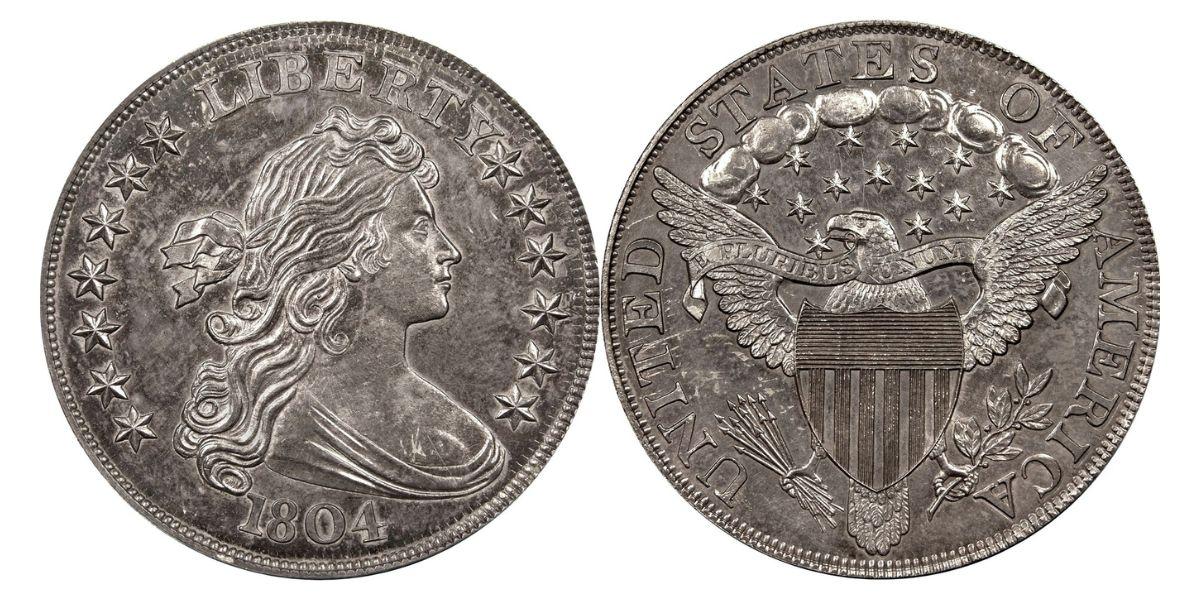
Image credit: PCGS
Understanding the 1804 Silver Dollar
The 1804 Silver Dollar represents one of the most fascinating paradoxes in American numismatics. Despite bearing the date 1804, no dollars were actually struck with this date during that calendar year. The coins known today as 1804 dollars were produced decades later, beginning in the 1834-1835 period, specifically for inclusion in diplomatic presentation sets intended for foreign dignitaries and rulers.
This unusual origin story, combined with extreme rarity and a provenance that reads like an adventure novel, has elevated the 1804 Silver Dollar to legendary status among collectors worldwide. The coin's reputation extends beyond the numismatic community, capturing the imagination of historians, investors, and anyone fascinated by American monetary history.
Only fifteen specimens are confirmed to exist, divided into three distinct classes based on when and why they were struck. This scarcity, paired with the coin's storied past involving diplomatic missions, clandestine mint activities, and high-profile collectors, creates a perfect storm of desirability that places the 1804 dollar in a category occupied by very few coins.
Historical Background of the 1804 Dollar
The story of the 1804 Silver Dollar begins with a misunderstanding about mint records and culminates in one of the most complex narratives in American coinage. To understand why these coins exist at all, collectors must first understand the context of early American dollar production and the diplomatic customs of the 19th century.
The Actual 1804 Coinage Year
In the year 1804, the United States Mint did strike silver dollars, but these coins bore the date 1803. Mint practice at the time allowed the continued use of dies from previous years until they wore out or new dies became necessary. This was a cost-saving measure that resulted in many coins bearing dates from earlier years than their actual striking.
Mint records from 1804 show that 19,570 silver dollars were coined that year, but numismatic research has conclusively demonstrated that all these pieces carried the 1803 date. No dollars dated 1804 were produced during the calendar year 1804, a fact that remained unknown for decades and led to the unusual circumstances that brought the 1804 dollar into existence.
The Diplomatic Mission of the 1830s
In 1834, President Andrew Jackson's administration planned diplomatic missions to Siam (modern-day Thailand), Japan, Cochin China (southern Vietnam), and Muscat (Oman). American diplomatic protocol of the era called for presentation of gifts that showcased American achievements, culture, and manufacturing capability.
The State Department approached the U.S. Mint with a request for special presentation sets that would include examples of current American coinage. These sets were intended to represent the full spectrum of United States monetary production and would be housed in elegant cases for presentation to foreign rulers.
Mint officials reviewed records and determined that the most recent year for which complete denomination sets could be assembled was 1804. Working from incomplete or misunderstood records, they believed dollars had been struck with the 1804 date and set about creating the presentation sets accordingly.
Creation of the Original Class I Specimens
When Mint employees discovered that no 1804-dated dollars actually existed, they faced a dilemma. Rather than abandon the presentation set concept or explain the discrepancy, Mint officials decided to produce 1804-dated dollars specifically for this purpose. This decision, made without apparent controversy at the time, created what numismatists now call Class I specimens.
These original strikes, produced around 1834-1835, were intended purely as presentation pieces and were never meant for circulation. The coins were struck using silver dollar planchets on the old-style collar, resulting in pieces that matched earlier dollar designs featuring the Draped Bust obverse and Heraldic Eagle reverse.
Eight Class I specimens are known to exist today. These coins have the strongest provenance connection to the original diplomatic mission and are considered the most historically significant of the three classes.
The Secret Restrikes: Class II and Class III
The story takes an intriguing turn in subsequent decades. During the 1850s and 1860s, certain individuals connected with the U.S. Mint produced additional 1804 dollars under questionable circumstances. These later pieces are classified as Class II and Class III specimens based on their physical characteristics and production circumstances.
Class II specimens were struck on different planchets with a plain edge, distinguishing them physically from Class I pieces. Only one Class II example is known, and its provenance suggests it was created as a private deal or accommodation strike rather than for any official purpose.
Class III dollars, of which six are known, were produced even later and show different die characteristics. Evidence suggests these pieces were struck clandestinely by Mint employees, possibly for sale to wealthy collectors who were already aware of the 1804 dollar's growing legend.
Why Collectors Consider the 1804 Dollar Numismatic Royalty
The title "King of American Coins" was not bestowed lightly or arbitrarily. Several factors combine to justify this supreme status in the hierarchy of collectible United States coinage.
Absolute Rarity
With only fifteen known examples across all three classes, the 1804 dollar ranks among the rarest coins in American numismatics. This scarcity is not the result of melting, loss, or attrition over time but rather limited production from the very beginning. The coin was rare by design, never intended for circulation, and produced in minuscule quantities.
Unlike some rarities that theoretically could surface from attics, estate sales, or overseas collections, the 1804 dollar population is essentially fixed. The provenance of each known specimen has been meticulously documented, and the likelihood of a genuinely unknown example appearing is vanishingly small.
Historical Significance
Few coins can claim direct connection to diplomatic history involving multiple nations and presidential administrations. The 1804 dollar's role in American foreign relations during the Jacksonian era gives it historical weight beyond its numismatic characteristics.
The coins that traveled to Siam and other destinations served as tangible ambassadors of American capability and craftsmanship. They represented not just monetary denominations but the young nation's technological achievement and artistic sensibility.
Provenance and Romance
Each known 1804 dollar carries its own story. Specimens have passed through the hands of legendary collectors including Matthew Stickney, William Idler, Charles Bushnell, and the DuPont family. Modern collectors and institutions such as the Smithsonian Institution, the American Numismatic Society, and private collectors of extraordinary means have competed for these pieces.
The documented history of ownership, exhibition, and sale creates a narrative layer that enhances desirability. Collectors acquire not just a coin but a connection to centuries of numismatic passion and the personalities who treasured these pieces before them.
Mystery and Intrigue
The circumstances surrounding the Class II and Class III restrikes add an element of numismatic detective work. Questions about exactly who authorized these pieces, when they were struck, and whether additional examples might exist in unrecorded form have fueled decades of research and speculation.
This air of mystery appeals to collectors who appreciate the investigative aspects of numismatics. The 1804 dollar is not simply a rare coin but a puzzle that has engaged generations of researchers.
Design, Specifications, and Identifying Characteristics
The 1804 Silver Dollar features the Draped Bust obverse design paired with the Heraldic Eagle reverse, a combination used on earlier dollar coinage. Understanding the specific design elements and physical characteristics helps collectors appreciate what they are examining and distinguish genuine pieces from replicas or counterfeits.
Obverse Design
The obverse displays Liberty facing right, her hair flowing and loosely bound. Drapery appears at the shoulder and bust line, creating the "Draped Bust" designation. Thirteen stars, representing the original colonies, surround Liberty, with seven stars to the left and six to the right. The date 1804 appears below the bust.
The design follows the artistic style established by engraver Robert Scot in the late 1790s, maintaining continuity with earlier dollar coinage even though the 1804 specimens were struck decades later.
Reverse Design
The reverse features the Heraldic Eagle design, showing an eagle with spread wings holding arrows in its right talon and an olive branch in its left. A shield covers the eagle's breast, and a banner reading "E PLURIBUS UNUM" flows from its beak. Thirteen stars appear above the eagle in a cloud formation, and the denomination appears as "100 CENTS" below, with "ONE DOLLAR OR" above that inscription.
This reverse design was based on the Great Seal of the United States and represented a departure from earlier, smaller eagle designs that had appeared on silver dollars in the mid-1790s.
Physical Specifications
The 1804 dollar measures approximately 39-40 millimeters in diameter, consistent with early dollar coinage. The pieces were struck in .8924 fine silver, the standard composition for silver dollars of that era. Weight specifications followed the established standard of approximately 416 grains or 26.96 grams.
Edge treatment differs between classes. Class I specimens show a lettered edge reading "HUNDRED CENTS ONE DOLLAR OR UNIT," while Class II pieces feature plain edges. Class III specimens return to lettered edges but may show slight variations in execution.
FAQ
Why is the 1804 Silver Dollar called the “King of Coins”?
The 1804 Silver Dollar is called the “King of Coins” because of its legendary rarity, fascinating history, famous collectors, and record-setting auction prices.
Was the 1804 Silver Dollar actually minted in 1804?
No. Despite the 1804 date, the first examples were struck decades later, mainly in the 1830s, as diplomatic presentation pieces.
Why were 1804 Silver Dollars made?
They were originally created for special proof sets intended as diplomatic gifts from the United States to foreign leaders.
How many 1804 Silver Dollars exist today?
Only 15 known examples of the 1804 Silver Dollar are confirmed to exist.
What are the different classes of 1804 Silver Dollars?
The 1804 Silver Dollar is divided into three categories: Class I, Class II, and Class III, based on when and how the coins were struck.
What is a Class I 1804 Silver Dollar?
Class I examples are the original diplomatic presentation coins struck in the 1830s and are considered the most historically significant group.
Why is the 1804 Silver Dollar so rare?
Its rarity comes from the extremely small number produced, its special-purpose creation, and the fact that only 15 examples are known today.
How much is an 1804 Silver Dollar worth?
An 1804 Silver Dollar can be worth millions of dollars, with value depending on its class, condition, pedigree, and auction history.
What is the most expensive 1804 Silver Dollar ever sold?
Some 1804 Silver Dollars have sold for several million dollars at major auctions, with top examples reaching prices above $7 million.
Can collectors still buy an 1804 Silver Dollar today?
Yes, but only rarely. Most examples are held in museums or major private collections, and when one appears at auction, it attracts intense competition from elite collectors.