

The 1950‑D Jefferson Nickel: Low Mintage and Value
Posted by Andrew Adamo - A certified ANA Professional Numismatist, Active member of ICTA, contributor to CoinWeek, Numismatic News, NGC and ANA on May 28th 2026
The 1950-D Jefferson Nickel Key Date: Low Mintage and Value
The 1950-D Jefferson Nickel is a key date coin valued from $2 to $10 in circulated condition, while uncirculated examples range from $15 to $150 depending on grade and eye appeal. Certified MS67 examples have reached over $10,000 at auction, making this Denver Mint issue one of the most sought-after nickels in the Jefferson series due to its notably low mintage.
Understanding the 1950-D Jefferson Nickel
The 1950-D Jefferson Nickel represents one of the lowest mintage issues in the entire Jefferson nickel series that began in 1938. With only 2,630,030 pieces struck at the Denver Mint, this coin stands out among post-World War II coinage as a scarce issue that collectors actively pursue. Its low production numbers make it considerably more difficult to locate than most Jefferson nickels from the same era.
Unlike many low-mintage coins that were hoarded upon release, the 1950-D nickel entered circulation in substantial numbers before collectors recognized its significance. This resulted in most examples showing varying degrees of wear, making high-grade uncirculated specimens particularly valuable today. The coin's importance extends beyond simple scarcity, as it serves as a benchmark for collectors building date and mintmark sets of Jefferson nickels.
Collectors who specialize in Jefferson nickels consider the 1950-D an essential acquisition. Its combination of low mintage, historical significance from the early Cold War period, and relative difficulty in high grades makes it a cornerstone piece. The coin also represents a period when mint production was adjusting to peacetime demands following the material restrictions of World War II.
Historical Context and Production Background
The year 1950 marked a significant period in American coinage history. The United States Mint was operating during the early Cold War era, a time when economic priorities shifted and coin production fluctuated based on commercial demand. The Denver Mint, which had been a major producer during wartime, saw reduced nickel production in 1950 compared to previous years.
Nickel coinage had resumed normal composition in 1946 after the wartime silver alloy used from mid-1942 through 1945. By 1950, the Mint was focusing resources on other denominations that saw heavier circulation demands, particularly cents and dimes. This resource allocation contributed to the unusually low mintage at the Denver facility for nickels that year.
The Philadelphia Mint struck 9,796,000 nickels in 1950, making the Denver issue approximately 73% scarcer than its Philadelphia counterpart. No San Francisco Mint nickels were produced in 1950, as that facility had ceased regular circulation coinage production in 1947. This two-mint production scenario makes the 1950-D even more prominent in the series, as collectors have only two date variations to pursue for that year.
Economic conditions in 1950 included the onset of the Korean War in June, which would eventually impact mint operations and metal priorities. While the war's full effect on coinage production would become more apparent in subsequent years, the reduced nickel mintage at Denver may have reflected early adjustments in resource allocation as the nation prepared for military engagement.
Why Collectors Focus on the 1950-D Jefferson Nickel
The primary driver of collector interest in the 1950-D Jefferson Nickel is its status as the lowest mintage regular-issue Jefferson nickel from the post-war era through the 1950s. This scarcity factor alone places it high on the want lists of collectors building comprehensive Jefferson nickel sets. The coin serves as a challenging yet attainable goal for most collectors, unlike some ultra-rare numismatic items that remain out of reach.
The 1950-D offers an accessible entry point into key date collecting. While prices for circulated examples remain reasonable, the coin still presents a genuine challenge to locate in problem-free condition. This balance between affordability and scarcity makes it particularly appealing to intermediate collectors who have completed basic sets and are ready to pursue more significant coins.
Market demand for the 1950-D Jefferson Nickel remains consistently strong across all grade levels. Collectors seeking circulated examples for album holes compete with quality-focused numismatists pursuing high-grade specimens. This multi-level demand creates a robust market that supports steady pricing and active trading. The coin's recognition factor means it remains liquid in the collector marketplace.
Jefferson nickel specialists particularly value the 1950-D because it represents a turning point in the series. After this date, mintages generally increased as the Mint ramped up production during the Korean War period and beyond. The 1950-D thus marks the end of an era in nickel production, giving it historical significance beyond mere mintage figures.
Design Specifications and Identification Features
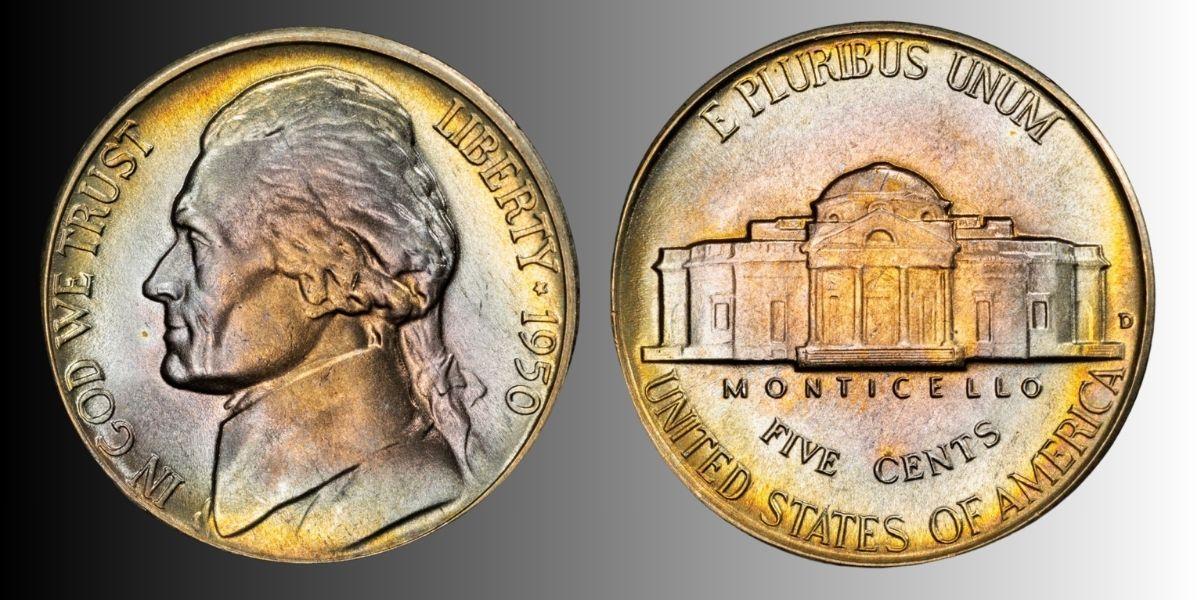
The 1950-D Jefferson Nickel features Felix Schlag's enduring design that debuted in 1938. The obverse displays Thomas Jefferson facing left, with the date positioned below his portrait and the motto "IN GOD WE TRUST" to the left of his profile. The word "LIBERTY" appears behind Jefferson's portrait, following the curve of the coin's rim. Schlag's design was selected through a public competition and has remained largely unchanged throughout the series.
The critical identifier for the 1950-D is the "D" mintmark located on the reverse, to the right of Monticello's base. The mintmark appears as a small letter and should be clearly visible on unworn specimens. On circulated coins, the mintmark may show some wear but typically remains identifiable unless the coin has experienced significant damage or cleaning.
The reverse depicts Monticello, Jefferson's Virginia home, shown in a frontal architectural view. The building's distinctive dome and columns are rendered in detail that varies depending on strike quality. The inscriptions "MONTICELLO" appear below the building, with "E PLURIBUS UNUM" above. The denomination "FIVE CENTS" and "UNITED STATES OF AMERICA" complete the reverse design along the rim.
The coin's specifications match standard Jefferson nickel parameters. It weighs 5 grams and measures 21.2 millimeters in diameter. The composition is 75% copper and 25% nickel, giving the coin its distinctive silvery appearance and magnetic properties. The edge is plain without reeding, consistent with all Jefferson nickels except the wartime silver issues.
Strike quality on 1950-D nickels varies considerably. Some examples show full detail on Jefferson's hair and Monticello's steps, while others exhibit weakness in these areas. Coins with fully struck details command premiums, particularly when accompanied by strong luster and clean surfaces. The steps of Monticello serve as a key diagnostic feature, with fully struck examples showing all five or six steps clearly defined.
Rarity Profile and Availability Assessment
With a mintage of 2,630,030 pieces, the 1950-D Jefferson Nickel ranks as the fourth lowest mintage in the series behind only the 1950 Philadelphia issue, the 1949-D, and the 1950-S. However, the 1950-D often draws more collector attention than some coins with lower mintages due to its position within the series and the fact that many examples were lost to circulation before their significance was recognized.
Circulated examples remain relatively available through dealer inventories, coin shows, and online marketplaces. Collectors can typically locate problem-free circulated specimens with some searching, though coins with original surfaces and no damage command premiums. Examples in Fine through Extremely Fine grades represent the most commonly encountered condition levels for this issue.
Uncirculated examples become significantly more challenging to locate. The majority of 1950-D nickels entered circulation, and roll quantities were not extensively saved by collectors or dealers at the time of issue. This lack of contemporary hoarding means that Mint State examples generally survived by chance rather than through intentional preservation efforts.
In higher Mint State grades, the 1950-D becomes genuinely scarce. Pieces grading MS65 and above combine full luster, minimal contact marks, and strong eye appeal in a package that few examples achieve. Certified specimens in MS66 and MS67 represent condition rarities that appeal to registry set collectors and quality-focused numismatists. The population of coins grading MS68 or higher remains extremely limited.
Authentication concerns for the 1950-D primarily involve altered date coins or added mintmarks. Some unscrupulous individuals have attempted to add a "D" mintmark to more common 1950 Philadelphia nickels. Collectors should examine the mintmark under magnification to ensure it matches the correct size, style, and position for Denver Mint issues. The mintmark should appear as an integral part of the die, not as an addition.
Grading Considerations and Condition Assessment
Grading the 1950-D Jefferson Nickel requires careful attention to specific wear points and surface characteristics. On circulated examples, the first signs of wear appear on Jefferson's cheekbone and the high points of his hair above the forehead. On the reverse, Monticello's dome and the tops of the columns show wear first. These areas help determine whether a coin grades Very Fine, Extremely Fine, or About Uncirculated.
For Mint State examples, grading focuses on contact marks, luster quality, and strike strength. The fields surrounding Jefferson's portrait and the open areas on the reverse show contact marks most visibly. Coins with fewer and less distracting marks grade higher, with MS65 representing a level where marks become minimal and do not significantly impact eye appeal.
Luster quality plays a crucial role in determining grade. Original mint luster should display a satiny or slightly frosty appearance with good cartwheel effect under rotation. Diminished luster from improper cleaning or environmental exposure reduces grade significantly. Coins that have been cleaned often show hairlines under magnification and lack the depth of original luster.
Strike quality varies among 1950-D nickels and affects both grade and value. Full Step designations apply to specimens showing complete separation of Monticello's steps, typically requiring five or six distinct steps to qualify. Full Steps coins trade at substantial premiums, as the designation indicates both strong strike and excellent preservation. These pieces appeal to specialized collectors pursuing the highest quality examples.