

The 1873‑CC Liberty Seated Dime: why Carson City’s dime fetches big money.
Posted by Andrew Adamo - A certified ANA Professional Numismatist, Active member of ICTA, contributor to CoinWeek, Numismatic News, NGC and ANA on May 13th 2026
The 1873-CC Liberty Seated Dime: Why Carson City's Dime Fetches Big Money
The 1873-CC Liberty Seated Dime ranks among the most sought-after coins in American numismatics, with values typically ranging from several thousand dollars in lower grades to over $100,000 for exceptional specimens. Its combination of low mintage, Carson City origin, and historical significance drives strong collector demand across all condition levels.
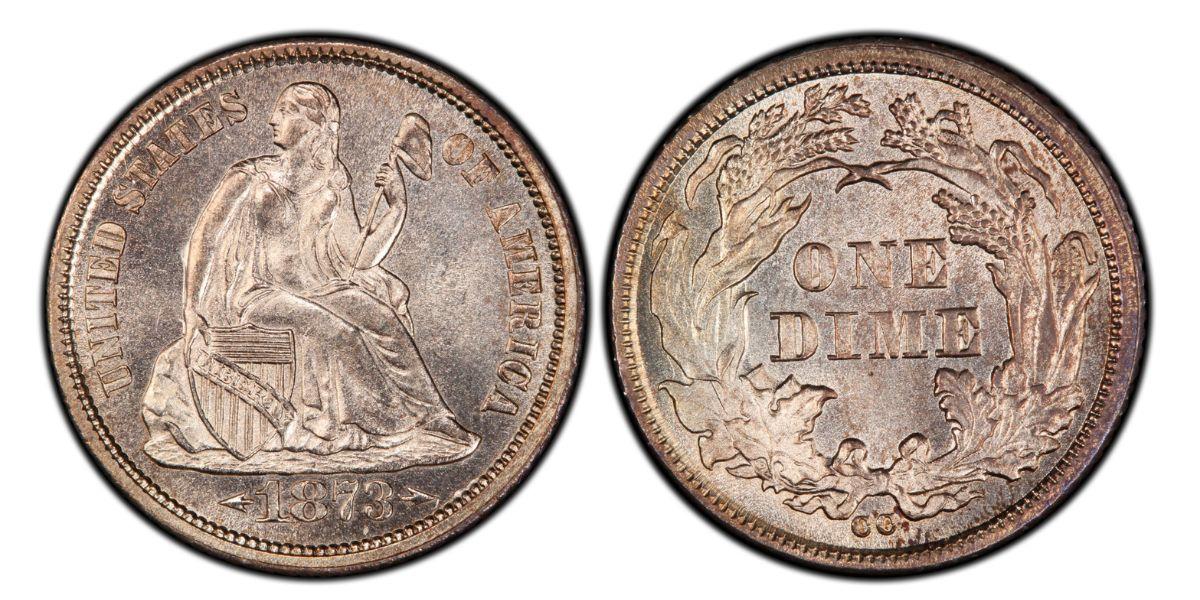
AUCTION RECORD: $552,000 • MS65 • 08-28-2022
Image credit: PCGS
Understanding the 1873-CC Liberty Seated Dime
The 1873-CC Liberty Seated Dime represents a pivotal moment in American coinage history. Struck at the Carson City Mint during a transitional year for U.S. silver coinage, this issue combines multiple factors that collectors prize: the romance of the Carson City Mint, the classic Liberty Seated design, and genuine scarcity in the marketplace.
Carson City coins carry a mystique that few other mint marks can match. Located in Nevada's silver country during the height of the Comstock Lode era, the Carson City Mint operated from 1870 to 1893, producing coins that today command premium prices across nearly every denomination and series. The CC mint mark signals not just a place of manufacture but an entire chapter of Western expansion and silver mining history.
The 1873 date itself marks an important transition in American silver coinage. This year saw significant changes to coin specifications and designs across multiple denominations, making 1873-dated coins particularly interesting to specialists who study the evolution of U.S. Mint policy and production methods.
Historical Context of the Liberty Seated Dime Series
The Liberty Seated design appeared on American dimes from 1837 through 1891, representing one of the longest-running motifs in U.S. coinage history. Christian Gobrecht, the third Chief Engraver of the United States Mint, created the original design based on earlier artistic concepts that symbolized Liberty as a seated female figure.
The obverse depicts Liberty seated on a rock, holding a liberty pole topped with a Phrygian cap in her left hand while her right hand rests on a Union shield. Thirteen stars surround the central figure, representing the original colonies. The date appears below Liberty's position. This design underwent several modifications throughout its production span, but the core imagery remained consistent.
The reverse features a wreath encircling the denomination, initially indicated simply as "ONE DIME." Later modifications changed how the denomination was expressed, and arrows appeared beside the date in certain years to indicate weight standard changes mandated by Congress.
Liberty Seated dimes were struck at multiple mint facilities throughout the series. Philadelphia produced them without mint marks, while New Orleans, San Francisco, and Carson City added their distinctive mint marks on the reverse, below the wreath. Carson City's participation in dime production lasted only from 1871 to 1878, making all CC-marked Liberty Seated dimes relatively scarce compared to their Philadelphia counterparts.
The Carson City Mint in 1873
By 1873, the Carson City Mint had been operating for just three years. The facility opened in 1870 to process the enormous quantities of silver being extracted from Nevada's Comstock Lode, one of the richest silver deposits ever discovered in North America. Rather than shipping raw silver to distant mints, establishing a facility in Carson City made economic and logistical sense.
The Carson City Mint faced numerous operational challenges during its early years. Equipment breakdowns, staffing difficulties, and the technical demands of coinage production in a relatively remote location all affected output. These challenges contributed to generally lower mintages compared to established facilities in Philadelphia, San Francisco, and New Orleans.
Production at Carson City reflected the realities of frontier minting. Quality control sometimes varied, striking pressure could be inconsistent, and dies wore differently than at other facilities. These production characteristics create distinctive collecting opportunities, as numismatists study strike quality, die states, and other technical details specific to Carson City operations.
The political and economic context of 1873 also matters. The Coinage Act of 1873, sometimes called the "Crime of 1873" by its critics, ended the free coinage of silver and removed the standard silver dollar from production. This legislation reflected ongoing debates about monetary policy, the gold standard, and the role of silver in American currency. These controversies swirled around the very coins being struck at Carson City that year.
Why Collectors Pursue the 1873-CC Liberty Seated Dime
Several interconnected factors drive collector interest in this particular issue. Understanding these elements helps explain why the 1873-CC commands attention and premium prices in the numismatic marketplace.
Genuine Scarcity
The 1873-CC Liberty Seated Dime was produced in limited numbers compared to Philadelphia issues from the same era. While precise survival rates remain difficult to quantify, the relatively small original mintage combined with normal attrition over 150 years means that locating examples in any grade requires patience and resources.
Scarcity alone does not guarantee collector interest, but when combined with other desirable attributes, it becomes a powerful value driver. The 1873-CC represents not just a scarce coin but a scarce coin from a beloved mint facility, in a popular series, from a historically significant year.
Carson City Collector Base
Carson City coins attract dedicated collectors who pursue complete or representative sets of CC-marked issues. These collectors understand that Carson City's brief operational period and generally lower mintages across denominations create natural scarcity. The CC mint mark carries premium value across gold, silver, and base metal denominations.
This dedicated collector base ensures consistent demand. When examples appear at auction or in dealer inventories, knowledgeable buyers compete for quality pieces. This competition supports price levels and creates a relatively liquid market for properly graded, authenticated specimens.
Series Collectors
Liberty Seated dime collectors represent another important demand source. Building a complete or near-complete set of Liberty Seated dimes by date and mint mark remains a challenging but achievable goal for collectors with sufficient resources and dedication. The 1873-CC represents one of the key Carson City dates needed for comprehensiveness.
Series collectors often focus on acquiring one example of each date and mint mark combination, prioritizing authenticity and problem-free surfaces over absolute grade perfection. This collecting approach creates steady demand across the grade spectrum, from Good through Mint State.
Historical Appeal
The combination of Carson City origin, Liberty Seated design heritage, and 1873 date creates a compelling historical narrative. Collectors who appreciate the stories behind their coins find much to value in an 1873-CC dime: frontier minting, Western expansion, silver mining history, monetary policy debates, and 19th-century craftsmanship all intersect in this small silver coin.
This historical dimension adds emotional and intellectual appeal beyond pure numismatic scarcity. Collectors often describe deeper satisfaction from owning coins that connect to broader historical themes, and the 1873-CC Liberty Seated Dime certainly qualifies.
Design Elements and Specifications
Understanding the physical characteristics and design details of the 1873-CC Liberty Seated Dime helps collectors properly identify, evaluate, and appreciate examples they encounter.
Obverse Design
The obverse features Christian Gobrecht's Liberty Seated motif. Liberty sits facing left, her right hand supporting her position against a shield marked with vertical stripes. Her left hand holds a staff topped with a liberty cap. Thirteen stars surround the figure, with seven to the left and six to the right. The date 1873 appears below Liberty's position, struck into the field beneath the rock on which she sits.
Design details to observe include the clarity of Liberty's facial features, the definition of the shield's vertical lines, the sharpness of the stars, and the completeness of the drapery folds in Liberty's gown. These elements reveal strike quality and serve as important grading references.
Reverse Design
The reverse displays a wreath composed of agricultural products including corn, wheat, oak leaves, and maple leaves. This wreath encircles the denomination "ONE DIME" struck in two lines. Above the wreath appears "UNITED STATES OF AMERICA" in an arc. The CC mint mark appears below the wreath, positioned between the base of the wreath and the coin's edge.
The wreath details provide important grading information. Examining the definition of individual leaves, the separation of wheat kernels, and the depth of the wreath's ribbon bow helps determine original strike quality and remaining detail after circulation.
Physical Specifications
The 1873-CC Liberty Seated Dime conforms to the standard specifications for dimes of this era. The coin measures 17.9 millimeters in diameter and weighs 2.5 grams. Composition consists of 90% silver and 10% copper, the standard alloy for U.S. silver coinage before 1965. The edge features reeding, which serves both aesthetic and anti-counterfeiting purposes.
These specifications remained consistent across mint facilities, meaning an 1873-CC dime shares the same size, weight, and composition as Philadelphia or San Francisco dimes from the same year. Differences appear in mint mark placement and sometimes in striking characteristics rather than fundamental specifications.
Identifying Authentic Examples
Given the premium prices that 1873-CC Liberty Seated Dimes command, authentication becomes critically important. Collectors should understand what to look for and when to seek expert assistance.
The CC mint mark is the primary identifying feature. It appears on the reverse, below the wreath, struck clearly into the field. Authentic mint marks show the proper style, size, and positioning consistent with genuine Carson City production. Counterfeiters have added fake CC mint marks to more common Philadelphia coins, making careful examination essential.
Studying the mint mark under magnification reveals important details. Genuine CC mint marks display the correct serif style, letter spacing, and depth consistent with authentic dies used at Carson City. Reference materials showing detailed photographs of genuine mint marks help collectors develop recognition skills.
Die characteristics provide additional authentication evidence. Each die used at the mint possessed unique markers: small scratches, die cracks, die chips, and other tiny features that appear on every coin struck from that die.