

The 1861 Confederate Half Dollar: Civil War Relic
Posted by Andrew Adamo - A certified ANA Professional Numismatist, Active member of ICTA, contributor to CoinWeek, Numismatic News, NGC and ANA on Jun 9th 2026
The 1861 Confederate Half Dollar: Civil War Relic
The 1861 Confederate Half Dollar is one of American numismatics' most storied rarities, with authentic original specimens valued in the six-figure range and restrikes commanding prices from several hundred to tens of thousands of dollars. The highest auction record for an original specimen exceeded $900,000, making this Civil War-era coin a centerpiece for serious collectors of Confederate and Southern numismatic history.
Overview of the 1861 Confederate Half Dollar
The 1861 Confederate Half Dollar represents a unique chapter in American coinage history. Struck during the early days of the Civil War, these coins were produced by the Confederate States of America in an attempt to establish an independent monetary system. Only four original examples were struck, making them among the rarest coins in American numismatics. Later restrikes, produced after the war, allow collectors of more modest means to own a piece of this fascinating history.
This coin holds tremendous appeal for collectors who focus on Civil War memorabilia, Southern numismatics, pattern coinage, and American monetary history. The combination of extreme rarity, historical significance, and the dramatic circumstances of production creates collector demand that extends well beyond traditional coin collecting circles into the broader world of American historical artifacts.
Understanding the 1861 Confederate Half Dollar requires examining both the original strikings and the later restrikes, as well as the political and economic context that brought this coin into existence during one of the most tumultuous periods in American history.
Historical Background and Production Context
When Confederate forces seized the New Orleans Mint in early 1861, they gained control of one of the most productive coining facilities in the United States. The mint had been striking federal coinage under U.S. authority until Louisiana seceded from the Union in January 1861. Following secession, the facility briefly operated under the authority of the State of Louisiana before transferring to Confederate control.
The Confederate government faced an immediate need for circulating coinage. While they initially continued striking coins using existing federal dies, the leadership soon desired distinctively Confederate coinage that would symbolize their new nation's sovereignty and independence from the Union.
In April 1861, Confederate officials commissioned J.A. Baily, a local New Orleans jeweler and die sinker, to prepare a distinctive Confederate design for the half dollar denomination. Baily created a reverse die featuring a shield with seven stars representing the original seven Confederate states, topped by a Liberty cap and flanked by cotton and sugar cane stalks, crops vital to the Southern economy.
The obverse retained the existing federal Seated Liberty design that had been used on U.S. half dollars since 1839. This practical decision saved time and resources, as creating a completely new design for both sides would have been considerably more complex and expensive.
Chief Coiner B.F. Taylor struck four original examples using a federal obverse die and Baily's Confederate reverse die. These specimens were struck on standard silver planchets using the regular coining presses at the New Orleans facility. The coins were presented to Confederate officials and supporters as prototypes for what could have become a regular issue.
However, the Confederate government never proceeded with mass production. Financial constraints, the deteriorating military situation, and the loss of New Orleans to Union forces in April 1862 ended any possibility of Confederate coinage production. The New Orleans Mint fell under Union control, and the Confederate monetary experiment effectively ceased.
The original Confederate reverse die survived the war. In 1879, J.W. Scott, a New York coin dealer, obtained the die and produced restrikes to satisfy collector demand. Scott acquired 500 genuine 1861 New Orleans Mint half dollars that had been struck under federal authority before the Confederate takeover. He planed off the original reverse design and restruck these coins using the Confederate reverse die, creating 500 restrike Confederate half dollars.
Scott also produced 500 tokens using white metal composition with the Confederate reverse design, providing an even more affordable option for collectors. These white metal pieces featured the Confederate reverse paired with a specially created obverse noting the limited production of the original coins.
Why Collectors Value the 1861 Confederate Half Dollar
The historical significance of the 1861 Confederate Half Dollar creates demand that transcends typical numismatic collecting. These coins represent a brief moment when the Confederate States attempted to establish all the institutions of an independent nation, including its own monetary system. For collectors interested in Civil War history, Southern heritage, or American political history, these coins offer tangible connections to that pivotal era.
The extreme rarity of the original four specimens places them among the most coveted items in American numismatics. Only a handful of collectors will ever have the opportunity to own an original example, and when one appears at auction, it generates significant attention from museums, advanced collectors, and institutions focused on preserving Civil War artifacts.
The restrikes, while far more available than originals, still represent important historical pieces. The fact that they were created using genuine 1861 New Orleans half dollars and the actual Confederate die gives them legitimacy that reproductions lack. Collectors can own an authentic piece struck with the Confederate die, even if it was produced years after the war ended.
The design itself holds artistic and symbolic interest. The Confederate reverse features distinctly Southern imagery with the cotton and sugar cane stalks representing the agricultural economy that defined the region. The seven stars commemorating the original Confederate states provide a historical snapshot of the Confederacy at a specific moment in its formation.
The story of how these coins came to be, the wartime circumstances of production, and the later restrike history all contribute to their appeal. Numismatic items with compelling narratives typically command stronger collector interest than those without such historical depth.
Design, Specifications, and Identifying Details
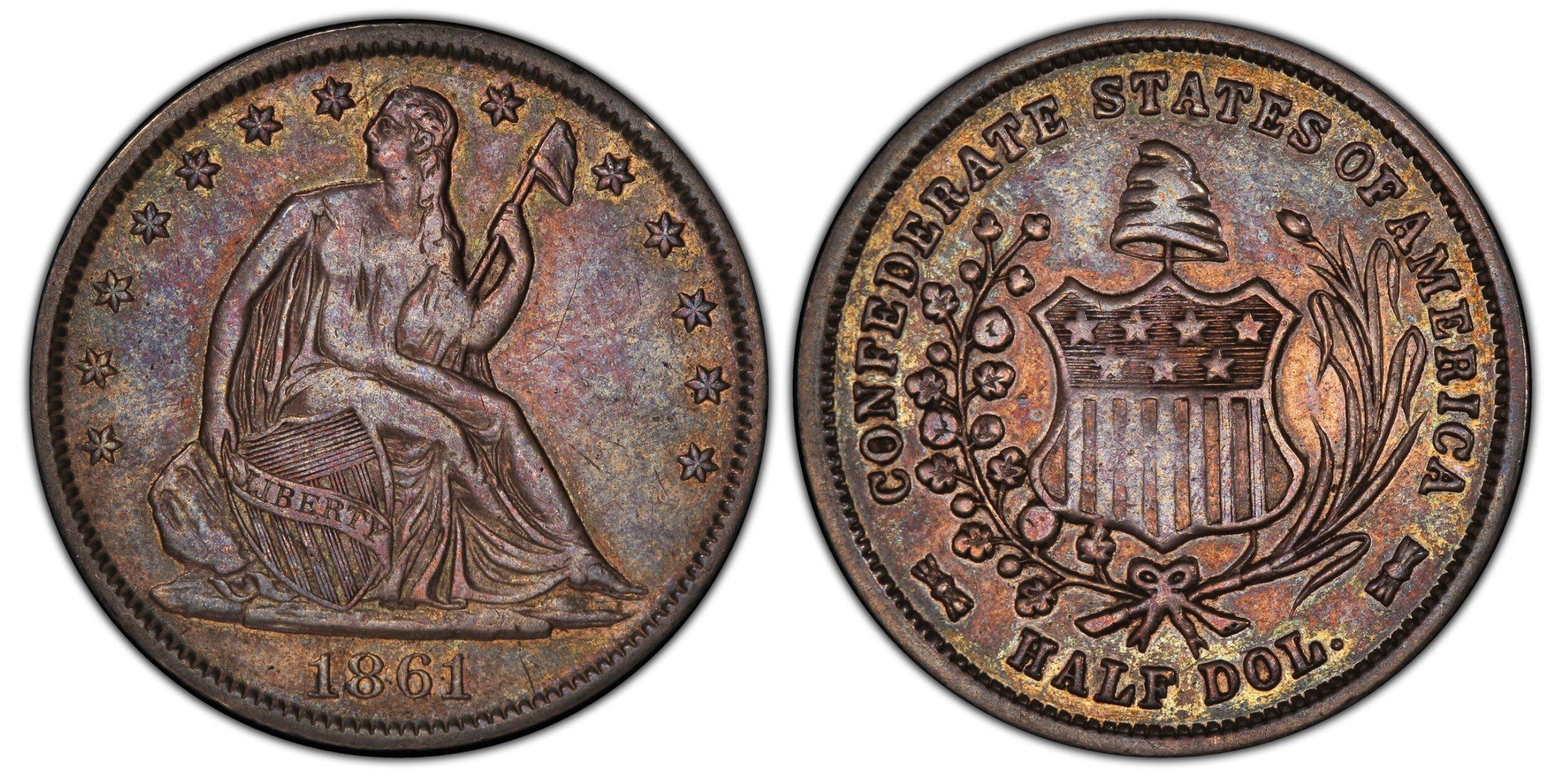
The obverse of the 1861 Confederate Half Dollar features the Seated Liberty design created by Christian Gobrecht. This design shows Liberty seated on a rock, holding a pole with a Liberty cap in her left hand and a shield inscribed "LIBERTY" in her right hand. Thirteen stars surround the figure, representing the original thirteen colonies, with the date 1861 below.
The Confederate reverse designed by J.A. Baily presents a central shield topped with a Liberty cap. Seven stars arranged in an arc above the shield represent the original seven Confederate states: South Carolina, Mississippi, Florida, Alabama, Georgia, Louisiana, and Texas. Cotton stalks appear on the left side of the shield, while sugar cane stalks appear on the right, symbolizing the agricultural foundation of the Confederate economy.
The denomination "HALF DOL." appears below the shield. The design consciously avoided including "United States of America" or any other federal designation, marking it clearly as Confederate rather than Union coinage.
The original specimens were struck on standard silver planchets containing 90 percent silver and 10 percent copper, weighing 12.44 grams with a diameter of 30.6 millimeters. These specifications matched the regular U.S. half dollars of the period.
The 1879 restrikes used genuine 1861-O half dollars that had been struck under federal authority. These coins had their original reverse designs planed off and were restruck with the Confederate reverse. The restrikes therefore feature the same obverse, composition, weight, and diameter as the originals, though the planing process and restriking can create subtle differences detectable by experts.
The white metal tokens produced by Scott feature the Confederate reverse paired with a different obverse that includes text explaining the limited production. These pieces use a copper-nickel or white metal composition rather than silver and are easily distinguished from both originals and silver restrikes.
Rarity, Mintage, and Availability
The four original 1861 Confederate Half Dollars represent one of the smallest mintages in American numismatic history. All four original specimens are accounted for and appear in the census maintained by researchers. These coins rarely change hands, and when they do, the transactions typically occur through major auction houses with extensive publicity and documentation.
The location and ownership history of each original specimen is generally known to researchers. Some reside in museum collections, while others remain in private hands. The rarity and value make authentication and provenance documentation critically important for any specimen claimed to be an original.
The 500 silver restrikes created in 1879 are far more available but still represent a very limited population. Over the decades since their production, some have been lost, damaged, or destroyed, reducing the number available to today's collectors. Third-party grading services have certified many examples, and their population reports provide useful data about how many specimens exist in various grades.
The white metal tokens, also limited to 500 pieces, appear on the market more frequently than the silver restrikes. While still collectible, they command lower prices due to their non-silver composition and token rather than coin status.
Collectors should be aware that modern replicas and reproductions exist. These pieces have no numismatic value and are typically marked as copies, though unscrupulous sellers sometimes attempt to misrepresent them. Purchasing certified examples from reputable dealers provides protection against counterfeits and reproductions.
Grading and Condition Considerations
Grading the 1861 Confederate Half Dollar follows standard numismatic grading principles, but the coin's unique production history creates some special considerations. For the silver restrikes, the planing process used to remove the original reverse design can affect the overall appearance and grading of the coin.
The obverse typically shows normal wear patterns consistent with the Seated Liberty design. Collectors examine Liberty's head, breast, and knee for friction and wear. The shield should display clear details with minimal smoothing from circulation or handling. The stars should be well defined with separation from the rim.
The reverse requires careful examination of the shield's details, the Liberty cap, and the agricultural elements. The cotton and sugar cane stalks feature fine details that can show weakness from striking or wear. The seven stars should be distinct and well formed.
Because the restrikes were created by planing off the original reverse and restriking with the Confederate die, some examples show slight weakness or unevenness. The planing process could create minor surface irregularities that carried through to the final product. These characteristics are part of the restrikes' production history rather than post-striking damage.