

The 1796 Draped Bust Quarter: America’s First Quarter
Posted by Andrew Adamo - A certified ANA Professional Numismatist, Active member of ICTA, contributor to CoinWeek, Numismatic News, NGC and ANA on May 22nd 2026
The 1796 Draped Bust Quarter: America's First Quarter
The 1796 Draped Bust Quarter represents the first quarter dollar ever produced by the United States Mint, with values ranging from approximately $20,000 in lower circulated grades to well over $1.5 million for exceptional specimens. The highest auction record for this historic issue reached $1,527,500 for a specimen graded MS67+, establishing it as one of the most valuable and sought-after early American coins.
Understanding the 1796 Draped Bust Quarter
The 1796 Draped Bust Quarter holds a unique position in American numismatic history as the inaugural quarter dollar produced by the young United States Mint. This coin represents more than just a denomination; it embodies the ambitious effort of a new nation to establish its monetary identity and commercial independence. For collectors, owning an example means holding a tangible piece of the earliest days of American coinage.
Struck during the Mint's formative years in Philadelphia, this quarter entered circulation when the United States was still defining itself politically, economically, and culturally. The production of quarter dollars had been authorized by the Coinage Act of 1792, but practical challenges delayed their manufacture until 1796, making this issue particularly significant for specialists in early American coinage.
Unlike modern coins produced by the millions, the 1796 Draped Bust Quarter was created in extremely limited numbers using hand-operated coining presses and individually prepared planchets. Each surviving specimen represents the skilled work of early Mint employees operating under primitive conditions by today's standards, adding layers of historical and manufacturing interest to an already compelling numismatic treasure.
Historical Context and Production Background
The United States Mint began operations in Philadelphia in 1792, but the production of various denominations proceeded gradually as equipment, skilled personnel, and precious metals became available. While half dimes, half dollars, and dollars were struck earlier, quarter dollars did not appear until 1796, four years after the Mint's founding.
The delay in quarter dollar production reflected practical priorities and resource constraints. The young Mint focused first on denominations considered most essential for commerce, and quarters fell into a middle category that could initially be accommodated by using half dimes and half dollars. When quarter production finally began in 1796, it represented an expansion of the Mint's capabilities and America's monetary system.
The coining occurred during the administration of President George Washington, though he would leave office in March 1797. The Mint Director during this period was Elias Boudinot, who oversaw the challenging task of establishing reliable coin production with limited technology and resources. The mintage of 1796 quarters occurred late in the year, with most production likely happening between October and December.
Production methods involved manually feeding individual planchets between dies and striking each coin with a screw press operated by human power. This labor-intensive process limited output and resulted in coins with varying strike quality, as each impression depended on factors including planchet alignment, die condition, and operator consistency. These production realities contribute to the wide range of quality seen among surviving examples.
Design and Artistic Features
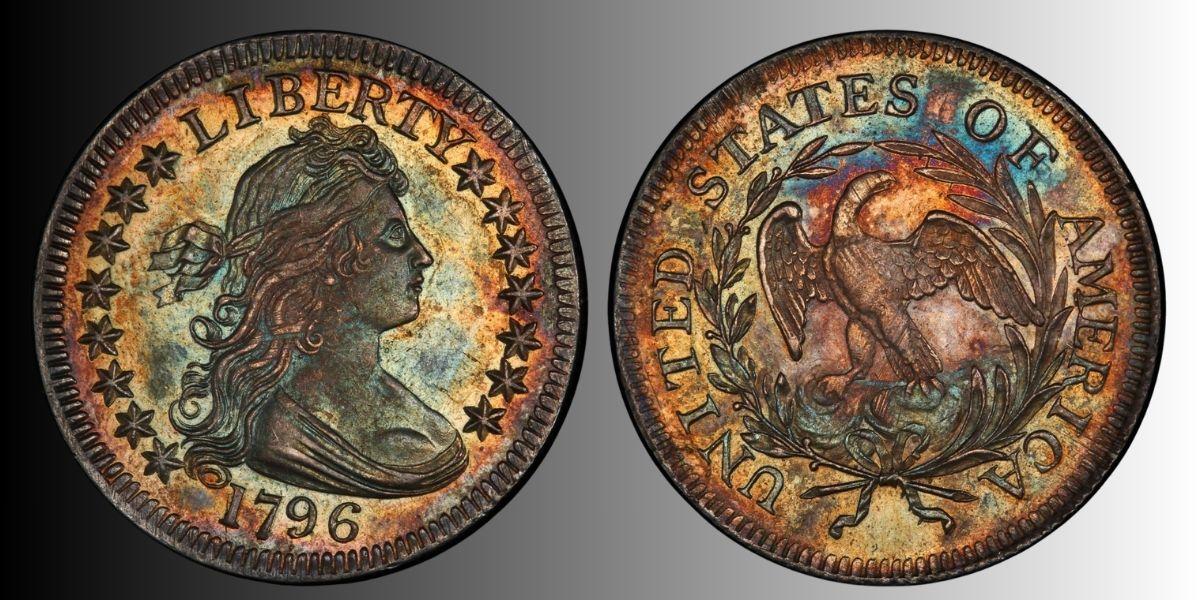
The design of the 1796 Draped Bust Quarter features the work of engraver Robert Scot, who served as the first Chief Engraver of the United States Mint. The obverse presents Liberty facing right, her hair flowing loosely and draped across her shoulders in the style that gives the series its name. This portrait style, known as the Draped Bust, was adapted from a drawing by artist Gilbert Stuart and represents an idealized classical interpretation of Liberty rather than a portrait of an actual person.
Surrounding Liberty's portrait are thirteen stars, representing the original thirteen colonies, arranged with eight to the left and five to the right of the portrait. The date 1796 appears below Liberty's truncation. The overall composition conveys dignity and classical restraint, reflecting the artistic preferences of the late 18th century and the young nation's desire to project permanence and respectability.
The reverse displays a small eagle perched on clouds, surrounded by a wreath. This Small Eagle reverse design was used on quarter dollars only in 1796, making it a one-year type coin for this particular design combination. The eagle motif was legally required by the Coinage Act of 1792, which specified that coins of silver and gold must bear "an impression emblematic of liberty" on one side and "the figure or representation of an eagle" on the other.
The legend UNITED STATES OF AMERICA encircles the eagle and wreath on the reverse, with no mention of the denomination. This absence of a stated value was typical of early American coinage, as the size and silver content were expected to communicate the denomination. The entire design reflects the Federal period aesthetic, with its emphasis on symmetry, classical imagery, and restrained ornamentation.
Technical Specifications and Composition
The 1796 Draped Bust Quarter was struck in silver, conforming to the specifications established by the Coinage Act of 1792. The composition consisted of approximately 89.24% silver and 10.76% copper, a mixture that provided durability while maintaining intrinsic precious metal value. This alloy standard remained consistent for early U.S. silver coinage and was designed to approximate the silver content of widely circulated Spanish colonial coins.
The diameter measures approximately 27.5 millimeters, and the authorized weight was 6.74 grams or 104 grains. These specifications positioned the quarter as exactly one-fourth the weight of the silver dollar, maintaining a logical proportional relationship within the denomination structure. The edge of the coin features reeding, a security measure that helped prevent the illegal practice of filing or clipping precious metal from the edges.
The planchets used to strike these coins were prepared manually, rolled to the proper thickness, and cut to size using hand-operated equipment. This process introduced slight variations in weight and diameter among individual coins, variations that modern collectors examine as part of understanding early Mint production techniques. The hand-crafted nature of these coins means that no two examples are precisely identical in every manufacturing detail.
Mintage and Rarity Considerations
The recorded mintage for the 1796 Draped Bust Quarter stands at 6,146 pieces, a figure that represents the total number of quarters reported as produced during the calendar year. This extremely low production total makes the issue rare by any standard, but the survival rate further compounds the scarcity. Numismatic researchers estimate that fewer than 500 examples exist today across all grades, with many of those showing significant circulation wear.
The low mintage reflects several factors, including the late start of quarter production in 1796, limited demand for this denomination, and the general constraints under which the early Mint operated. Quarter dollars represented a relatively large unit of currency in the 1790s economy, where daily wages for laborers might amount to less than a dollar, making quarters less practical for everyday transactions than smaller denominations.
Most examples that survived the melting pot did so because they either left circulation quickly or were preserved by individuals who recognized their significance. Many 1796 quarters remained in circulation for years or decades, accumulating wear until they were eventually removed from circulation due to damage, loss, or deliberate preservation. The coins that survived in higher grades often did so through fortunate circumstance rather than intentional numismatic preservation, as systematic coin collecting was not yet widespread in early 19th-century America.
Today, the 1796 Draped Bust Quarter ranks among the most sought-after issues in American numismatics. Its status as the first quarter dollar, combined with its one-year type status featuring the Small Eagle reverse, creates multiple collecting motivations. Specialists in early American coinage, type collectors seeking one example of each major design, and completists assembling date sets all compete for the limited supply of available specimens.
Why Collectors Pursue This Coin
The appeal of the 1796 Draped Bust Quarter extends beyond its monetary value to encompass historical significance, design artistry, and collecting challenge. As America's first quarter dollar, it represents a landmark in the development of the nation's coinage system and holds intrinsic interest for anyone fascinated by the founding era. Collectors value the direct connection to the 1790s, when the constitutional experiment was still new and uncertain.
The one-year type status adds another dimension of desirability. Because the Small Eagle reverse appeared on quarters only in 1796, collectors building type sets of early American coinage must acquire this specific issue to represent this design pairing. This creates consistent demand that transcends the interests of date collectors alone, broadening the market and supporting values across the grade spectrum.
Rarity plays an obvious role in collector interest. With fewer than 500 examples believed to survive from an original mintage of just over 6,000, the 1796 quarter qualifies as genuinely scarce. Unlike some coins that carry inflated reputations despite adequate supplies, this issue presents authentic difficulty for collectors seeking to acquire an example. The challenge of locating and obtaining a specimen adds to the satisfaction of ownership.
The coin's visual appeal attracts collectors who appreciate early American artistic interpretation. The Draped Bust portrait, though stylized by modern standards, conveys dignity and classical beauty. The Small Eagle reverse presents a different aesthetic than the larger, more heraldic eagle designs that followed, offering variety and charm. Well-preserved examples display attractive luster and surfaces that reveal the hand-crafted character of early coinage.
Investment considerations also factor into collector decisions, though serious numismatists typically emphasize the historical and aesthetic aspects over purely financial motivations. The combination of documented rarity, strong collector demand, and limited availability suggests that quality examples should maintain their position in the numismatic marketplace, though all collectibles remain subject to market fluctuations and changing tastes.
Grading Factors and Condition Assessment
Evaluating the condition of a 1796 Draped Bust Quarter requires understanding the wear patterns typical of this design and recognizing the production characteristics that can mimic wear. The highest points of the design, which receive the first contact wear, include Liberty's hair above the forehead and draped along the shoulder, the cheek, and the bust line. On the reverse, the eagle's breast and the upper portions of the wreath show wear earliest.