

The 1787 Brasher Doubloon: First U.S. Gold Coin
Posted by Andrew Adamo - A certified ANA Professional Numismatist, Active member of ICTA, contributor to CoinWeek, Numismatic News, NGC and ANA on May 26th 2026
The 1787 Brasher Doubloon: First U.S. Gold Coin
The Brasher Doubloon, struck in 1787 by New York goldsmith Ephraim Brasher, represents one of the rarest and most historically significant gold coins in American numismatics. Values range dramatically based on variety and condition, with examples typically commanding seven to eight figures at auction. The record stands at $9.36 million for an EB-on-Wing specimen sold in January 2021.
Brasher Doubloon Overview: A Collector Intelligence Report
The Brasher Doubloon occupies a unique position in American coinage history. Created before the establishment of the United States Mint, this privately struck gold coin emerged during a period when the young nation lacked official federal coinage. Ephraim Brasher, a respected New York City goldsmith and neighbor of George Washington, produced these pieces as America's financial system struggled to establish uniformity and trust.
Only a small number of Brasher Doubloons survive today, making each specimen a museum-quality treasure. The coin's historical significance extends beyond its precious metal content. It represents early American entrepreneurship, the transition from colonial to federal systems, and the practical challenges of commerce in post-Revolutionary America.
Collectors and institutions prize the Brasher Doubloon not only for its rarity but for its connection to American independence and monetary evolution. Each surviving example carries a documented provenance that traces ownership through generations of numismatic connoisseurs.
Post-Revolutionary America Coinage
Following the Revolutionary War, the United States faced a severe shortage of reliable currency. Foreign coins circulated freely alongside state-issued pieces and private tokens. The Spanish doubloon, a widely accepted gold coin, served as the model for Brasher's creation. These Spanish coins represented a standard of value that Americans understood and trusted.
The Constitution granted Congress the power to coin money in 1787, the same year Brasher struck his doubloons. However, the federal mint would not begin operations until 1792. This five-year gap left merchants, tradesmen, and citizens without a unified national currency. Enterprising individuals like Brasher stepped into this void.
Ephraim Brasher maintained a shop on Cherry Street in New York City, where he practiced his trade as a goldsmith and silversmith. Records indicate he assayed and adjusted the weight of foreign coins circulating in New York. His decision to strike his own gold coins reflected both business opportunity and civic contribution, providing quality-assured gold pieces for local commerce.
The timing proved significant. New York served as the nation's capital from 1785 to 1790, creating demand for reliable currency among government officials, merchants, and visiting dignitaries. Brasher's location positioned him perfectly to serve this market with privately struck gold coins that met accepted standards.
Brasher's Petition and the Road to Private Coinage
Before striking his famous doubloons, Brasher petitioned the New York State Legislature for a contract to produce copper coins. His 1787 petition, submitted jointly with John Bailey, requested authorization to establish a mint. The legislature ultimately rejected this proposal, but the petition demonstrates Brasher's ambition to participate in American coinage production.
Following this rejection, Brasher proceeded independently. Without official authorization but also without prohibition, he created his gold doubloons using his own dies, metal, and expertise. This private coining represented a bold entrepreneurial move in an era of monetary uncertainty.
The coins he produced carried his distinctive EB counterstamp, functioning as both maker's mark and assurance of gold content. This hallmark approach aligned with traditional goldsmithing practices, where craftsmen guaranteed the quality of their work through personal marks.
Why Collectors Pay Attention: Rarity, History, and Market Dynamics
The Brasher Doubloon commands attention across multiple dimensions of numismatic collecting. First and foremost, extreme rarity drives collector interest. With fewer than ten examples known to exist across all varieties, the coin ranks among the rarest American issues. Institutional holdings account for several specimens, further limiting availability to private collectors.
Historical significance amplifies desirability beyond rarity alone. The Brasher Doubloon represents America's earliest gold coinage, predating the federal mint by five years. This "first" status appeals to collectors building comprehensive type sets of American coins or focusing on colonial and early American issues.
The coin's connection to the founding era adds narrative power. Struck in the year the Constitution was written, handled by citizens of the early republic, and created by a craftsman who knew George Washington personally, the Brasher Doubloon offers tangible connection to American beginnings.
Market performance reinforces collector interest. Brasher Doubloons consistently achieve record-breaking prices when they appear at auction. The combination of extreme rarity, impeccable provenance, and historical importance creates competition among elite collectors and institutions willing to commit substantial resources.
Authentication and Provenance Considerations
Given the value and fame of Brasher Doubloons, authentication requires expert examination. Each known specimen carries documented provenance tracing ownership through decades or centuries. Certification by major grading services provides additional verification, though the small population means that numismatic experts often recognize individual specimens by specific characteristics.
Counterfeits and replicas exist, as they do for any famous coin. Collectors should approach any claimed Brasher Doubloon with appropriate skepticism and insist on certification from recognized authentication services. The weight, dimensions, die characteristics, and gold content must align with known specifications for genuine examples.
Provenance documentation adds value beyond authentication alone. A specimen with continuous ownership records from the 18th or 19th century through to the present carries enhanced appeal. Major auction appearances, exhibition history, and publication in numismatic references all contribute to a coin's documented story.
Design, Specifications, and Identifying Details
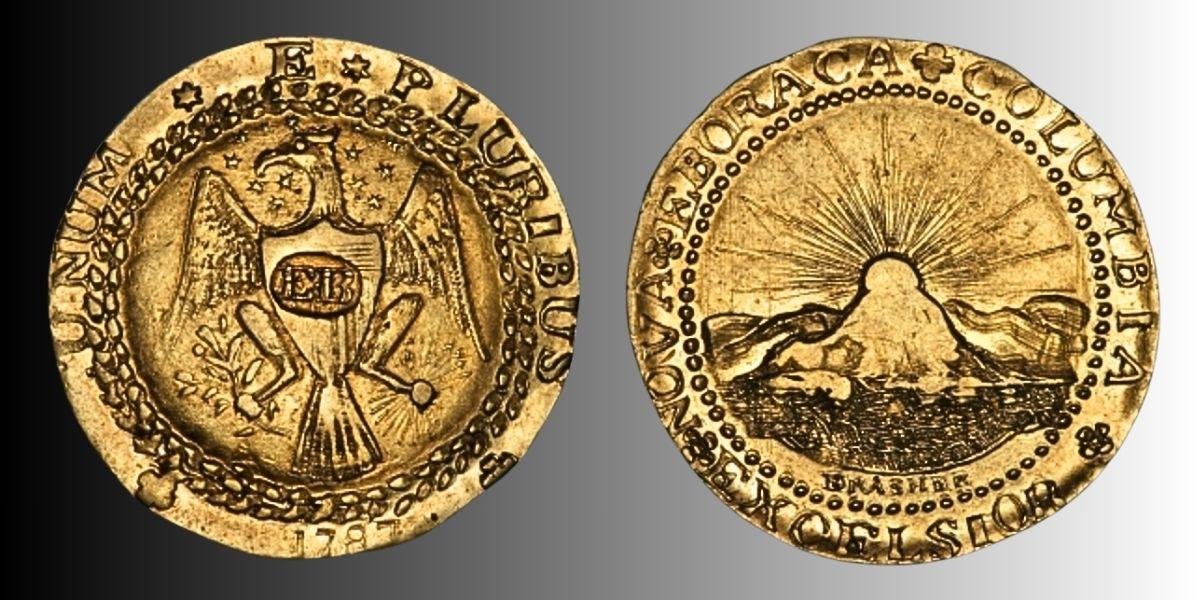
The Brasher Doubloon's design reflects both Spanish influence and American innovation. The obverse features a mountain landscape with the sun rising above it, an image representing the dawn of American independence. Surrounding this central motif, the inscription reads "NOVA EBORACA COLUMBIA EXCELSIOR," combining Latin references to New York and Columbia, the poetic name for America.
The reverse displays the Great Seal of the United States, featuring an eagle with wings displayed and a shield on its breast. The eagle clutches arrows in one talon and an olive branch in the other, symbolizing military readiness and peaceful intentions. The motto "E PLURIBUS UNUM" appears above the eagle, while "UNUM" also appears below.
The most distinctive identifying feature is Brasher's hallmark: the letters "EB" in a rectangular or oval punch. The location of this hallmark creates the primary classification system for Brasher Doubloons. Two main varieties exist based on counterstamp placement.
EB on Wing Variety
The EB-on-Wing variety places Brasher's hallmark on the eagle's wing on the reverse. This variety represents the rarest configuration, with only one confirmed specimen known. The January 2021 sale of this unique example for $9.36 million established it as one of the most valuable coins in American numismatics.
The distinctive hallmark placement on the wing suggests this may have been Brasher's initial approach before relocating the mark to a less intrusive position. The single surviving example displays bold strike details and attractive gold surfaces that have appealed to generations of collectors.
EB on Breast Variety
The more common EB-on-Breast variety positions the hallmark on the eagle's breast shield. Several examples of this variety survive in various grades and conditions. While still extraordinarily rare in absolute terms, the existence of multiple specimens makes this variety more accessible than the unique EB-on-Wing piece.
Collectors debate whether Brasher struck both varieties simultaneously or whether the breast placement represented a refinement of his initial design. Regardless of sequence, both varieties carry equal historical importance and strong market demand.
Physical Specifications
The Brasher Doubloon matches the approximate weight and size of Spanish doubloons, facilitating circulation and acceptance. The coin weighs roughly 408 grains or about 26.4 grams. The diameter measures approximately 30 millimeters, comparable to modern American half dollars but significantly thicker and heavier.
The gold content reflects high purity standards. Analysis of surviving specimens indicates fineness approaching .900 or better. This purity level aligned with accepted standards for quality gold coins and supported Brasher's reputation as a reliable assayer and metalworker.
Strike quality varies among known examples, as would be expected from hand-struck coins produced with 18th-century technology. Some specimens show full design details with sharp edges and clear lettering. Others display softer strikes or adjustment marks where excess metal was filed away to achieve proper weight.
Rarity, Mintage, and Availability
Precise mintage figures for Brasher Doubloons remain unknown. No contemporary records document how many pieces Brasher struck. Numismatic scholars estimate that fewer than ten genuine 1787 Brasher Doubloons survive today across both major varieties. This small surviving population places the coin among the rarest American numismatic treasures.
The distribution between varieties favors the EB-on-Breast configuration. Only one EB-on-Wing specimen is confirmed, while several EB-on-Breast examples exist in public and private collections. Major numismatic institutions including the Smithsonian Institution hold examples, further limiting availability to private collectors.
Availability in the marketplace occurs extremely rarely. Decades may pass between auction appearances. When a Brasher Doubloon does reach the market, it generates significant advance publicity and attracts international attention from elite collectors, dealers, and institutions with acquisition budgets.
Related Brasher Gold Issues
Ephraim Brasher also produced other gold pieces bearing his EB hallmark. These include foreign gold coins that he assayed and stamped, confirming their weight and fineness. Examples of Lima gold doubloons bearing Brasher's counterstamp survive and carry significant collector interest, though they command lower values than his original doubloon strikes.
FAQ: The 1787 Brasher Doubloon
1. Who created the Brasher Doubloon? The Brasher Doubloon was struck in 1787 by Ephraim Brasher, a New York City goldsmith and silversmith who maintained a shop on Cherry Street. He was a respected craftsman and a neighbor of George Washington.
2. Why was the Brasher Doubloon created if the U.S. had no official mint yet? Following the Revolutionary War, the United States faced a severe shortage of reliable currency. The federal mint would not begin operations until 1792, leaving a five-year gap without unified national currency. Enterprising individuals like Brasher stepped into this void to provide quality-assured gold pieces for local commerce.
3. Did Brasher have government authorization to strike these coins? Before striking his doubloons, Brasher petitioned the New York State Legislature for a contract to produce copper coins, but the legislature ultimately rejected his proposal. He then proceeded independently — without official authorization but also without prohibition — creating his gold doubloons using his own dies, metal, and expertise.
4. What does the Brasher Doubloon look like? The obverse features a mountain landscape with the sun rising above it, surrounded by the inscription "NOVA EBORACA COLUMBIA EXCELSIOR." The reverse displays the Great Seal of the United States, featuring an eagle with a shield on its breast, clutching arrows in one talon and an olive branch in the other, along with the motto "E PLURIBUS UNUM."
5. What is the "EB" mark found on the coin? The letters "EB" represent Brasher's personal hallmark, stamped in a rectangular or oval punch. It functioned as both a maker's mark and an assurance of gold content, aligning with traditional goldsmithing practices where craftsmen guaranteed the quality of their work through personal marks.
6. What are the two main varieties of the Brasher Doubloon? The two varieties are classified by the location of Brasher's EB hallmark. The rarer "EB-on-Wing" variety places the hallmark on the eagle's wing, with only one confirmed specimen known. The more common "EB-on-Breast" variety positions the hallmark on the eagle's breast shield, and several examples of this variety survive.
7. How much is a Brasher Doubloon worth? Values range dramatically based on variety and condition, with examples typically commanding seven to eight figures at auction. The record stands at $9.36 million for the EB-on-Wing specimen sold in January 2021.
8. How many Brasher Doubloons still exist today? Numismatic scholars estimate that fewer than ten genuine 1787 Brasher Doubloons survive today across both major varieties. Major numismatic institutions including the Smithsonian Institution hold examples, further limiting availability to private collectors.
9. What are the physical specifications of the Brasher Doubloon? The coin weighs roughly 408 grains (about 26.4 grams) and measures approximately 30 millimeters in diameter, comparable to a modern American half dollar but significantly thicker and heavier. Analysis of surviving specimens indicates gold fineness approaching .900 or better.
10. How can a buyer verify a Brasher Doubloon is authentic? Authentication requires expert examination. Collectors should insist on certification from recognized authentication services, as counterfeits and replicas exist. The weight, dimensions, die characteristics, and gold content must align with known specifications. Provenance documentation — including continuous ownership records and auction history — adds further verification and value beyond authentication alone.