

Rare Bicentennial Quarter: How to Spot Valuable 1776–1976 Quarters
Posted by Andrew Adamo - A certified ANA Professional Numismatist, Active member of ICTA, contributor to CoinWeek, Numismatic News, NGC and ANA on May 5th 2026
Rare Bicentennial Quarter: How to Spot Valuable 1776–1976 Quarters
A rare bicentennial quarter is typically a 1776–1976 Washington quarter that stands out for exceptional condition, special composition, a sought-after mintmark, or an unusual error. Most are common, but a small number attract strong collector interest because they grade high, show scarce varieties, or display clear minting anomalies.
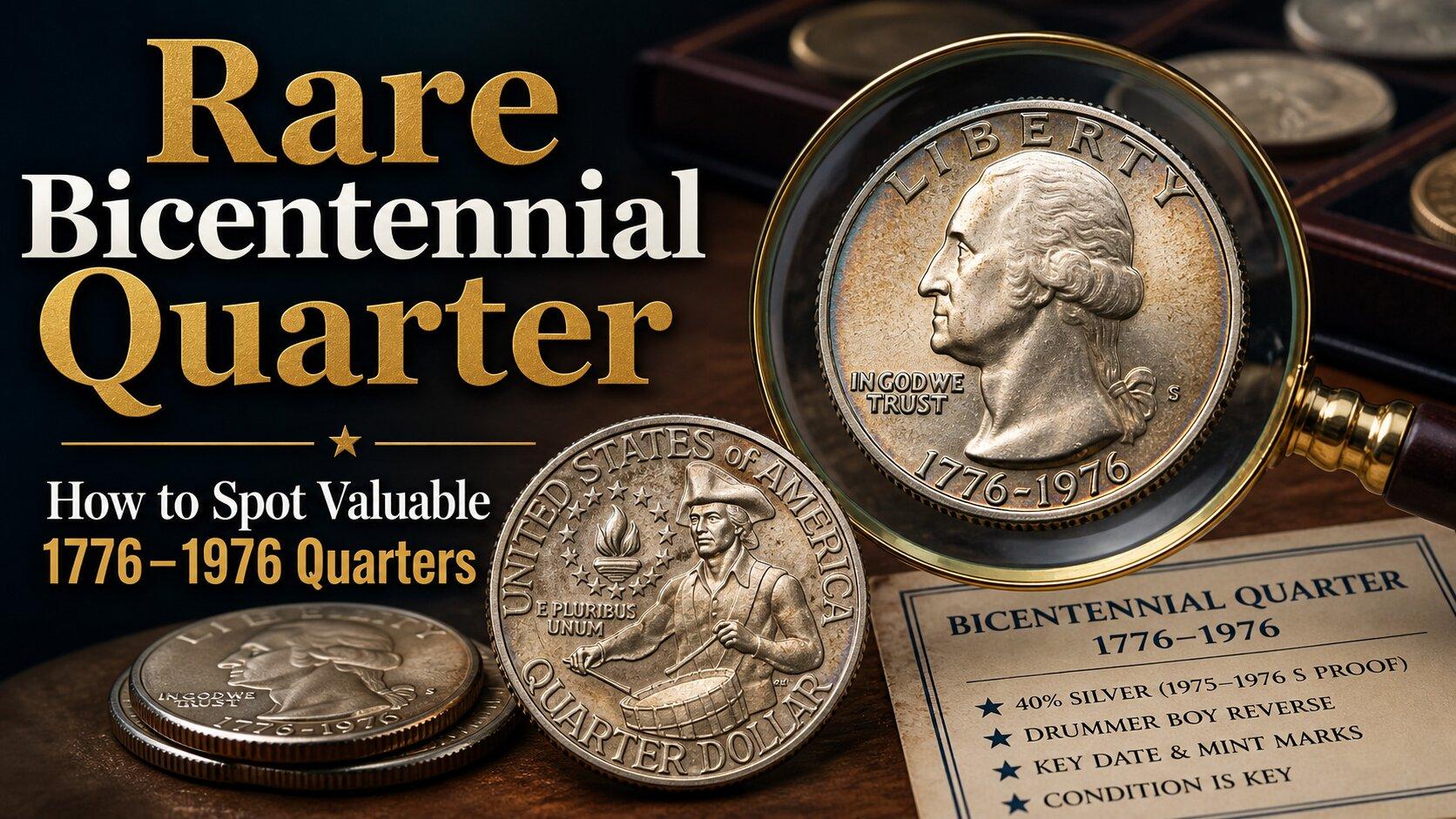
What the 1776–1976 Bicentennial Quarter Is?
The U.S. Mint issued Bicentennial quarters dated 1776–1976 to commemorate America’s 200th anniversary. They feature the familiar Washington obverse paired with a special reverse design. Because millions were saved as souvenirs, many examples exist today, but collectors still pursue standout pieces for type sets, high-grade registry sets, and error collections.
Collector demand tends to concentrate in a few areas: pristine surfaces, strong strikes, attractive luster, and coins with clear diagnostics that separate a normal example from a premium one. Understanding what “rare” means in modern coinage helps you avoid paying rarity prices for a coin that’s simply popular.
Most Bicentennial Quarters Aren’t Rare
Bicentennial quarters were widely distributed, and plenty survive in circulated condition. A typical pocket-worn example is mainly a fun historical find. Value can rise meaningfully only when something sets the coin apart, such as top-tier certified grade, a recognized error, or a special-issue format that collectors actively compete for.
That’s why experienced buyers focus less on the date and more on the coin’s specifics. Two Bicentennial quarters can look similar at arm’s length, yet differ sharply in collectibility once you factor in grade, surfaces, and whether the coin matches known varieties.
How to Spot a Standout Bicentennial Quarter
1) Check the Mintmark and How the Coin Was Made
Look for the mintmark on the obverse. Bicentennial quarters were produced at multiple mints, and they were also made in special collector formats. Some collector versions were sold in sets and can differ in finish and composition from typical circulation strikes.
- Circulation strikes: Made for everyday use, commonly found with contact marks and wear.
- Proof issues: Made with special dies and handling, often showing mirrored fields and sharper detail.
- Special collector strikes: Some sets feature different finishes that can be attractive when well preserved.
If you suspect a coin is a proof or special strike, handle it carefully by the edges. Hairlines and fingerprints can reduce desirability quickly, especially on mirrored surfaces.
2) Look at the Edge for Composition Clues
One quick screening method is the edge. Many U.S. quarters show a copper-colored stripe on the edge due to their clad construction. Some collector issues have different compositions and may not show the same appearance. Because lighting can mislead, treat this as a clue rather than a final verdict.
If composition is a major part of the coin’s value case, consider professional authentication. A reputable grading service can confirm what you have and put it into a tamper-evident holder that’s easier to trade.
3) Evaluate Condition Like a Grader Would
Condition is often the biggest driver of premiums for modern coins. For Bicentennial quarters, many pieces exist, but truly clean, high-end examples are much harder to find. Collectors look for strong eye appeal and minimal distractions.
- Luster: Original mint luster without dulling or haze tends to be preferred.
- Contact marks: Bagmarks on Washington’s cheek and in open fields can limit the grade.
- Strike: Sharper hair detail and cleaner lettering can separate average from exceptional.
- Color and surfaces: Spots, stains, and heavy hairlines usually hurt desirability.
If your coin is uncirculated, resist the urge to “improve” it. Cleaning and polishing often cause permanent hairlines that graders and buyers can spot immediately.
Error Coins and Varieties: Where “Rare” Can Be Real
Another path to a rare bicentennial quarter is a legitimate mint error or recognized variety. Error collecting is popular because the diagnostics are specific, and dramatic mistakes can be scarce. The key is to separate real mint errors from damage that happened after the coin left the Mint.
Common error categories collectors look for include off-center strikes, broadstrikes, clips, and doubled dies. Each has specific visual markers, and many can be confirmed by experienced dealers or third-party grading services. If an “error” looks like gouges, scraping, or heat damage, it’s usually post-mint damage, not a collectible mint mistakes.
Explore certified rare coins and collectible releases at Bullion Shark.
Should You Get a Bicentennial Quarter Graded?
Grading can make sense when a coin appears to be high-end uncirculated, a proof with strong eye appeal, or a clear error that the market recognizes. Certification helps protect the coin, confirms authenticity, and provides a standardized grade that buyers can compare.
Before submitting, compare your coin to certified examples and ask whether the potential premium justifies fees. If you’re unsure, working with a specialist can help you avoid spending grading money on a coin that will come back as a common grade.
Smart Buying and Selling: Practical Collector Tips
If you’re shopping online or at a show, insist on clear photos of both sides and the edge when possible. For higher-end purchases, look for certification from major grading services and verify the certification number if available.
- Don’t pay “error” prices without diagnostics: Ask what type of error it is and what markers confirm it.
- Be cautious with cleaned coins: Bright shine can be a red flag if it looks unnatural.
- Buy the coin, not the story: Provenance is great, but condition and authenticity come first.
- Match the coin to your goal: Type set, proof set, error set, or registry-style collecting all prioritize different traits.
Collectors who prefer vetted material often gravitate to established dealers with transparent photos and a focus on certified inventory. Bullion Shark is one resource collectors use when comparing graded coins, modern releases, and other collectible issues where authentication and consistent descriptions matter.
Common Misconceptions About 1776–1976 Quarters
“All Bicentennial quarters are valuable.” Most circulated examples trade close to face value. Premiums usually require high grade, proof status, notable error, or standout eye appeal.
“A shiny quarter is uncirculated.” Many coins are cleaned or polished. Original mint luster has a distinct look that differs from artificial shine.
“Any doubling means doubled die.” Mechanical doubling and worn dies can mimic doubling. True doubled dies typically show more consistent, design-based doubling.
FAQ
What makes a rare bicentennial quarter different from a normal one?
Collectors usually mean a coin with exceptional grade, a special collector strike or proof, confirmed unusual composition, or a recognized mint error or variety rather than a typical circulated 1776–1976 quarter.
Where is the mintmark on a 1776–1976 quarter?
The mintmark is on the obverse (Washington’s side) near the date area. Checking it helps identify where the coin was produced and whether it matches certain collector preferences.
Are Bicentennial quarters with no mintmark rare?
A missing mintmark can be normal for some U.S. coins depending on the era and mint. Rarity depends on the specific issue and whether the absence is expected or tied to a documented error.
How can I tell if my Bicentennial quarter is proof?
Proofs often show mirrored fields, very sharp detail, and careful striking. Many also have fewer contact marks than circulation coins. If you’re unsure, comparing to certified proof examples is helpful.
Should I clean a Bicentennial quarter before selling it?
Cleaning is usually discouraged because it can leave hairlines and altered surfaces that reduce collector demand. It’s typically better to leave the coin as-is and store it safely.
What errors should I look for on a Bicentennial quarter?
Collectors often look for off-center strikes, clips, broadstrikes, and doubled-die varieties. Confirming diagnostics matters, since many “errors” are actually post-mint damage.
Where can I find certified Bicentennial-related coins and other graded collectibles?
Many collectors browse established dealers that specialize in certified material. You can explore graded coins and collector-focused releases at BullionSharks.com and compare attributes like grade, eye appeal, and certification.