

Mexican gold coins - Centenario and Libertad series.
Posted by Andrew Adamo - A certified ANA Professional Numismatist, Active member of ICTA, contributor to CoinWeek, Numismatic News, NGC and ANA on May 15th 2026
Mexican Gold Coins - Centenario and Libertad Series
Mexican gold coins key dates, particularly the 1921, 1931, and 1943 Centenario issues and modern proof Libertads in PF70 condition, represent some of the most sought-after pieces in world numismatics. Values range from several thousand dollars for circulated key dates to over $100,000 for pristine proof examples at major auctions, with record prices continuing to climb as collector demand intensifies.
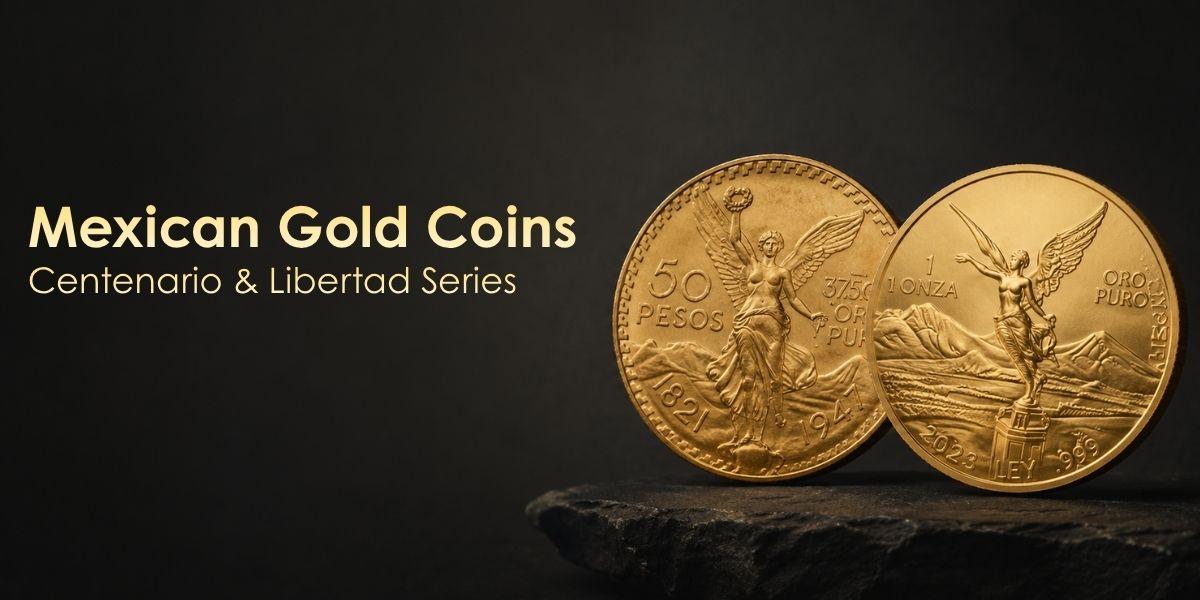
Mexican Gold Coins Key Dates Overview
Mexico's gold coinage history offers collectors two distinct categories of numismatic treasures: the classic Centenario series from the early to mid-20th century and the modern Libertad gold proof series. Both categories feature key dates that command significant premiums, driven by limited production, historical significance, and exceptional rarity in top grades.
The Centenario series, officially known as the 50 Peso gold coin, was introduced in 1921 to commemorate the centennial of Mexican independence. While the series continued through several decades with various restrike dates, certain original production years stand out as true rarities. The 1921, 1931, and 1943 dates represent the pinnacle of collector interest within this beloved series.
Modern Mexican gold Libertads in proof and reverse proof formats have emerged as highly competitive collectibles, particularly in perfect PF70 condition. These contemporary issues combine traditional Mexican iconography with modern minting technology, creating coins that appeal to both precious metals investors and serious numismatists.
Historical Background of Mexican Gold Coinage
Mexico's gold coinage tradition extends back to the colonial era, but the modern era of collectible Mexican gold begins with the establishment of the Republic and particularly with the independence commemoratives of the 1920s. The Centenario was conceived as both a circulating gold piece and a commemorative issue celebrating Mexico's break from Spanish colonial rule.
The original 1921 Centenario was struck in limited quantities at the Mexico City Mint. This inaugural issue featured the iconic Winged Victory design on the obverse and the Mexican national coat of arms on the reverse. The coin's substantial size and .900 fine gold composition made it an impressive statement piece from its introduction.
Following the 1921 debut, production was sporadic. The 1931 issue came during a period of economic uncertainty, and mintage was extremely limited. The 1943 date represents another wartime rarity, produced in small numbers during World War II when gold coinage worldwide faced restrictions and reduced production.
Later Centenario production included extensive restrike programs, particularly in the 1940s through 1970s, with most pieces bearing dates that did not correspond to their actual year of manufacture. These restrikes, while containing the same gold content, lack the numismatic premium associated with original-date strikings.
The modern Libertad gold series launched in the 1980s represents Mexico's continuation of its proud gold coinage tradition. Proof and reverse proof editions in various denominations have been produced in limited quantities, with certain years and finishes achieving remarkable scarcity, especially in perfect certified grades.
Why Collectors Pay Attention to Mexican Gold Coins Key Dates
Rarity drives collector interest more than any other factor when it comes to Mexican gold coins key dates. The 1921 Centenario serves as the foundation date for the entire series, and original strikes are significantly scarcer than the millions of later restrikes. Collectors seeking to assemble complete date sets must obtain this cornerstone issue.
The 1931 Centenario represents one of the true condition rarities in world gold coinage. Original production was minimal, and surviving examples often show evidence of circulation or handling. High-grade specimens certified by major grading services appear infrequently at auction and generate substantial bidding activity when they do surface.
Similarly, the 1943 issue combines wartime scarcity with strong collector demand. This date was not part of the massive restrike programs, making every authenticated 1943 Centenario a genuine product of that year's limited production run. The historical context of World War II adds narrative appeal to an already rare numismatic item.
Modern proof Libertads in PF70 condition attract attention for different reasons. The combination of modern minting precision, limited production numbers, and the challenge of achieving technically perfect grades creates a competitive collecting environment. Population reports from certification services show that even among proof coins struck with contemporary quality control, perfect specimens remain elusive.
Reverse proof editions add another dimension of collectibility. The contrasting frosted fields and mirrored devices create a striking visual effect that appeals to collectors who appreciate innovative finishes. When combined with PF70 certification, these pieces represent the intersection of modern minting artistry and condition rarity.
Design, Specifications, and Identifying Details
The Centenario features one of the most recognizable designs in world numismatics. The obverse displays Winged Victory, also known as the Angel of Independence, a symbol deeply rooted in Mexican national identity. The figure stands triumphantly, wings spread, holding a laurel wreath and broken chains representing liberation from colonial rule.
The reverse presents the Mexican coat of arms: an eagle perched on a cactus, grasping a serpent in its beak. This powerful image derives from Aztec legend and has appeared on Mexican coinage for centuries. The design is surrounded by text indicating the coin's denomination, metal content, and year of issue.
Centenario specifications include a diameter of approximately 37 millimeters, a weight of 41.666 grams, and a composition of .900 fine gold containing 1.2057 troy ounces of pure gold. The denomination is 50 Pesos, though the coin's value has always been primarily tied to its gold content and numismatic significance rather than face value.
Identifying original-date strikes versus restrikes requires careful examination and expert authentication. Original 1921, 1931, and 1943 pieces often display characteristics specific to their production year, including die states, luster patterns, and surface qualities that differ from later restrikes. Certification by established grading services provides essential authentication for these key dates.
Modern Libertad gold coins share similar design themes while incorporating contemporary minting techniques. The obverse typically features the Winged Victory monument as it appears in Mexico City, while the reverse displays the current Mexican coat of arms surrounded by historical versions used throughout the nation's history.
Libertad proof coins exhibit deeply mirrored fields with frosted design elements, creating strong visual contrast. Reverse proof editions invert this relationship, with frosted fields and mirrored devices. The technical execution required to achieve PF70 status demands flawless surfaces, perfect strike, and pristine preservation with no contact marks or imperfections visible under magnification.
Rarity, Mintage, and Availability
Original mintage figures for the key date Centenarios remain subjects of numismatic research and debate. The 1921 issue had limited production as the inaugural year of the series. Records suggest modest mintage compared to the millions of restrikes produced in subsequent decades, though exact figures vary across historical sources.
The 1931 Centenario stands as particularly scarce. Production occurred during economically turbulent times, and surviving specimens represent a small fraction of already limited mintage. The combination of low original production and attrition over nearly a century makes this date one of the most challenging to locate in any grade.
The 1943 issue benefits from more certain authentication, as restrikes were not produced with this date. Every genuine 1943 Centenario represents actual production from that year. However, wartime conditions resulted in reduced mintage, and many pieces entered circulation or were later melted for bullion value.
Availability of these key dates in the numismatic marketplace remains limited. High-grade examples certified by PCGS or NGC appear sporadically at major auctions and through specialized dealers. Collectors seeking these pieces often wait months or years for suitable examples to become available, particularly in grades above MS63.
Modern Libertad proof editions typically have published mintage limits, often ranging from a few hundred to several thousand pieces depending on denomination and year. The challenge with these coins lies not in total production but in the percentage receiving perfect PF70 grades from certification services.
Population reports reveal that even among carefully produced proof coins, the PF70 designation remains difficult to achieve. Surface perfection, flawless strike, and pristine preservation create a narrow gate through which only a fraction of submitted coins pass. This reality transforms seemingly modest mintage numbers into genuine condition rarities.
Grading and Condition Factors
Grading Centenario key dates requires attention to several critical areas where wear first appears. The high points of Winged Victory, particularly the breast, knee, and wing tips, show contact and friction before other design elements. On the reverse, the eagle's breast and the serpent's details wear first with handling or circulation.
Luster quality separates exceptional examples from merely nice specimens. Original mint luster on uncirculated Centenarios displays a rich, satiny appearance with consistent texture across both obverse and reverse. Dipped or processed coins often show unnatural brightness or muted luster that experienced collectors recognize immediately.
Strike quality varies among Centenarios, even within the same date. Full strike examples show complete detail in Victory's feathers, facial features, and the wreath she holds. The reverse eagle should display full feather definition and sharp detail in the serpent. Weak strikes, particularly in the central devices, limit grade potential regardless of surface preservation.