

Classic coins that bridge history and investment: Gold Double Eagles.
Posted by Andrew Adamo - A certified ANA Professional Numismatist, Active member of ICTA, contributor to CoinWeek, Numismatic News, NGC and ANA on May 18th 2026
Classic Coins That Bridge History and Investment: Gold Double Eagles
Gold Double Eagles, representing $20 U.S. gold coins minted from 1849 to 1933, typically range from bullion value for common dates in lower grades to tens of thousands of dollars for rare dates and high-grade specimens, with exceptional examples like the 1933 Double Eagle setting auction records exceeding $18 million, making them among the most valuable and historically significant numismatic U.S. coins.
Gold Double Eagle Overview
The Gold Double Eagle stands as one of the most recognizable and historically important denominations in American numismatics. Issued as the highest regular-issue denomination coin during its production era, the twenty-dollar gold piece played a vital role in domestic and international commerce for more than eight decades. The combination of substantial gold content, artistic merit, historical significance, and enduring collector demand has positioned the Gold Double Eagle as both a numismatic treasure and a tangible store of precious metal value.
Collectors appreciate these coins for multiple reasons. They represent periods of American expansion, economic growth, and artistic achievement. They contain nearly one ounce of gold, providing intrinsic metal value that supports their price floor. The series includes famous rarities, widely available common dates, and everything in between, offering entry points for collectors at various experience and budget levels. Whether sought for type sets, date runs, investment diversification, or pure historical interest, the Gold Double Eagle remains a cornerstone of U.S. coin collecting.
Historical Background
The Gold Double Eagle was authorized by the Act of March 3, 1849, following the California Gold Rush. The discovery of gold in California created an urgent need for higher-denomination coinage to facilitate large transactions and absorb the flood of newly mined precious metal entering the economy. The twenty-dollar gold piece answered this need, becoming the largest denomination regularly issued by the United States Mint.
Production began in 1849 at the Philadelphia Mint, with the first coins struck in extremely limited numbers. Regular production expanded quickly, and by the 1850s the Gold Double Eagle had become a staple of American commerce. Over the decades, additional mint facilities in San Francisco, Carson City, Denver, and New Orleans contributed to the series, each leaving its distinctive mint mark on the coins produced.
The series divides into two major design types. The Liberty Head design, created by Chief Engraver James B. Longacre, was used from 1849 through 1907. This design features Liberty wearing a coronet inscribed with the word "LIBERTY," surrounded by thirteen stars representing the original states. The reverse displays a heraldic eagle with shield, arrows, and olive branch, encircled by the inscription "UNITED STATES OF AMERICA" and the denomination "TWENTY D."
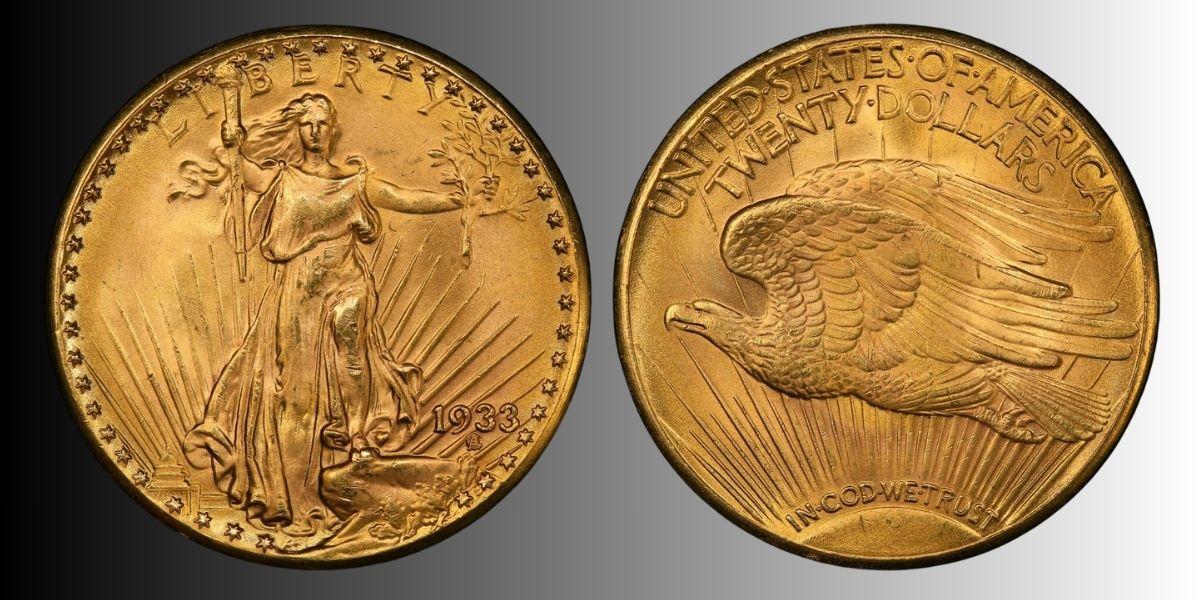
In 1907, the design changed dramatically under the direction of President Theodore Roosevelt, who sought to elevate American coinage to the artistic standards of ancient Greece and Rome. Roosevelt commissioned renowned sculptor Augustus Saint-Gaudens to redesign the nation's gold coinage. The resulting Saint-Gaudens Double Eagle, introduced in 1907, is widely considered one of the most beautiful coins ever produced by any nation. The obverse features a full-length figure of Liberty striding forward, holding a torch and olive branch, with rays of sunlight emanating behind her. The reverse originally depicted a flying eagle above the rising sun, though design modifications were made in subsequent years.
Production of Gold Double Eagles for circulation ceased in 1933 when President Franklin D. Roosevelt issued Executive Order 6102, which required citizens to surrender most gold coins, bullion, and certificates to the Federal Reserve in exchange for paper currency. This action effectively ended the era of gold coinage in everyday American commerce. Nearly all 1933 Double Eagles were melted before release, making surviving examples extraordinarily rare and the subject of legal controversies that persisted for decades.
Why Collectors Pay Attention to Gold Double Eagles
Several interconnected factors drive sustained collector interest in Gold Double Eagles. First, the coins represent a tangible connection to pivotal periods in American history. They circulated during westward expansion, the Civil War, Reconstruction, the Gilded Age, and the early twentieth century. Holding a Gold Double Eagle means holding a piece that might have passed through the hands of frontier merchants, railroad magnates, or international traders during some of the most transformative decades in American development.
Second, the gold content provides inherent value. Each Gold Double Eagle contains 0.9675 troy ounces of pure gold, giving the coin a bullion floor that moves with precious metal markets. This characteristic appeals to collectors who appreciate numismatic value supported by intrinsic metal worth, offering dual-purpose appeal as both collectible and precious metal holding.
Third, the series offers depth and variety. With multiple design types, dozens of date and mint mark combinations, and a wide range of available grades, collectors can pursue Gold Double Eagles in many ways. Type collectors might seek a single high-quality example of each major design. Date collectors might assemble complete runs of Liberty Head or Saint-Gaudens issues. Mint mark specialists might focus on Carson City or New Orleans coins. Condition-focused collectors might pursue Mint State examples with exceptional eye appeal. The series accommodates nearly every collecting approach.
Fourth, the Saint-Gaudens design in particular enjoys exceptional aesthetic reputation. Its beauty transcends the numismatic community, earning recognition from art historians, museum curators, and the general public. Owning a Saint-Gaudens Double Eagle means owning a piece widely acknowledged as an artistic masterpiece.
Fifth, market liquidity remains strong. Gold Double Eagles are globally recognized, actively traded, and readily accepted by dealers, auction houses, and collectors worldwide. This liquidity provides confidence to buyers who value the ability to sell when desired without extensive searching for qualified buyers.
Design, Specifications, and Identifying Details
Gold Double Eagles share consistent physical specifications across both design types. Each coin weighs 33.436 grams and measures 34 millimeters in diameter. The composition consists of 90% gold and 10% copper, yielding the 0.9675 troy ounces of pure gold content. The edge features a reeded design, standard for higher-denomination U.S. gold coinage of the era.
Liberty Head Double Eagles, minted from 1849 through 1907, display Liberty facing left on the obverse, wearing a coronet with the inscription "LIBERTY." Thirteen stars encircle the portrait, with the date below. The reverse shows the heraldic eagle with shield, clutching arrows in its left talon and an olive branch in its right. The inscriptions "UNITED STATES OF AMERICA" and "TWENTY D." surround the eagle. Early examples from 1849 to 1866 lack the motto "IN GOD WE TRUST," which was added starting in 1866 following authorization by Congress. This motto appears on a scroll above the eagle on later Liberty Head coins.
Saint-Gaudens Double Eagles, introduced in 1907, present a radically different aesthetic. The obverse features Liberty in full stride, holding a torch aloft in her right hand and an olive branch in her left. Rays of sunlight emanate behind her, and the U.S. Capitol building appears faintly in the lower left background. Forty-six stars originally encircled the obverse border on 1907 issues, reduced to forty-eight stars in 1912 following the admission of New Mexico and Arizona to statehood. The date appears below Liberty's feet.
The Saint-Gaudens reverse underwent modifications during its production run. The initial 1907 design depicted a flying eagle in profile above the rising sun, without a motto. Later in 1907, "IN GOD WE TRUST" was added at congressional direction, placed above the sun on the reverse. In 1908, modifications were made to flatten the relief, making the coins easier to strike and stack. These variations create distinct subtypes within the Saint-Gaudens series, including the ultra-high relief 1907 patterns, the high relief 1907 business strikes, and the modified lower relief versions produced from 1907 onward.
Mint marks, when present, appear on the obverse of Liberty Head Double Eagles, positioned below the date. On Saint-Gaudens Double Eagles minted from 1908 to 1933, the mint mark appears on the reverse, above the date near the rim. Philadelphia coins carry no mint mark. San Francisco coins display an "S," Carson City coins a "CC," Denver coins a "D," and New Orleans coins an "O." The presence and location of mint marks help collectors identify production facility and date combinations, essential information for cataloging and valuation.
Rarity, Mintage, and Availability
Rarity within the Gold Double Eagle series varies dramatically. Some dates were produced in large quantities and survive in substantial numbers today, making them readily available and affordable relative to their gold content. Other dates were minted in small quantities, saw heavy circulation, were extensively melted, or suffered other attrition, leaving few surviving examples and commanding significant premiums.
Common-date Liberty Head Double Eagles from the 1870s, 1880s, and 1890s remain plentiful in circulated grades and are frequently available in Mint State. These coins typically trade near their gold bullion value plus modest numismatic premiums, making them accessible entry points for new collectors or investors seeking gold content with added collectibility.
Rarer dates within the Liberty Head series include many Carson City issues, certain New Orleans coins, and low-mintage Philadelphia dates. Carson City Double Eagles enjoy particular popularity due to the historic significance of the Carson City Mint, which operated from 1870 to 1893 in Nevada's silver mining region. Coins bearing the "CC" mint mark often command premiums well above bullion value, even in worn condition.
The Saint-Gaudens series includes both common and rare dates. Many Philadelphia and San Francisco issues from the 1920s survive in Mint State, sometimes in large quantities, due to European bank hoards repatriated in recent decades. Conversely, certain dates saw limited production or extensive melting. The 1927-D is notably rare in all grades, and the 1933 issue stands as one of the most famous rarities in all of American numismatics due to the circumstances surrounding its non-release and subsequent legal history.