

1964-D Penny Value: What This Denver Lincoln Cent Is Worth
Posted by Andrew Adamo - A certified ANA Professional Numismatist, Active member of ICTA, contributor to CoinWeek, Numismatic News, NGC and ANA on May 6th 2026
1964-D Penny Value: What This Denver Lincoln Cent Is Worth
A 1964-D penny is usually worth only 2–5 cents in circulated condition because it is a very common Denver-minted Lincoln Memorial cent. Typical uncirculated examples are worth about $0.18 to $1.24+, while superb certified Red MS67examples can bring hundreds or even thousands. The auction record for a regular 1964-D penny is $4,025, paid for a PCGS MS67 Red coin sold in March 2012.
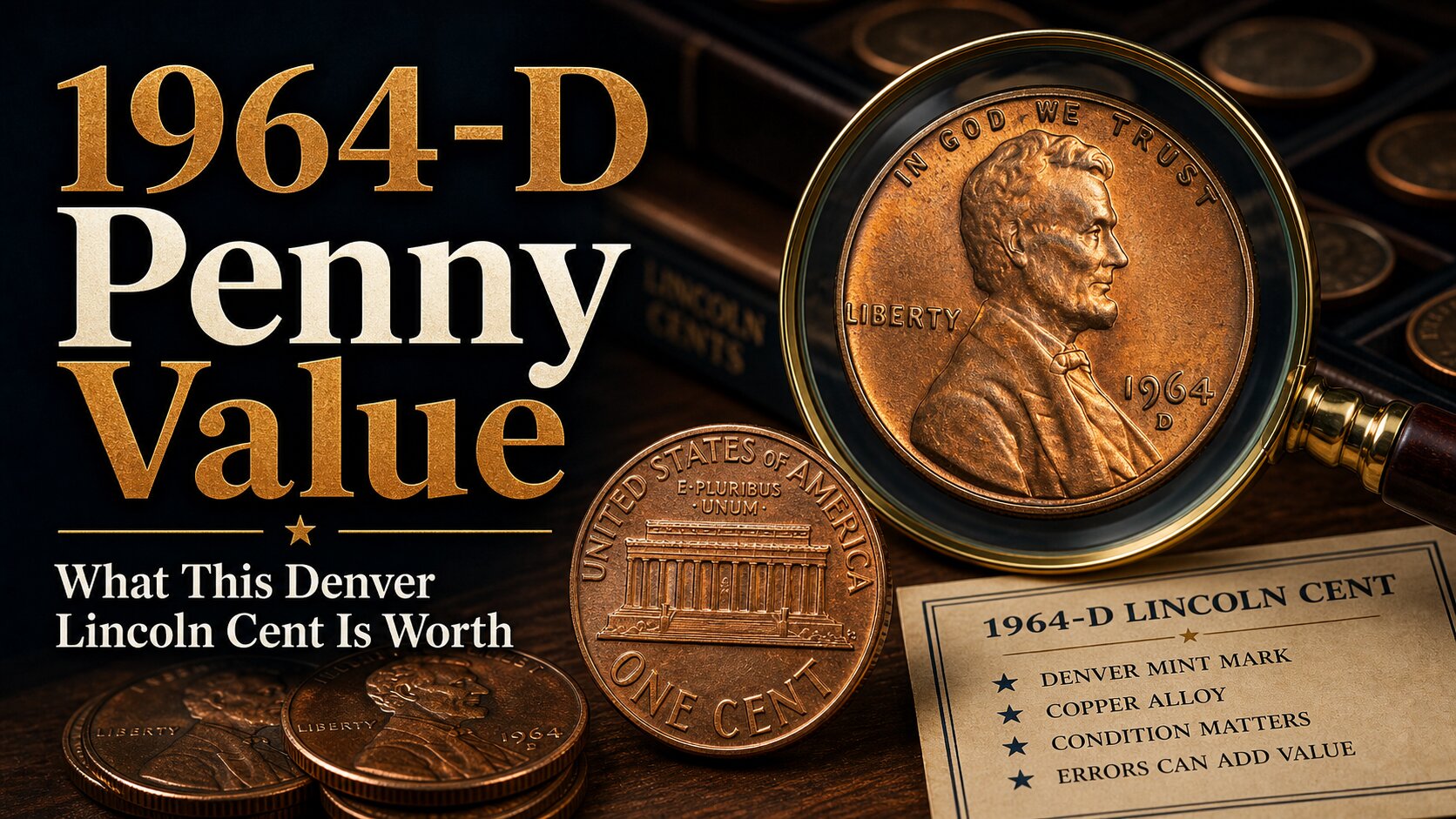
1964-D Penny Value
The 1964-D cent is a classic “common date, condition rarity” coin. In everyday grades it typically trades as a readily available Lincoln Memorial cent, yet it remains a legitimate target for collectors building high-grade sets, registry-style collections, or variety sets. The market generally responds to three things: grade (Mint State versus worn), color designation (RD versus RB), and attributed varieties such as repunched mint marks (RPM) or doubled-die obverses documented in specialty references and grading-service attribution systems.
For most collectors, the practical question is not whether the date is scarce, but whether a specific coin is premium quality for the issue and whether it is worth certification. That decision depends on surfaces, luster, eye appeal, and whether the coin appears to qualify for top-end Mint State grades where demand concentrates.
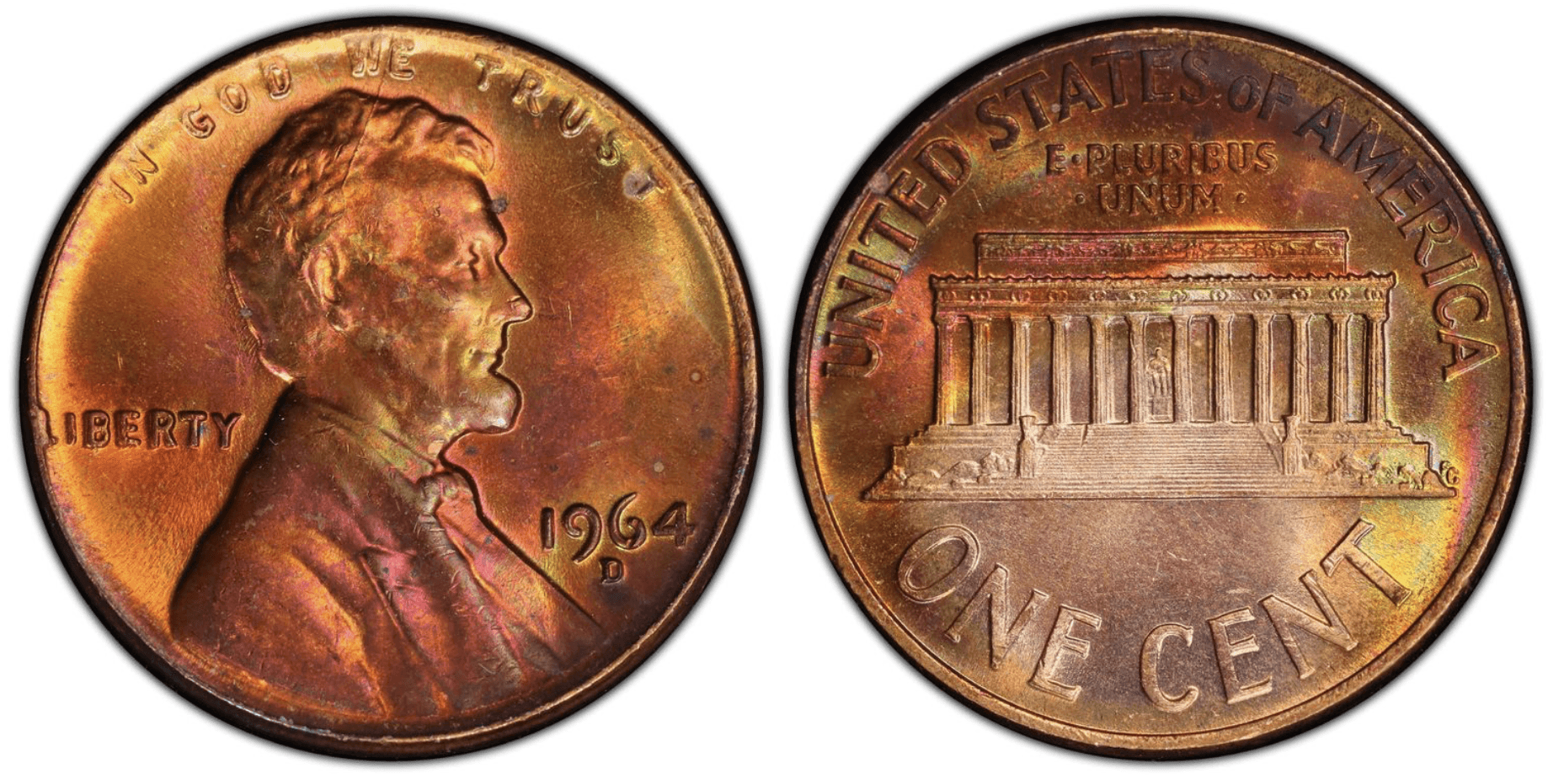
AUCTION RECORD: $4,025 • MS67 • 03-22-2012
The auction record for a regular 1964-D penny is $4,025, paid for a PCGS MS67 Red coin sold in March 2012.
1964-D Penny Value Overview
| Approx. Value | |
|---|---|
| Circulated | 2–5 cents, mostly copper value |
| Uncirculated MS60–MS65 | About $0.18–$1.24+ |
| Certified MS67 Red | Often hundreds; top examples much higher |
| Record sale | $4,025 |
The 1964-D cent was struck at the Denver Mint, with a reported mintage of about 3.799 billion, and is made of 95% copper and 5% zinc.
Record Sale
The current PCGS-listed auction record is:
$4,025: 1964-D Lincoln Cent, PCGS MS67 Red — Stack’s Bowers, March 2012.PCGS notes the coin was tied for finest Red certified at the time.
Other Notable Sales
| Sale Price | Coin | Date |
|---|---|---|
| $3,172.50 | 1964-D 1C MS67 Red PCGS | Sept. 5, 2014 |
| $2,350.00 | 1964-D 1C MS67 Red PCGS | July 10, 2014 |
| $1,410.00 | 1964-D 1C MS67 Red PCGS | Sept. 5, 2014 / also June 8, 2016 for another MS67 Red example |
Historical background
The 1964-D cent belongs to the Lincoln Memorial cent era, the long-running reverse design introduced in 1959 and used through 2008. The obverse portrait of Abraham Lincoln traces to Victor David Brenner’s original 1909 design lineage, while the Lincoln Memorial reverse was created by Frank Gasparro.
By 1964, the Lincoln cent was a workhorse denomination struck in huge quantities for commerce. Denver’s 1964 output is especially notable because it represents one of the heaviest production years for the series. These coins were struck for circulation, and most surviving pieces show the normal signs of mass production and handling.
Why collectors pay attention to this topic
Collectors focus on the 1964-D issue for reasons that go beyond simple date scarcity. The coin is widely available, which makes it accessible for beginners, but it also has enough nuance to interest advanced collectors who pursue top grades and attributed varieties.
Primary demand drivers
- Condition rarity at the top end: While the date is common, truly clean, high-grade examples are more selective, and the market often pays up for gem coins.
- Color matters: RD (red) examples generally command stronger demand than RB (red-brown) at the same numeric grade.
- Variety collecting: Certain RPM and doubled-die listings for 1964-D attract specialists seeking attributed pieces.
- Registry and set building: Lincoln Memorial cents are frequently assembled by date and mint mark, and high-grade certified coins are important to competitive collectors.
Design, specifications, and identifying details
How to identify a 1964-D cent
Identification is straightforward. The obverse shows Lincoln facing right, and the reverse features the Lincoln Memorial. The distinguishing mark is the “D” mint mark on the obverse, indicating Denver. A 1964 cent with no mint mark is generally a Philadelphia issue.
Core specifications (standard issue)
- Denomination: 1 cent ($0.01)
- Mint: Denver (D mint mark)
- Composition: 95% copper, 5% zinc
- Weight: approximately 3.11 grams
- Diameter: approximately 19.05 mm
- Edge: Plain
- Obverse designer (design lineage): Victor David Brenner
- Reverse design type: Lincoln Memorial (Frank Gasparro)
Varieties and errors collectors watch for
Specialty catalogs and grading-service references list RPM (Repunched Mint Mark)varieties for 1964-D, and collectors also report doubled-die obverse listings in variety systems. In addition, common mint errors such as off-center strikes or clipped planchets can exist for any high-mintage cent issue, including 1964-D.
Because variety naming conventions and attribution eligibility can differ by service, serious buyers typically verify a variety through a recognized attribution pathway, especially if paying a premium.
Rarity, mintage, and availability
Denver produced the 1964-D Lincoln cent in extraordinary quantity. The reported mintage is about 3,799,071,500 pieces (often cited around 3.799 billion, with small differences across references). That scale makes the coin abundant in circulated grades and commonly encountered in groups of copper cents.
What “common date” really means here
High mintage does not automatically translate to abundant supply in every grade. Most surviving pieces show contact marks, spotting, dulling, or color change from storage. Collectors therefore evaluate rarity in two ways:
- Absolute availability: Easy to find in worn or average Mint State condition because so many were made.
- Conditional scarcity: Much more challenging to find with pristine surfaces, strong luster, and full RD color at gem levels.
Grading and condition factors
For Lincoln cents, condition often determines whether a coin is a face-value example or a collector-grade piece. The 1964-D is an especially clear case where small condition differences can change market interest.
What graders and advanced collectors look for
- Luster: Original mint luster is important for Mint State coins. Dull, “lifeless” surfaces can limit desirability.
- Surface preservation: Contact marks, carbon spots, and abrasions are common on cents and can cap the grade quickly.
- Strike quality: Weak detail or mushy definition may reduce eye appeal, even if the coin is technically uncirculated.
- Eye appeal and color: RD coins, when truly red and attractive, typically bring stronger premiums than RB at the same grade level.
RD vs RB: why color designation matters
For copper coins, professional grading uses color designations that are closely tied to market demand. RD (red) indicates a coin retains more original red mint color than RB (red-brown). For the 1964-D issue, the RD designation can be a major price driver in Mint State, particularly as the numeric grade rises.
Certification and authentication
For coins that appear high grade or potentially attributable as an RPM or doubled die, third-party certification is the standard way collectors reduce risk. PCGS and NGC holders provide market-recognized grading and, when applicable, variety attribution. For expensive examples, certification also helps discourage problems such as misattributed varieties or post-mint alterations.
Value factors and market context
The market for this coin is best understood as two separate lanes: typical circulated pieces and premium-grade or specialty pieces. With billions minted, circulated examples are widely available and often trade in bulk. Premium value is usually reserved for coins with the right combination of grade, color, and eye appeal, plus recognized varieties or unusual error characteristics.
What most influences what a 1964-D cent sells for
- Numeric grade: Higher Mint State grades can change value dramatically compared to lower Mint State or circulated coins.
- Color designation: RD typically outperforms RB at equivalent grade when the red color is stable and attractive.
- Variety attribution: Recognized RPMs or doubled-die listings can create a separate pricing tier.
- Market venue: Certified gems and varieties often realize stronger prices through major auction platforms than raw coin channels.
- Provenance and presentation: A premium coin with strong eye appeal and clear surfaces may command more than a technically similar example.
Using price guides responsibly
Price guides and recent auction archives can be useful for understanding grade sensitivity, but the 1964-D market is highly dependent on the specific grade and the color designation. For gem RD coins, buyers often cross-check professional reference pages and major auction results to understand realistic ranges for the exact grade being considered.
Explore certified rare coins and collectible releases at Bullion Shark.
Collector checklist: evaluating a 1964-D cent
Use this quick screen before assuming a premium value.
- Confirm the mint mark: A clear “D” indicates Denver; no mint mark generally indicates Philadelphia for 1964.
- Assess circulation wear: Any wear typically places the coin in circulated grades where large premiums are less common.
- Check color quality: Separate true RD from RB; be cautious with coins that look artificially bright.
- Inspect surfaces under light: Look for carbon spots, corrosion, heavy ticks, and fingerprints, all of which can limit grade.
- Look for variety markers: If you suspect an RPM or doubled die, compare to recognized references and consider attribution.
- Decide if certification is justified: High-grade, attractive coins and suspected varieties are the most logical candidates.
Comparison with related coins and collecting options
1964-D vs 1964 (no mint mark)
For 1964 cents, the biggest day-to-day difference is the mint mark: 1964-D is Denver, while the no-mint-mark coin is generally Philadelphia. Collecting approaches often pair them as a date-and-mint set. In practice, both are obtainable, and premium values tend to appear at higher grades and in fully red examples.
How the 1964-D fits within 1960s Lincoln cents
Many 1960s Lincoln cents are common in circulated grades, and the 1964-D stands out primarily for its immense production. That means collectors usually focus on quality selection rather than date scarcity. If you collect by decade, the coin is an essential slot, and it can be upgraded repeatedly as you find cleaner examples.
Special Mint Set (SMS) context
Special Mint Set 1964 cents are discussed in numismatic references and can be valuable, but they represent a distinct category and are not the same as a standard circulation strike. If an example is represented as SMS, collectors typically expect clear diagnostics and appropriate certification to support that claim.
Common mistakes or misconceptions
- Assuming all 1964 pennies are rare: The Denver issue is extremely high mintage and common in average condition.
- Equating “shiny” with high grade: Cleaning can make copper look bright while destroying originality and value.
- Overpaying for unattributed varieties: RPM and doubled-die claims should be verified through recognized attribution standards.
- Ignoring color designation: RD versus RB can materially change demand for Mint State coins.
- Skipping authentication on premium pieces: For top-grade examples, certification is often how serious buyers manage risk.
How this coin fits into a collection
This issue works in multiple collecting strategies. Beginners can add it easily as a representative Lincoln Memorial cent. Date-and-mint collectors use it as a standard slot that can be upgraded over time. Advanced collectors may pursue gem RD examples or attributed RPMs, while registry collectors often target the best-certified grades available.
Because the coin is common in lower grades, it is a practical learning coin for studying copper color, luster, and surface preservation. It is also a useful reference point for understanding how modern grading rewards small differences in eye appeal and originality.
Bullion Shark connection
Collectors who prefer to buy with clear grading and authentication often focus on certified coins. Bullion Shark is a resource for collectors seeking graded U.S. coins and collectible releases, along with education that supports smarter buying decisions. Related references and collecting guidance may also be helpful, including a general Lincoln Cents collector guide, a practical overview of grading modern coins, and a focused explanation of RD vs RB color designations.
For readers specifically hunting this issue, Bullion Shark’s dedicated listing page can serve as a reference point for availability: 1964-D Lincoln Cent (Penny).
FAQ
Question: What is a 1964-D penny?
Answer: It is the Denver-minted 1964 Lincoln Memorial cent, identified by a “D” mint mark on the obverse. It was struck as a regular-issue circulation coin and is widely collected within the Lincoln cent series.
Question: How many 1964-D Lincoln cents were minted?
Answer: The reported mintage is about 3,799,071,500 pieces (often cited around 3.799 billion, with minor variations across references). This very large production is why the coin is common in circulated condition.
Question: Are 1964-D cents worth more in RD than RB?
Answer: In Mint State, RD (red) examples typically carry stronger demand and can sell for more than RB (red-brown) coins at the same numeric grade. The difference depends on overall eye appeal, surfaces, and the specific grade.
Question: What are notable 1964-D penny varieties?
Answer: Collectors report and catalog repunched mint mark (RPM) varieties for 1964-D, and doubled-die obverse listings may also exist in specialty references. Premiums generally depend on recognized attribution and the coin’s grade.
Question: What affects 1964 d penny value the most?
Answer: The biggest drivers are grade (especially gem Mint State levels), copper color designation (RD versus RB), surface quality, and whether the coin is an attributed variety or notable error. Most circulated examples remain very common.
Question: Should I get my 1964-D cent certified?
Answer: Certification is most often considered for coins that appear high-grade with strong luster and clean surfaces, or for coins suspected to be recognized varieties (such as an RPM). Professional authentication can also help if a coin is represented as a special format like an SMS issue.