

1916‑D Mercury Dime: Scarcity and Values
Posted by Andrew Adamo - A certified ANA Professional Numismatist, Active member of ICTA, contributor to CoinWeek, Numismatic News, NGC and ANA on May 21st 2026
1916‑D Mercury Dime Value and Scarcity
The 1916‑D Mercury Dime is one of the most sought-after coins in American numismatics, with values ranging from approximately $1,500 in Good condition to over $200,000 for certified Mint State examples. The highest auction record for a 1916‑D Mercury Dime in pristine condition has exceeded $200,000, making it the key date in the entire Mercury dime series.
Overview of the 1916‑D Mercury Dime
The 1916‑D Mercury Dime holds a unique position in 20th-century American coinage. As the first year of issue for the Mercury dime series and the only year the Denver Mint produced relatively few examples, this coin represents both the beginning of an iconic design and one of the scarcest regular-issue dimes ever struck. Collectors pursuing complete Mercury dime sets invariably encounter this coin as their most challenging acquisition, and its reputation has only grown over the decades.
What makes the 1916‑D particularly compelling is its dual status. It serves as the inaugural issue of a beloved design while simultaneously functioning as the series key date. This combination of historical significance and genuine scarcity creates consistent demand across all grade levels, from heavily circulated examples to the rare specimens that survive in uncirculated condition.
Historical Context and Design Background
The Mercury dime series began in 1916 as part of a broader effort to revitalize American coinage design. By the early 20th century, many U.S. coins had reached the statutory 25-year minimum required before redesign, and artistic reform was in the air. Sculptor Adolph A. Weinman received the commission to redesign both the dime and half dollar, resulting in two of the most admired coin designs in American history.
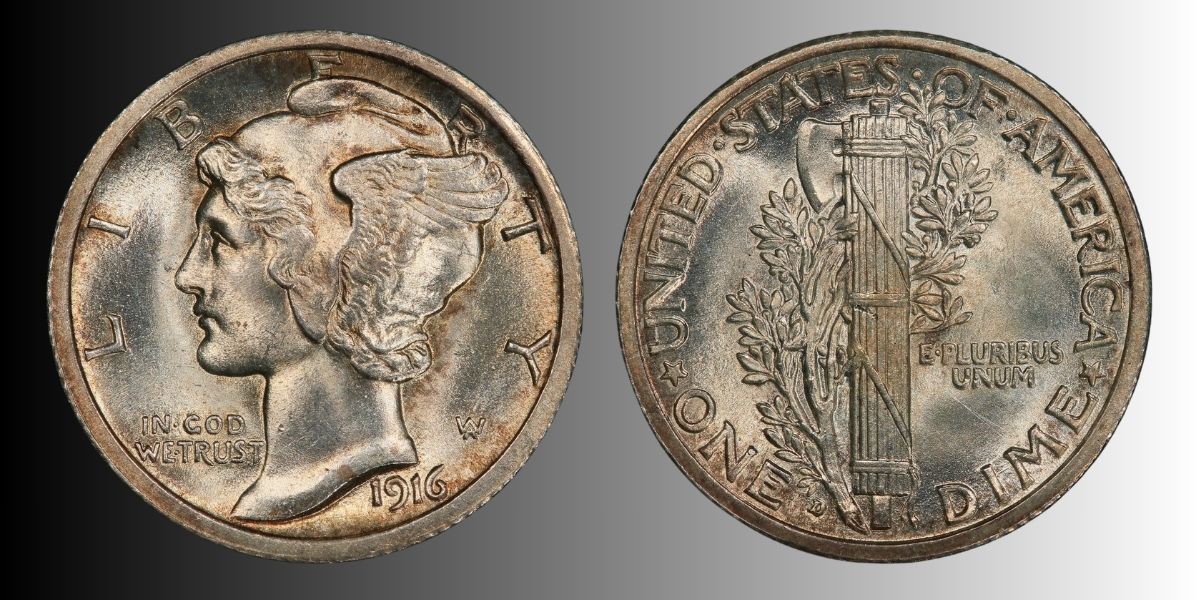
Weinman's dime design features a left-facing portrait of Liberty wearing a winged Phrygian cap, symbolizing freedom of thought. The design was immediately nicknamed the "Mercury" dime due to its resemblance to the Roman messenger god, though Weinman's intent was purely allegorical. The reverse displays a fasces, representing strength through unity, with an olive branch signifying peace.
Production began at all three operating mints in 1916: Philadelphia, Denver, and San Francisco. The Philadelphia facility struck over 22 million dimes without a mint mark. San Francisco produced more than 10 million pieces marked with an "S." Denver, however, struck just 264,000 examples, creating an immediate rarity that collectors recognized almost from the moment of issue.
The Denver Mint's limited production likely resulted from several factors. The facility was still establishing its capacity for dime production, resources were being allocated to other denominations, and the late start in the calendar year left little time for extensive coinage runs. Whatever the specific reasons, the result was a coin that would become legendary among collectors for generations.
Why Collectors Value the 1916‑D Mercury Dime
The appeal of the 1916‑D Mercury Dime extends beyond simple scarcity. Several factors combine to make this coin a centerpiece of serious collections and a recognized status symbol within the numismatic community.
First, the coin represents a genuine rarity in a popular series. The Mercury dime collection is manageable in scope, spanning only from 1916 to 1945, yet it includes several challenging dates. The 1916‑D stands alone as the most difficult regular issue to acquire, making it the natural focal point for collectors attempting to complete the set.
Second, the design itself has endured as one of America's most beloved coin motifs. Weinman's artistry captured Liberty with grace and dynamism, and the reverse symbolism resonated with collectors who appreciated both aesthetic beauty and deeper meaning. Owning the first Denver Mint example of such an admired design holds special significance.
Third, the 1916‑D Mercury Dime has developed a reputation that transcends the hobby itself. Even non-collectors often recognize the coin's name and understand its status as a valuable rarity. This broader cultural recognition reinforces demand and ensures continued interest across collecting generations.
Fourth, the coin appears frequently in discussions of key dates and important 20th-century rarities. Its inclusion in virtually every list of essential American coins maintains visibility and desirability. Collectors building type sets, date sets, or investment portfolios consistently identify the 1916‑D as a priority acquisition.
Design Elements and Identifying Characteristics
Identifying an authentic 1916‑D Mercury Dime requires careful attention to specific details. The obverse features Liberty's left-facing portrait wearing the winged cap, with the word LIBERTY appearing along the upper edge. The date 1916 appears at the bottom, and seven stars flank the figure on the left with six on the right, representing the original thirteen colonies.
The mint mark appears on the reverse, positioned to the left of the fasces near the bottom of the coin. The "D" for Denver should be clearly visible, though wear on circulated examples can sometimes make mint marks less distinct. The fasces dominates the reverse center, bound with horizontal bands, while the olive branch extends diagonally from the lower right. The motto E PLURIBUS UNUM appears along the right edge, with UNITED STATES OF AMERICA and ONE DIME completing the legends.
The coin measures 17.9 millimeters in diameter and weighs 2.5 grams. Composition consists of 90 percent silver and 10 percent copper, giving the coin its characteristic silvery appearance when uncirculated and various toned patinas when circulated or aged.
Weinman's attention to detail shows in Liberty's facial features, the delicate rendering of the cap's wings, and the careful execution of the fasces' individual rods. On well-struck examples, these details remain sharp and fully defined. Production quality at the Denver Mint in 1916 generally resulted in acceptable strikes, though some variation exists across the surviving population.
Rarity and Population Characteristics
The original mintage of 264,000 pieces represents a small fraction of the dimes produced in 1916. To put this in perspective, the Philadelphia Mint struck more than 22 million dimes that year, making Denver's output less than 1.2 percent of the total. This disparity created immediate scarcity, and attrition over the subsequent decades has further reduced the number of surviving examples.
Most 1916‑D Mercury Dimes entered circulation upon release. The coin carried no premium at the time, and collectors of the era did not necessarily anticipate its future value. As a result, the majority of surviving examples show varying degrees of wear. Circulated grades from Good through Very Fine represent the most commonly encountered conditions, though even heavily worn specimens command substantial premiums over common-date Mercury dimes.
Uncirculated examples are genuinely rare. Certification data from major grading services indicates that Mint State 1916‑D Mercury Dimes represent only a small fraction of the known population. Even in lower Mint State grades such as MS-60 through MS-63, the coin remains scarce and highly collectible. As condition improves into MS-64 and above, rarity increases dramatically and prices escalate accordingly.
The coin also presents authentication challenges due to its high value. Counterfeiters have targeted the 1916‑D for decades, creating altered dates, added mint marks, and complete fabrications. Collectors should approach any 1916‑D Mercury Dime with appropriate caution, verifying authenticity through expert examination or third-party certification before purchase.
Grading Considerations and Condition Assessment
Understanding how condition affects value requires familiarity with the specific wear points and visual characteristics that graders evaluate. For the 1916‑D Mercury Dime, certain areas receive particular attention during the grading process.
On the obverse, the high points of Liberty's portrait show wear first. Her hair details, particularly the horizontal bands across the forehead and the definition within the curls, fade with circulation. The wings of the cap also lose sharpness, with the individual feather details merging together as wear progresses. The cheek and jawline remain relatively smooth areas that show friction and loss of original luster in circulated grades.
The reverse wear concentrates on the fasces' horizontal bands and the individual vertical rods. As circulation wear increases, these elements lose separation and detail. The diagonal olive branch and its leaves also show wear, though these areas typically retain more detail longer than the central fasces. The fields on both sides can develop contact marks, scratches, and other surface disturbances that affect eye appeal and grade.
For uncirculated examples, strike quality becomes an important consideration. Full details in Liberty's hair bands and wing feathers, complete separation of the fasces rods, and sharp definition throughout indicate a well-struck coin. Some Denver Mint strikes from 1916 show slight weakness in certain areas, and collectors evaluate both preservation and production quality when assessing Mint State specimens.
Luster characteristics also influence desirability. Original mint luster on uncirculated 1916‑D dimes displays a satiny, cartwheel effect when rotated under light. Toning can range from brilliant white to various shades of gray, blue, gold, or russet. Natural, attractive toning often enhances appeal, while harsh or artificial-looking color may detract from value. Surface preservation matters significantly, with fewer marks and abrasions resulting in higher grades and stronger demand.
Third-party certification provides authentication and condition verification. Both PCGS and NGC have graded thousands of 1916‑D Mercury Dimes over the years, creating a reference population and standardizing grade assignments. Collectors generally prefer certified examples, particularly at higher price points, due to the coin's counterfeiting history and the precision required in grade differentiation at higher levels.