

1895 Proof Morgan Dollar: “King of Morgan Dollars”
Posted by Andrew Adamo - A certified ANA Professional Numismatist, Active member of ICTA, contributor to CoinWeek, Numismatic News, NGC and ANA on Jun 4th 2026
1895 Proof Morgan Dollar: "King of Morgan Dollars"
The 1895 Morgan Dollar is a proof-only issue with no circulation strikes produced, making it one of the rarest and most coveted coins in the Morgan Dollar series. Values typically range from $30,000 to over $100,000 depending on grade and cameo designation, with premium proof specimens commanding significantly more. The highest auction records for exceptional cameo proofs have exceeded $150,000, establishing this coin as a cornerstone of advanced Morgan Dollar collections.
Overview of the 1895 Morgan Dollar
The 1895 Morgan Dollar occupies a unique position in American numismatics. Unlike every other year in the Morgan Dollar series from 1878 through 1904, the Philadelphia Mint produced no circulation strikes in 1895. Only proof specimens were struck, with a reported mintage of just 880 pieces intended exclusively for collectors who purchased proof sets that year.
This proof-only status immediately separated the 1895 from its counterparts and created a numismatic legend. For collectors attempting to assemble a complete date set of Morgan Dollars, the 1895 represents the single most expensive and difficult acquisition. Its reputation as the "King of Morgan Dollars" stems not from design or historical event, but from pure rarity and the circumstances of its production.
The coin's significance extends beyond its limited mintage. It serves as a critical lesson in mint policy, collector demand, and the economic conditions that shaped late 19th-century American coinage. Understanding why the Philadelphia Mint chose to strike only proofs in 1895 requires examining the broader context of silver coinage during this period.
Historical Background and Production Context
The Morgan Dollar series began in 1878 following passage of the Bland-Allison Act, which required the U.S. Treasury to purchase large quantities of silver and convert it into dollar coins. This legislation was a response to pressure from Western silver mining interests and advocates of silver currency. For years, the mints produced Morgan Dollars in enormous quantities, far exceeding public demand for the denomination.
By the mid-1890s, massive stockpiles of Morgan Dollars sat in Treasury vaults. The coins circulated minimally in most of the country, with the exception of Western states where silver dollars remained popular for commerce. Eastern and Midwestern businesses and individuals preferred paper currency and smaller denominations for daily transactions. The Treasury found itself storing millions of unwanted silver dollars.
In 1895, the Philadelphia Mint faced this reality and made a practical decision. With vault space at a premium and no public demand for additional circulation strike dollars, officials determined that producing more business strikes would be wasteful. However, the mint still needed to fulfill orders from collectors who purchased annual proof sets. The solution was to strike only proof specimens for the year.
This decision created an immediate rarity. While the 1895-O Morgan Dollar from the New Orleans Mint exists in circulation strike form with a mintage of 450,000 pieces, Philadelphia's proof-only production of 880 coins meant the 1895 would remain forever scarce. Most proof coins from this era were carefully preserved by their original purchasers, but attrition over more than a century has reduced the number of surviving specimens.
Why Collectors Focus on the 1895 Morgan Dollar
The 1895 Morgan Dollar commands attention for several interconnected reasons. First and foremost is its essential role in date set completion. Collectors who pursue a full run of Morgan Dollars by date and mint mark cannot avoid this issue. While alternatives exist such as settling for a high-grade circulation strike from New Orleans, serious collectors recognize that a Philadelphia coin is required for a complete set.
Rarity drives demand in numismatics, and the 1895 proof represents the rarest regular-issue Morgan Dollar. Other dates like the 1889-CC or 1893-S have lower surviving populations in high grades, but their original mintages were substantially higher and business strikes were produced. The 1895 stands alone as the only proof-only year in the series, creating a mystique that transcends pure population numbers.
Market psychology amplifies this coin's status. Owning an 1895 Morgan Dollar signals achievement and commitment to the hobby. It represents a substantial financial investment and demonstrates that a collector has progressed beyond entry-level accumulation. The coin functions as both a numismatic treasure and a status symbol within the collecting community.
The story itself adds value. Collectors appreciate coins with historical narratives, and the 1895 offers an excellent example of how mint policy and economic conditions intersect. Explaining why this coin exists only in proof format provides insight into the challenges facing the U.S. coinage system during the era, making it an educational piece as well as a valuable one.
Design and Specifications
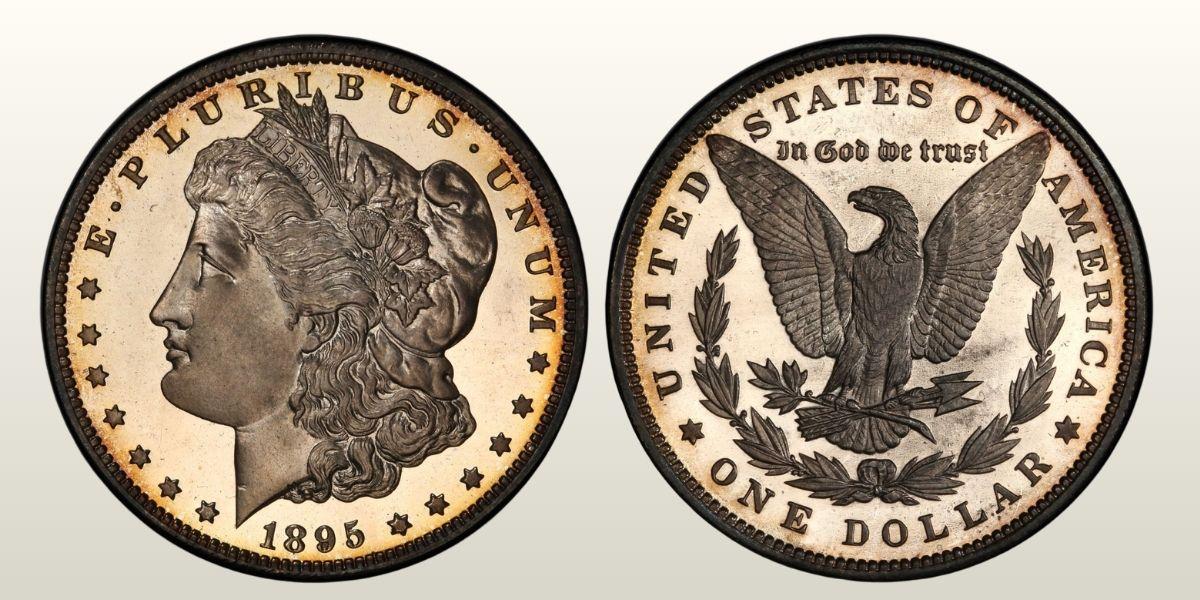
The 1895 proof Morgan Dollar shares the same fundamental design as all other Morgan Dollars. George T. Morgan, an English-born engraver who joined the U.S. Mint in the 1870s, created the design that debuted in 1878. His work has become one of the most recognizable and beloved designs in American numismatic history.
The obverse features a left-facing portrait of Liberty wearing a Phrygian cap adorned with cotton and wheat, symbolizing American agriculture. A headband bears the word LIBERTY, and thirteen stars representing the original colonies encircle the portrait. The date appears at the bottom of the obverse field. Morgan based the portrait on Anna Willess Williams, a Philadelphia schoolteacher who served as his model, though the final design represents an idealized Liberty rather than a strict portrait.
The reverse displays a heraldic eagle with wings spread, clutching arrows and an olive branch. The eagle holds these symbols in the opposite talons from traditional heraldry, a detail that sparked minor controversy when the coin was introduced. A wreath surrounds the eagle, and the inscriptions UNITED STATES OF AMERICA and ONE DOLLAR encircle the design. The motto E PLURIBUS UNUM appears on a ribbon above the eagle.
Specifications for the 1895 proof follow the standard Morgan Dollar format. The coin measures 38.1 millimeters in diameter and weighs 26.73 grams. Composition consists of 90 percent silver and 10 percent copper, a ratio standard for U.S. silver coinage of the period. The edge is reeded with consistent ridging around the circumference.
Proof examples exhibit the characteristics typical of proof production. Dies received special preparation with polishing and sometimes frosting of design elements. Planchets were carefully selected and cleaned. Striking occurred with multiple blows from the press, creating sharp definition and crisp detail. Fields typically display mirror-like reflectivity, while devices may show frosted contrast depending on die preparation at the time of striking.
Rarity and Availability
The original mintage of 880 proof specimens establishes the baseline for 1895 Morgan Dollar rarity, but surviving population provides the practical measure of availability. Not all coins struck in 1895 exist today. Over more than 125 years, some specimens were lost, damaged, cleaned improperly, or otherwise removed from the collectible population. Determining exactly how many survive requires examining certification service population reports.
Major grading services have certified hundreds of 1895 proof Morgan Dollars over the decades, but resubmissions complicate population analysis. Collectors and dealers sometimes resubmit coins hoping for grade improvements, leading to the same physical coin being counted multiple times in population reports. Numismatic researchers estimate that perhaps 500 to 600 distinct specimens survive today, though precise figures remain difficult to confirm.
Grade distribution matters significantly for this issue. Proof coins from the 1890s were sold to collectors who generally understood their value and took reasonable care to preserve them. As a result, many 1895 proofs survived in respectable condition. Grades typically range from PR-60 to PR-65, with examples in the PR-63 to PR-64 range being most frequently encountered in the marketplace.
Higher-grade specimens in PR-66 and above command substantial premiums. At these levels, surface preservation, strike quality, and eye appeal separate merely nice examples from exceptional ones. Cameo and deep cameo designations, which indicate strong frosted contrast between devices and fields, add further premium and desirability. Deep cameo 1895 proofs represent some of the finest Morgan Dollars available to collectors.
Market availability fluctuates but remains limited. Several 1895 Morgan Dollars appear at major auctions each year, and coin shows occasionally feature examples. However, collectors seeking this coin should expect to wait for the right opportunity. Purchasing decisions often involve careful consideration of grade, eye appeal, and price relative to current market conditions.