

1792 Half Disme: America’s First Half Dime
Posted by Andrew Adamo - A certified ANA Professional Numismatist, Active member of ICTA, contributor to CoinWeek, Numismatic News, NGC and ANA on May 29th 2026
1792 Half Disme: America's First Half Dime
The 1792 Half Disme represents one of America's earliest silver coinage experiments, with values ranging from approximately $25,000 in lower circulated grades to well over $1 million for exceptional specimens. The highest auction record reached $1,410,000 for a Specimen-67 example sold in 2015, reflecting the coin's extraordinary significance as a foundational piece of United States numismatic history.
Overview of the 1792 Half Disme
The 1792 Half Disme stands as one of the most historically important coins in American numismatics. Struck before the United States Mint officially opened its doors, this small silver coin represents the nation's first federal coinage effort. While technically a pattern or experimental piece rather than an official circulation strike, the 1792 Half Disme holds a unique position as tangible evidence of America's transition from British colonial currency to an independent monetary system.
Collectors regard this coin as essential to understanding the origins of United States coinage. Its connection to founding figures, its role in demonstrating the feasibility of domestic silver coinage, and its extreme rarity combine to make it one of the most desirable pieces in American numismatics. Fewer than 300 examples are believed to survive today, and each appearance at auction draws significant attention from advanced collectors and institutions.
What Is a Half Disme and Why Is It Significant?
On April 14, 1792, President George Washington appointed David Rittenhouse, a noted polymath and former Treasurer of Pennsylvania, as the first Director of the United States Mint. Rittenhouse quickly secured a suitable site at 7th and Arch Streets in Philadelphia, where construction began on July 31 on a lot that had once housed an abandoned whiskey distillery.
Rittenhouse, however, was eager to begin coinage before the new Mint facility was completed. In a July 9 letter, he requested Washington’s approval to produce half cents, cents, half dismes, and dismes. At the time, Rittenhouse had access to a coin press and workspace in the cellar of Philadelphia saw-maker John Harper’s shop at Sixth and Cherry Streets.
The Mint’s first depositor was Secretary of State Thomas Jefferson, who visited Rittenhouse on July 11 and arranged for his $75 silver deposit to be coined. With dies already prepared for a five-cent denomination known as the “half disme” — pronounced “deem” — Henry Voight likely struck the resulting 1,500 coins.
The first half dismes proved difficult to produce. Many were struck off-center, and the dies deteriorated quickly under use. Die cracks appeared after only a few hundred coins had been made, adding to the rarity and historical importance of these early federal issues.
Historical Background and Experimental Origins
The story of the 1792 Half Disme begins during a pivotal moment in American history. Following the ratification of the Constitution, the young nation needed to establish its own currency system. The Coinage Act of April 2, 1792, authorized the creation of a United States Mint and defined the denominations, specifications, and standards for federal coinage.
However, construction of the Philadelphia Mint facility was still underway in July 1792 when approximately 1,500 Half Dismes were struck. Without a functioning mint building, these coins were produced using borrowed equipment, likely in the cellar of a nearby building owned by saw maker John Harper at Sixth and Cherry Streets in Philadelphia.
The timing of this striking was significant. President George Washington referenced these coins in his fourth annual address to Congress on November 6, 1792, stating that a small beginning had been made in the coinage of half dimes, the want of small coins in circulation calling for immediate attention. This presidential mention elevates the 1792 Half Disme beyond mere pattern status and into the realm of historically documented experimental coinage with direct involvement from the nation's leadership.
According to numismatic tradition, some of the silver used to strike these coins may have come from silverware provided by George and Martha Washington themselves, though this account remains difficult to verify with absolute certainty. Whether legend or fact, the story underscores the personal involvement of America's founding generation in establishing the nation's monetary system.
Why Collectors Prize the 1792 Half Disme
The 1792 Half Disme occupies a singular position in American numismatics for several compelling reasons. First, it represents the earliest silver coinage struck under federal authority, predating the official opening of the United States Mint by several months. This distinction alone makes it a cornerstone piece for collectors building comprehensive type sets or early American collections.
Second, the coin carries direct associations with George Washington and the founding era. The presidential reference in Washington's congressional address provides documentary evidence connecting these coins to the highest levels of early American government. Few coins can claim such prominent historical credentials.
Third, the 1792 Half Disme demonstrates the technical feasibility of domestic silver coinage. Prior to this striking, many doubted whether the young nation possessed the expertise and resources to produce quality coinage. The Half Disme proved that American-made coins could meet acceptable standards of design and execution.
Fourth, the extreme rarity of surviving examples creates intense competition among advanced collectors. With an estimated surviving population of fewer than 300 pieces across all grades, opportunities to acquire a 1792 Half Disme are uncommon. Many collectors consider it the ultimate goal in building a complete early American type set.
Finally, the coin's design captures the aesthetic sensibilities of the federal period. The simple yet dignified motifs reflect the values and aspirations of the new republic, making each specimen not just a coin but a miniature work of historical art.
Design, Specifications, and Identifying Details
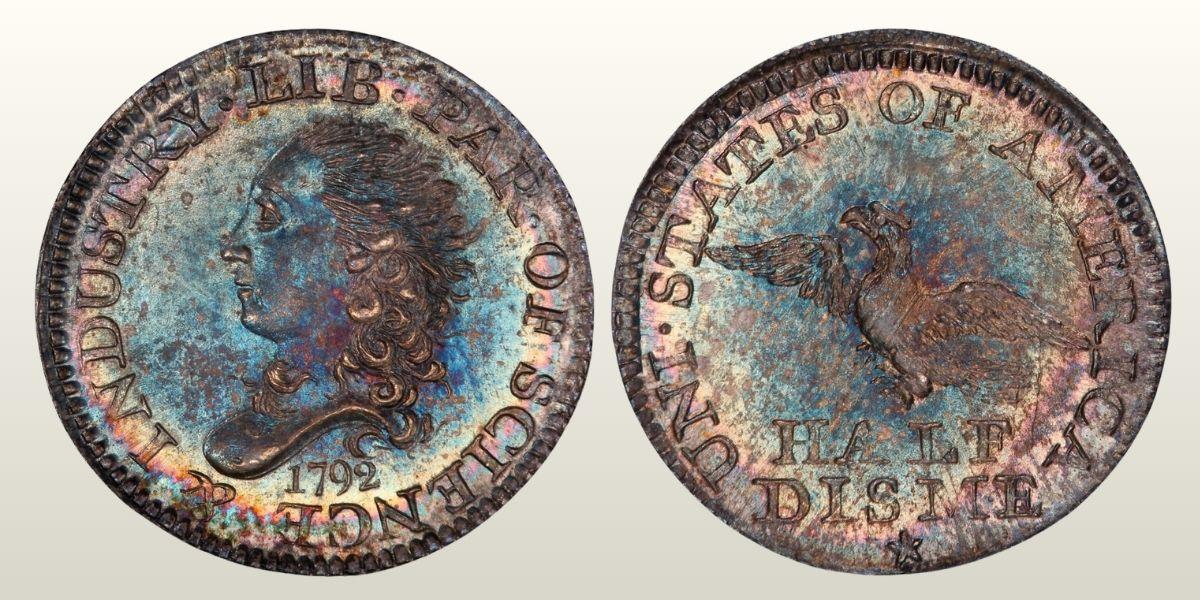
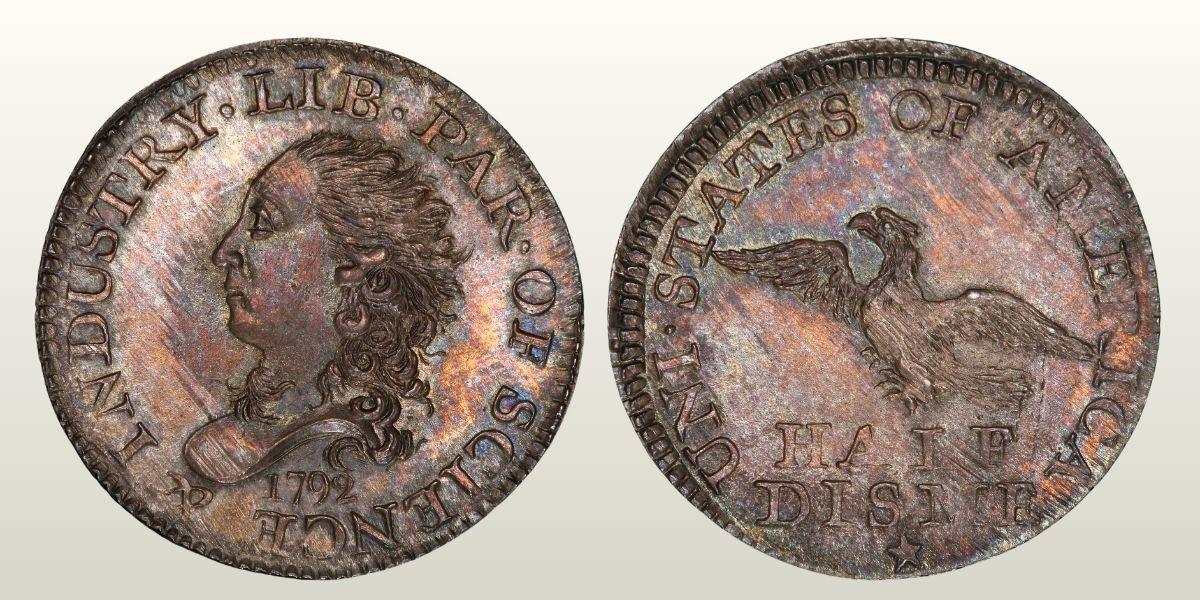
The 1792 Half Disme features distinctive design elements that reflect the artistic and political climate of the early republic. The obverse displays a left-facing portrait of Liberty with flowing hair, surrounded by the inscription LIB PAR OF SCIENCE & INDUSTRY. This unusual legend emphasizes Enlightenment values rather than traditional monarchical imagery, marking a deliberate departure from European coinage conventions.
The reverse shows a small eagle, sometimes described as a scrawny or heraldic eagle, perched within a wreath. The denomination HALF DISME appears below, with the fraction 1/200 indicating the coin's relationship to the proposed dollar unit. The edge of the coin is plain, unlike later United States silver coinage which typically featured reeded edges.
The coin's physical specifications were defined by the Coinage Act of 1792. Each Half Disme was intended to contain 20.8 grains of pure silver, with a gross weight slightly higher to account for alloy. The composition was specified as .8924 fine silver, with the remainder being copper to provide durability. The diameter measures approximately 16.5 millimeters, making it comparable in size to a modern dime.
The designer of the 1792 Half Disme remains a subject of numismatic debate. While no definitive documentation survives identifying the artist, many scholars attribute the design to either Robert Birch or Adam Eckfeldt, both of whom were involved in early mint operations. The engraving style shares characteristics with other experimental pieces from the same period, suggesting the work came from within the small circle of craftsmen working on America's first coinage efforts.
Identifying Authentic Examples
Given the significant value of genuine 1792 Half Dismes, authentication is paramount. Collectors should only consider examples certified by major third-party grading services such as PCGS or NGC. These services have extensive databases of genuine examples and can detect the subtle characteristics that distinguish authentic pieces from later copies or replicas.
Authentic 1792 Half Dismes display specific die characteristics and striking qualities consistent with late 18th-century minting technology. The surfaces typically show evidence of hand-engraved dies, including minute variations and tooling marks. The strike quality varies significantly among surviving examples, with some showing weakness in certain design elements due to the experimental nature of the production process.
Collectors should be aware that various replicas and fantasy pieces resembling the 1792 Half Disme have been produced over the years, some quite deceptive. Purchasing only certified examples from reputable dealers eliminates the risk of acquiring non-authentic material.
Rarity, Mintage, and Availability
Historical records indicate that approximately 1,500 Half Dismes were struck in July 1792. However, the surviving population is dramatically smaller, with current estimates suggesting fewer than 300 examples exist across all grades. This attrition rate reflects the normal loss, melting, and disappearance that affects coins over more than two centuries.
The rarity of the 1792 Half Disme places it among the most sought-after United States coins. Unlike many classic rarities that appear at auction with some regularity, Half Dismes enter the market infrequently. Years may pass between offerings of high-grade examples, and when they do appear, they typically attract significant bidder attention.
The grade distribution of surviving 1792 Half Dismes skews toward circulated and problem examples. Most known specimens show evidence of handling, circulation, cleaning, damage, or other issues that developed over two centuries. Mint State examples are extraordinarily rare, with only a handful known to survive. Specimens grading Fine to Very Fine represent the majority of available examples, with About Uncirculated pieces already considered condition rarities.
Collectors seeking a 1792 Half Disme must often wait for the right opportunity and should be prepared to act decisively when an acceptable example becomes available. The combination of historical importance and genuine scarcity means that demand consistently exceeds supply at virtually any price level.
Grading and Condition Factors
Grading a 1792 Half Disme requires specialized knowledge and careful attention to the coin's unique characteristics. Because these pieces were struck using experimental equipment and techniques, normal grading standards must be applied with understanding of period manufacturing limitations.
On the obverse, key grading points include Liberty's portrait details, particularly the hair strands and facial features. Well-preserved examples show clear separation in the hair locks and distinct definition in Liberty's profile. The surrounding legend should be complete and legible, though some weakness is common due to die wear or striking pressure inconsistencies.
The reverse requires evaluation of the eagle's feather details and the wreath surrounding it. Higher-grade examples display individual feathers on the eagle's body and wings, along with clear definition in the wreath leaves. The denomination and fraction should be sharp and fully struck, though minor weakness sometimes appears in these areas even on otherwise high-grade specimens.
Surface preservation plays a critical role in determining a 1792 Half Disme's grade and market value. Original surfaces with natural toning are highly prized, while cleaned or impaired examples face significant market resistance despite their rarity. Because so many specimens have been cleaned or otherwise altered over the centuries, examples with unmolested surfaces command substantial premiums.
Strike quality varies among known examples. Some Half Dismes show full, sharp strikes with all design elements well-defined, while others display weakness in the centers or at the rims. This variation reflects the experimental production circumstances and the limitations of borrowed equipment. Collectors should understand that a slightly weak strike does not necessarily indicate wear and should be evaluated within the context of how these coins were originally produced.