

1652 Pine Tree Shilling: Early Colonial Currency
Posted by Andrew Adamo - A certified ANA Professional Numismatist, Active member of ICTA, contributor to CoinWeek, Numismatic News, NGC and ANA on May 27th 2026
1652 Pine Tree Shilling: Early Colonial Currency
The 1652 Pine Tree Shilling typically ranges in value from $400 to $5,000 depending on condition, variety, and strike quality. Well-preserved specimens with strong details and attractive surfaces can exceed $64,000 at auction. The highest-quality examples, especially those with full branch detail and minimal wear, have sold for significantly more among advanced colonial coin collectors.
Overview of the Pine Tree Shilling
The Pine Tree Shilling represents one of the most historically significant silver coins ever produced in colonial America. Struck at the Massachusetts Bay Colony mint between 1667 and 1682, these coins carry the symbolic 1652 date throughout their entire production run. This dating practice was a deliberate strategy to circumvent British restrictions on colonial coinage.
These early American silver coins circulated alongside a chaotic mix of foreign currency, including Spanish reales, English shillings, and various European denominations. The Pine Tree Shilling provided much-needed monetary stability for colonial trade and commerce. Today, collectors prize these pieces for their connection to America's economic independence, their distinctive design, and their role in numismatic history.
The coin takes its name from the pine tree depicted on the obverse, a symbol that held deep meaning for the Massachusetts colonists. The tree represented the valuable timber resources of New England and became an enduring emblem of colonial identity. This imagery would later appear on Revolutionary War flags and continues to resonate in American symbolism.
Historical Background and Colonial Context
During the mid-17th century, the Massachusetts Bay Colony faced severe currency shortages. English coins were scarce, and the colonial economy relied heavily on barter, wampum, and foreign coinage. This monetary chaos hindered commerce and economic growth. In 1652, the colonial government authorized John Hull and Robert Sanderson to establish a mint in Boston.
The minting operation began with simple Willow Tree and Oak Tree designs before evolving to the more elaborate Pine Tree coinage. The consistent use of the 1652 date served a strategic purpose. By maintaining this single date, the colonists could argue that all coins were struck during the original authorization period, avoiding potential conflicts with the Crown's monopoly on coinage.
The Royal Charter of 1629 had granted the Massachusetts Bay Colony significant autonomy, but the legal authority to strike coins remained questionable. The colonial mint operated in a gray area of jurisdiction. When Charles II regained the English throne in 1660, the mint continued operations despite the potential for royal disapproval. This bold act of economic self-determination foreshadowed the independent spirit that would emerge more than a century later.
John Hull, the mint master, played a crucial role in colonial finance. He received one shilling out of every twenty struck as compensation, a profitable arrangement that made him one of the wealthiest men in New England. Robert Sanderson, his partner, provided the technical expertise necessary for consistent production. Together, they maintained standards that ensured colonial confidence in the coinage.
Production Timeline and Varieties
The Pine Tree series encompasses several distinct varieties, typically classified by the size and style of the planchet. Large planchet Pine Tree Shillings were struck first, followed by small planchet versions. Collectors also pursue sixpence and threepence denominations within the Pine Tree series, though shillings remain the most widely recognized and collected.
Large planchet examples feature a broader, thinner flan with the design elements spread across a wider surface. These early strikes often show considerable variation in centering and strike quality due to hand-hammering techniques. Small planchet versions utilized a more compact, thicker flan and generally exhibit improved centering and detail definition.
Die varieties further diversify the series. Differences in tree style, lettering arrangement, and bead placement allow specialists to attribute specific die combinations. Some varieties show the tree with full branches and detailed bark, while others display a more stylized representation. These variations resulted from die wear, die replacement, and the individual craftsmanship of the engravers.
Why Collectors Value the Pine Tree Shilling
The Pine Tree Shilling occupies a unique position in American numismatics. As one of the earliest coins struck in what would become the United States, it represents a tangible connection to colonial history. Collectors appreciate the coin's role in establishing economic autonomy before political independence became a reality.
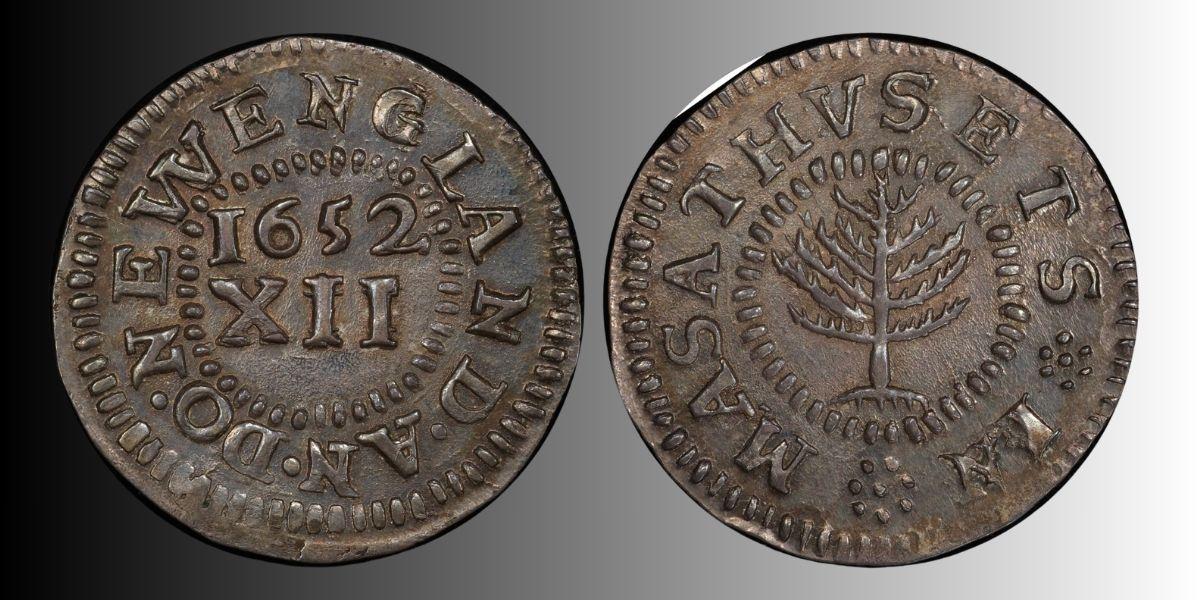
The design itself carries symbolic weight. The pine tree imagery resonated deeply with colonists who saw their natural resources as sources of wealth and identity. The motto "IN MASATHVSETS" (spelling intentional) and "NEW ENGLAND AN DOM" (Anno Domini) on the reverse connect the coin to its geographic and temporal origins. These inscriptions make each specimen a small historical document.
Rarity enhances collector interest. While the exact number of survivors remains unknown, Pine Tree Shillings exist in far smaller quantities than 19th or 20th century U.S. coinage. The survival rate for colonial silver coins was low. Many were lost, melted for their silver content, or worn beyond recognition through decades of circulation. Finding examples with sharp details and minimal environmental damage requires patience and market knowledge.
The coins also appeal to type collectors building representative sets of early American coinage. A Pine Tree Shilling serves as an essential anchor piece in colonial collections. Advanced collectors often pursue multiple varieties, seeking examples of both large and small planchet types, different die combinations, and varying grade levels to illustrate the series comprehensively.
Design Elements and Specifications
The obverse of the Pine Tree Shilling features a stylized tree in the center, surrounded by the inscription "MASATHVSETS IN" arranged in a circular pattern. The tree typically displays a trunk with branches extending outward, though the level of detail varies considerably among different die states and strikes. Some examples show intricate branch structure, while others present a more simplified design.
The reverse displays the denomination in Roman numerals (XII for twelve pence, equivalent to one shilling) at the center, surrounded by "NEW ENGLAND AN DOM" and the date 1652. The arrangement and spacing of lettering varies among die varieties, providing attribution points for specialists. A ring of beads typically borders both sides, though these may be weakly struck or missing on poorly centered examples.
The coins were struck on irregular planchets that were individually prepared. This hand-production method resulted in significant variation in shape, size, and weight. Planchet flaws, adjustment marks, and edge irregularities are common and generally considered acceptable characteristics of the manufacturing process rather than defects that diminish value.
Silver Content and Composition
Pine Tree Shillings were struck in sterling silver, matching the standard maintained by English coinage of the period. The composition provided intrinsic value that supported public confidence in the currency. The weight standard aimed for approximately 72 grains, though actual weights vary due to production methods, planchet preparation, and circulation wear.
The silver content made these coins attractive targets for melting when the bullion value exceeded face value or when silver was needed for other purposes. This economic pressure contributed to the attrition rate over centuries. Today, the numismatic value of surviving examples far exceeds their metal content, protecting them from modern melting pressures.
Rarity and Availability in Today's Market
Pine Tree Shillings survive in modest numbers compared to later U.S. coinage, but they appear at auction and in dealer inventories with reasonable frequency. Collectors with patience can usually locate examples within their budget and grade preferences. The key lies in understanding condition rarity rather than absolute rarity.
Lower grade examples showing heavy wear, environmental damage, or weak strikes are more readily available and accessible to collectors with modest budgets. These pieces still convey the historical significance and design elements that make the series important. Many collectors begin with a problem-free but well-worn example before upgrading as opportunities arise.
High-grade specimens with sharp tree details, full legends, and minimal surface issues are considerably scarcer. These pieces attract strong competition when they reach the market. Collectors should expect to pay premium prices for examples that retain significant original surface detail and eye appeal. Certification by major grading services provides confidence in authenticity and condition assessment.
Authentication Considerations
The historical significance and value of Pine Tree Shillings have unfortunately made them targets for counterfeiters over the centuries. Cast copies, struck reproductions, and deceptive restrikes exist in the marketplace. Some fakes are crude and easily detected, while others show sophistication that can deceive inexperienced buyers.
Authentication by recognized experts or third-party grading services is strongly recommended, especially for higher-value purchases. Professional numismatists examine die characteristics, metal composition, weight, patina development, and microscopic surface features to confirm authenticity. Collectors should exercise caution when purchasing raw examples without expert verification.
Provenance and auction history can provide additional confidence. Coins with documented ownership chains or previous appearances in major auction sales carry reduced authentication risk. However, even pieces with provenance should undergo professional examination, as historical documentation does not guarantee authenticity in all cases.
Grading and Condition Factors
Grading colonial coins like the Pine Tree Shilling requires understanding the series-specific characteristics and realistic condition expectations. Most survivors show evidence of circulation, environmental exposure, or both. Pristine examples essentially do not exist, and even pieces considered high grade by colonial standards display wear and surface characteristics that would be considered significant on later coinage.
The tree design on the obverse serves as the primary diagnostic point for assessing wear. On better-preserved examples, individual branches, bark texture, and overall tree structure remain visible. As wear progresses, these details flatten and merge. Advanced wear reduces the tree to a simple outline or blob with minimal internal detail.
Legend clarity provides another grading indicator. Sharp, fully readable lettering indicates limited circulation and good strike quality. Partial letters or missing legend segments suggest either heavy wear or weak original striking. Evaluating whether weak areas result from strike quality or wear requires experience with the series.
Strike Quality and Planchet Issues
Strike quality varies substantially among Pine Tree Shillings. Hand-hammered production methods resulted in uneven force application, causing some design areas to appear weak while others show full detail. Collectors should understand that weak strikes represent a manufacturing characteristic rather than circulation wear.