
There are no products listed under this category.
Certified Silver Dollars. Graded U.S. $1 Coins (PCGS, NGC, CAC/CACG).
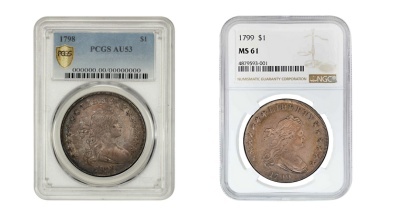
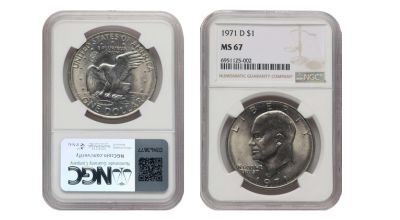
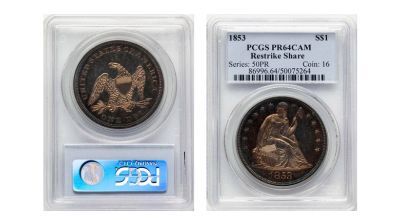
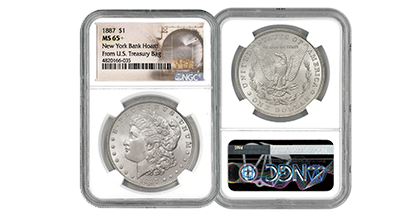
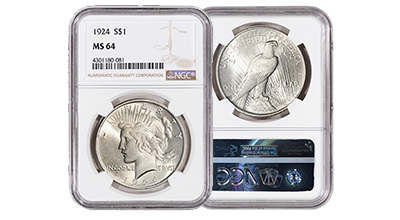
A certified silver dollar is a U.S. $1 coin that has been authenticated, graded, and sealed in a tamper-evident holder (“slab”) by a third-party grading service like PCGS, NGC or CAC. From the very first federal-era dollars struck in the 1790s to the iconic Morgan and Peace dollars of the late 19th and early 20th centuries, silver dollars have long been a cornerstone of American numismatics. Today, that legacy is amplified when a coin is professionally certified, authenticated, graded, and encapsulated by leading third-party grading services. On this category page, you’ll find Certified Silver Dollars across major designs, organized into dedicated collecting lanes such as Certified Flowing Hair Dollars, Draped Bust Dollars, Seated Liberty Dollars, Morgan Dollars, Peace Dollars, and Eisenhower Dollars.
History of the U.S. Silver Dollar
The U.S. dollar was shaped by early commerce and the popularity of the Spanish milled dollar in the colonies; the Coinage Act framework and the early Mint ultimately led to the first U.S. silver dollars entering production in the 1790s. These early issues were statements of national identity, metallurgy, and economic credibility.
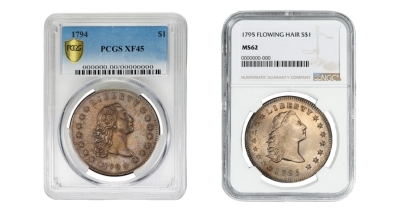
A major milestone arrives with the 1794 Flowing Hair dollar, America’s first silver dollar issue. PCGS notes the first delivery took place October 15, 1794, with 1,758 coins delivered, an astonishingly small figure by modern standards and one reason early dollars are so intensely collected. From there, designs evolved rapidly (Flowing Hair → Draped Bust → Seated Liberty and beyond), reflecting changing artistic tastes, political priorities, and the role of silver in U.S. monetary policy.
Types of certified silver dollars you’ll see in this category
This category groups certified silver dollars into the major “type” families collectors pursue:
-
Flowing Hair Dollars (1794–1795) – the first federal dollars; ultra-early American coinage with major historical prestige.
-
Draped Bust Dollars (1795–1804 dates, including later famous rarities) – an early classic design, with some of the most legendary U.S. rarities associated with the series.
-
Seated Liberty Dollars (1840–1873) – widely collected by date/mintmark, with famous Western mint issues.
-
Morgan Dollars (1878–1921) – the most broadly collected silver dollar series, famous for mintmarks like CC, key dates, and abundant varieties.
-
Peace Dollars (1921–1935) – a post–World War I design symbolizing peace, with key low-mintage dates.
-
Eisenhower Dollars (1971–1978) – the large “Ike” dollar era; many collectors target high-grade business strikes and special collector issues.
Bullion Shark’s Certified Silver Dollars category specifically surfaces these subcategories for easy shopping and collecting focus.
Key dates and “low mintage” years collectors watch
“Key date” can mean the lowest mintage, the toughest coin in high grade, a coin heavily counterfeited, or simply the most demanded by the market. Here are some widely recognized headliners across the silver dollar landscape:
Early dollars: small numbers, massive demand
-
1794 Flowing Hair $1 – only 1,758 delivered per PCGS, making it a foundational rarity.
-
1804 Draped Bust $1 – often called the “King of American Coins.” PCGS highlights that only 16 specimens are known, and famously, it was not actually struck in 1804 (its origin story ties to 1830s diplomacy and later restrikes).
Seated Liberty standouts
-
1870-S Seated Liberty $1 – one of the most famous U.S. rarities, with PCGS noting just 12 known survivors.
-
1873-CC Seated Liberty $1 – PCGS states 2,300 were struck and that most were likely melted, making it a major Carson City target.
Morgan Dollar key-date magnets
Collectors often build Morgan sets by date/mintmark, by “CC” focus, or by key-date checklist. Two of the most discussed stoppers:
-
1893-S Morgan $1 – widely recognized as the lowest-mintage business strike Morgan at 100,000 struck.
-
1895 Morgan $1 (Proof) – PCGS calls it the “King of Morgan Dollars,” noting that while Mint records list circulation strikes, experts believe only 880 Proofs were made.
Peace Dollar keys
-
1928 Peace $1 – NGC notes it is the lowest mintage in the series at 360,649 pieces, and that it becomes extremely difficult in Gem Mint State levels.
Important note: “Low mintage” is powerful, but condition rarity can be just as important. Some dates had decent mintages but are exceptionally scarce in MS65+ because most coins saw heavy circulation or were poorly struck.
Why certification matters: authenticity, grade confidence, and market liquidity
When you’re buying a rare or high-value silver dollar, two risks loom largest: authenticity and overgrading. That’s why professional certification is central to modern collecting:
1) Standardized grading you can compare and trust
Top grading services use the Sheldon 1–70 scale, which has become the industry standard for U.S. coin grading. NGC explains it uses the internationally accepted Sheldon scale and adopted it when it began operations in 1987. PCGS similarly notes its standards are built on the Sheldon scale and that encapsulated third-party grading began with its launch in 1986.
2) Encapsulation (“slabbing”) protects and preserves
Certified holders help protect coins from handling damage and environmental exposure, while the label records attribution such as grade, mintmark, and sometimes special designations.
3) Liquidity and resale confidence
Certified coins are generally easier to buy, sell, and insure, especially for key dates. Many collectors specifically seek PCGS or NGC certified examples for registry sets and long-term market confidence.
On Bullion Shark’s Certified Silver Dollars page, you’ll see inventory represented across major services—examples include NGC-certified pieces, PCGS-certified pieces, and even coins in newer-generation holders like CACG on select listings.
CAC and CACG: the “premium for the grade” factor
Beyond numerical grade, advanced collectors care about quality within the grade. That’s where CAC comes in. CAC explains that less than half of coins submitted receive its green sticker, making it a signal many collectors use to identify premium-quality examples for the assigned grade; CAC also describes a rarer gold sticker tier.
In practice, CAC approval can matter most when:
-
You’re shopping for “thin-margin” grades (e.g., MS64 vs MS65 Morgans)
-
You want stronger assurance of originality and eye appeal
-
You’re building a higher-end set where market acceptance is crucial
Signature labels and special certifications: what they mean
In addition to certification, some collectors enjoy specialty holders and labels, especially signature series labels. NGC describes its Signature Series as hand-signed coin certification labels from notable figures such as Mint Directors, Chief Engravers, and coin designers.
A few practical takeaways:
-
A signature label is about presentation and provenance/connection, not a different coin.
-
The signature is on the label/holder, not signed on the coin itself.
-
Premiums can be real when demand is high, but the coin’s date, grade, eye appeal, and rarity still drive core value.
Buy Certified Silver Dollars Online
If you’re deciding where to begin, here are smart collecting approaches:
-
Type set route: one certified example of each major design (Flowing Hair → Draped Bust → Seated → Morgan → Peace → Ike).
-
Key-date route: focus budget on recognized stoppers like 1893-S, 1895 Proof, 1928 Peace, or rare Seated issues.
-
Condition route: pick a series (Morgan or Peace) and pursue the best grade you can afford—often where certification and CAC/CACG matter most.
Whether you’re building your first type set coin-by-coin or upgrading a serious registry-caliber collection, certified silver dollars bring together America’s monetary story and the modern confidence of third-party grading—all in one of the most beloved formats in numismatics.
If you want, tell me your budget range and whether you prefer type coins or key dates, and I’ll suggest 5–10 “best next buys” from within the silver dollar families on this category page.
FAQ
A certified silver dollar is a U.S. $1 coin that has been authenticated, graded, and sealed in a tamper-evident holder (“slab”) by a third-party grading service like PCGS or NGC.
Certification helps confirm authenticity, assigns a standardized grade, and generally makes the coin easier to buy, sell, insure, and compare across the market, especially for key dates and higher-value coins.
The most widely recognized third-party grading services for U.S. coins are PCGS and NGC. Many collectors also value CAC approval (stickers) or CACG holders for premium-quality examples.
These are condition ranges: MS (Mint State, uncirculated), AU (About Uncirculated), XF/EF (Extremely Fine), VF (Very Fine), and so on. Higher grades generally mean stronger detail, fewer marks, and better eye appeal, often increasing value.
It’s the standard numeric scale used by major grading services, where 1 is the lowest condition and 70 is a perfect coin. Many collectible silver dollars trade in ranges like AU50–AU58 or MS60–MS67+.
Morgan dollars (1878–1921) are known for classic 19th-century design and heavy collector variety. Peace dollars (1921–1935) feature a modern Art-Deco feel and commemorate peace after World War I.
Not all. Classic silver dollar types (Flowing Hair, Draped Bust, Seated Liberty, Morgan, Peace) are silver issues. Later large-dollar types like Eisenhower dollars are generally not silver unless they are special collector compositions.
Key dates are the most important (often rarest or most demanded) dates/mintmarks in a series, typically the hardest to find and most expensive in comparable condition.
Low mintage means fewer coins were struck that year at a given mint. Lower mintages can increase scarcity and value, but condition rarity (how many survive in high grade) can matter just as much.
A mintmark is a small letter showing where the coin was made (e.g., CC, S, O, D). On Morgan and Peace dollars, it’s typically on the reverse near the bottom. Certain mintmarks, like CC (Carson City), are especially popular.
CAC is an additional quality verification for coins already graded by PCGS or NGC. A CAC-approved coin can command a premium because many collectors see it as stronger “for the grade.”
Signature labels are special certification labels signed by notable numismatic figures (like Mint Directors, engravers, or designers). They’re collectible as presentation items; the signature is on the label/holder, not on the coin itself.
Not always. Coin values depend on rarity, demand, the overall market, and the specific coin’s quality. Certification helps protect value by confirming authenticity and grade, but it doesn’t guarantee appreciation.
Keep them in their holders, store them in a cool/dry place, and avoid extreme heat, moisture, or direct sunlight. Even slabbed coins benefit from careful storage to preserve the holder and label condition.
A good approach is to pick a goal:
Type set (one coin from each major design),
Series set (Morgan or Peace by date/mintmark), or
Key dates (scarcity-focused).
Then buy the best combination of authenticity, eye appeal, and grade your budget allows.