

Certified Quarters (PCGS, NGC & CAC): Graded U.S. Quarters
The first quarter made by the U.S. Mint debuted in 1796, and for more than a century the denomination typically featured Liberty on the obverse and an eagle on the reverse, evolving through multiple classic designs before the iconic Washington portrait arrived.
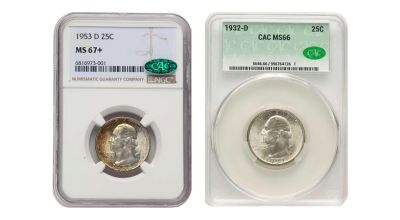
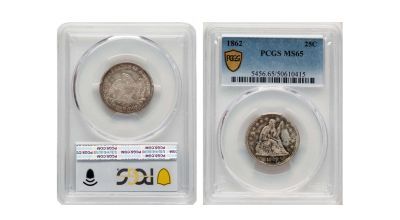
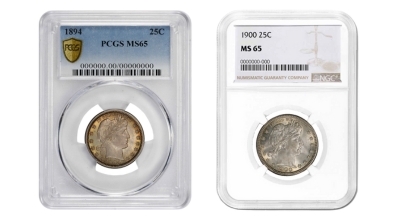
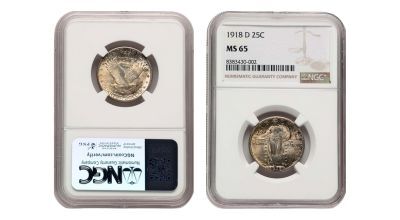
This category is dedicated to certified quarters, coins authenticated and professionally graded by leading third-party services like PCGS and NGC, and often further validated by CAC. Certified (slabbed) quarters remove much of the guesswork from condition, authenticity, and attribution, making them the preferred choice for collectors who want confidence, liquidity, and long-term value protection. PCGS notes that its coins are backed by a guarantee and tracked through an online certification verification database, and that PCGS pioneered tamper-evident encapsulation methods for secure storage.
A quick history of U.S. quarters: key eras and designs
The U.S. Mint summarizes the denomination’s long arc clearly: quarters begin in 1796 (originally struck in silver), continue through a Liberty-and-eagle tradition until 1930, and include the famed Standing Liberty quarter (1916–1930). From there, the quarter becomes a canvas for both classic portraiture and modern commemorative storytelling.
Here are the major quarter “types” collectors pursue, many of which appear in certified form in this category:
-
Early Federal quarters (Draped Bust, Capped Bust, Seated Liberty): foundational U.S. silver coinage, prized for history, low survival rates, and eye appeal.
-
Barber quarters (1892 - 1916): a workhorse series with several legendary key dates.
-
Standing Liberty quarters (1916 - 1930): one of the most artistic U.S. designs, famous for condition sensitivity and strike designations.
-
Washington quarters (1932 - present, with major subtypes): beginning as a bicentennial tribute to George Washington and later becoming America’s most popular “program coin” platform. The U.S. Mint notes the Washington obverse design has been used on the quarter since 1932.
Key dates, low-mintage years, and why they matter
In numismatics, mintage is only part of rarity, but low mintage often flags dates that become long-term demand drivers, especially when combined with heavy circulation, poor saving habits at the time, or condition scarcity in top grades.
A few headline low-mintage or key-date quarters collectors chase include:
-
1796 Draped Bust Quarter (first year of issue) - mintage just 6,146, making it a cornerstone “type” for early U.S. quarter specialists.
-
Barber Quarter key dates
-
1896-S — mintage 188,039, a major semi-key with tough high-grade availability.
-
1901-S — mintage 72,664, widely regarded as one of the great Barber (and 20th-century) silver rarities.
-
1913-S — mintage 40,000, the lowest-mintage regular-issue Barber quarter and a classic “trophy” date.
-
-
Standing Liberty Quarter keys and famous varieties
-
1916 — mintage 52,000, the series’ key date and one of the best-known 20th-century quarter rarities.
-
1918/7-S overdate — a premier variety rarity; PCGS describes it as one of the key-date silver coin rarities of the 20th century.
-
-
Washington Quarter key dates
-
1932-D — mintage 436,800
-
1932-S — mintage 408,000 (the lowest-mintage Washington quarter)
These are the classic keys of the long-running Washington series.
-
Beyond “date-and-mintmark” keys, certified quarters are also a playground for varieties and errors, including doubled dies, repunched mintmarks, and reverse design anomalies. For example, Bullion Shark highlights the 1960 Type B reverse (a business strike with a proof-style reverse appearance) as a distinctive collectible variety, and offers examples with specialty labels such as Bill Fivaz signed holders (Fivaz is well-known in variety collecting circles).
Modern quarter programs: big milestones and collecting angles
Modern quarters aren’t just pocket change, they’re often “gateway collectibles” that bring new collectors into the hobby through design themes and set-building.
Some of the most important program milestones include:
-
50 State Quarters (1999–2008) — five new designs each year honoring every state.
-
America the Beautiful Quarters (2010–2021) — 56 designs depicting national parks and sites across states, territories, and D.C.
-
American Women Quarters Program (2022–2025) — five designs per year honoring influential women in U.S. history (a major modern-era collecting theme).
Collectors often pursue these modern issues in top-pop grades, special finishes (proof, silver proof), first/last-year themes, and notable errors or varieties, where professional attribution on the holder can be especially valuable.
Why certification matters: grading, authentication, and market trust
A quarter’s value can swing dramatically based on grade, strike quality, and originality. That’s why third-party grading has become central to the rare coin market.
-
NGC uses the internationally accepted Sheldon 1–70 grading scale, widely considered an industry standard.
-
PCGS emphasizes secure encapsulation and database-backed verification, helping buyers confirm what they’re purchasing.
-
CAC adds another layer: it evaluates already-certified coins and applies a green or gold sticker to pieces it deems high quality for the assigned grade—an endorsement that CAC itself says is widely recognized and can command a premium in the market.
Certification is also where many quarter-specific value drivers get “locked in,” such as:
-
Prooflike / Cameo designations on proofs
-
Strike designations (e.g., Standing Liberty “Full Head”)
-
Attributions for recognized varieties (FS numbers, RPMs, doubled dies)
-
Pedigree, special labels, and signature series
The significance of labels, signatures, and specialty holders
For many collectors, the holder isn’t just protection, it’s provenance and storytelling. Bullion Shark highlights that it is an authorized dealer (including PCGS, NGC, and CAC) and offers exclusive labels and signature series across its inventory. Signature labels (like the Bill Fivaz signed example noted above) can add collectability by tying a coin to a recognized numismatic figure or specialty program, while still preserving the core benefits of professional grading and authentication.
Build your set: popular ways collectors collect certified quarters
Collectors typically approach certified quarters in a few satisfying paths:
-
Type sets (one example of each major design: Barber, Standing Liberty, Washington, etc.)
-
Key-date hunting (focusing on the scarce, high-demand dates listed above)
-
Registry-grade sets (chasing the finest certified examples, often where a single grade point matters)
-
Variety and error collecting (attributed pieces like Type B reverses, doubled dies, and overdates)
-
Theme sets (State Quarters, national parks, notable historical figures)
However you collect, certified quarters offer a rare blend of history, artistry, and measurable rarity, with third-party grading making it easier to buy, sell, and upgrade confidently.