

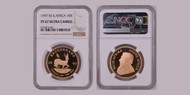
The Most Expensive Krugerrands: 1997 Sabi‑Sabi Krugerrand
Posted by Andrew Adamo - A certified ANA Professional Numismatist, Active member of ICTA, contributor to CoinWeek, Numismatic News, NGC and ANA on May 14th 2026
The Most Expensive Krugerrands: 1997 Sabi-Sabi Krugerrand and Other Gems
The 1997 Sabi-Sabi Krugerrand is a modern numismatic rarity with a mintage of just 3,000 pieces, commanding collector premiums far above bullion value. Certified examples in high grades can reach several thousand dollars, with the most exceptional pieces occasionally appearing at major auctions. This special commemorative Krugerrand represents one of the scarcest modern gold coins from South Africa.
Understanding the 1997 Sabi-Sabi Krugerrand
The 1997 Sabi-Sabi Krugerrand stands apart from standard bullion Krugerrands as a limited commemorative issue created to celebrate the Sabi-Sabi Private Game Reserve in South Africa. Unlike the millions of standard Krugerrands produced annually for the bullion market, this special edition was produced in extremely limited numbers for a specific purpose outside the normal distribution channels.
This coin carries the standard Krugerrand design but was issued with special packaging and documentation linking it to the prestigious wildlife reserve. Collectors recognize it as one of the most significant modern Krugerrand variants, combining the iconic design with meaningful scarcity. The combination of low mintage, specific commemorative purpose, and connection to South African heritage makes this coin highly sought after.
The Sabi-Sabi issue emerged during a period when the South African Mint began exploring special edition Krugerrands beyond the standard bullion program. This represented an important evolution in how these coins were marketed and collected, moving beyond pure precious metal content into the realm of numismatic collectibles with documented provenance.
Historical Background of Krugerrand Collecting
The Krugerrand first appeared in 1967, created by the South African Mint to promote South African gold and provide an accessible way for individuals to own gold bullion. The coin featured a portrait of Paul Kruger, the former president of the South African Republic, on the obverse and a springbok antelope on the reverse.
Otto Schultz designed the obverse portrait based on earlier depictions of Kruger, while Coert Steynberg created the elegant springbok design. The coin was struck in 22-karat gold, containing exactly one troy ounce of pure gold with copper added for durability. This became the standard that many other gold bullion coins would later follow.
For decades, Krugerrands served primarily as bullion investments, with millions struck annually. Collectors initially showed little interest in individual dates or mint marks since the coins traded based on gold content rather than numismatic factors. However, as the series matured and certain years showed dramatically lower mintages, a collector market emerged.
Early-year Krugerrands from 1967 through the 1970s began attracting attention as collectors recognized that mintages varied significantly. Some years saw production in the millions, while others produced far fewer pieces. Political factors, including international sanctions against South Africa during the apartheid era, affected distribution and availability in key markets.
The Emergence of Krugerrand Varieties
Beyond date collecting, numismatists began identifying subtle varieties, proof issues, and special editions. The South African Mint produced proof Krugerrands for collectors starting in 1967, though these were not widely marketed initially. Proof mintages remained low, and many examples stayed in South Africa or went to specialized collectors.
The 1990s saw increased attention to Krugerrands as collectibles rather than pure bullion. The end of apartheid and South Africa's return to the international community created renewed interest in the country's coinage. The mint began exploring commemorative editions and special packaging to appeal to numismatists alongside traditional gold buyers.
This environment set the stage for special issues like the 1997 Sabi-Sabi Krugerrand, which represented a new category of modern rarities. These were not proof coins or mint errors but deliberately limited releases tied to specific events, places, or institutions within South Africa.
Why Collectors Pursue the 1997 Sabi-Sabi Krugerrand
Several factors drive collector demand for the 1997 Sabi-Sabi Krugerrand beyond the gold content itself. The extremely low mintage places this coin in rare company among modern gold issues, with only 3,000 pieces produced. This compares to annual Krugerrand production that has reached into the millions during peak years.
The commemorative nature adds story value that resonates with collectors. Sabi-Sabi represents one of South Africa's most prestigious private game reserves, known for luxury safari experiences and conservation efforts. The connection between this iconic location and South Africa's most famous gold coin creates meaningful context that transcends simple precious metal content.
Scarcity in the marketplace amplifies demand. Many of the original 3,000 coins remained in South Africa or went to specialized collectors who understood the significance. Others may have been damaged, lost, or dispersed in ways that make them difficult to locate. The number of high-grade certified examples available to collectors worldwide remains limited.
The 1997 Sabi-Sabi Krugerrand also appeals to completist collectors building comprehensive Krugerrand sets. Serious collectors working to assemble representative examples of special editions, proofs, and commemorative issues recognize this as an essential piece. Its inclusion can significantly enhance the scope and quality of a collection.
Modern Gold Collecting Trends
The broader trend toward modern rarity collecting supports demand for pieces like the Sabi-Sabi Krugerrand. Collectors increasingly recognize that not all modern coins are common, and certain issues produced in small numbers during recent decades can be genuinely scarce. This challenges the assumption that only old coins are truly rare.
Modern gold rarities offer advantages that appeal to today's collectors. They are well-documented, their mintages are known with precision, and authentication is straightforward compared to older coins that may have been counterfeited or altered. The availability of third-party certification services provides additional confidence for buyers.
The combination of precious metal content and numismatic value creates a dual appeal. Even if numismatic premiums fluctuate, the coin retains significant intrinsic value from its gold content. This provides a form of downside protection that pure collectibles without precious metal content do not offer.
Design, Specifications, and Identifying Details
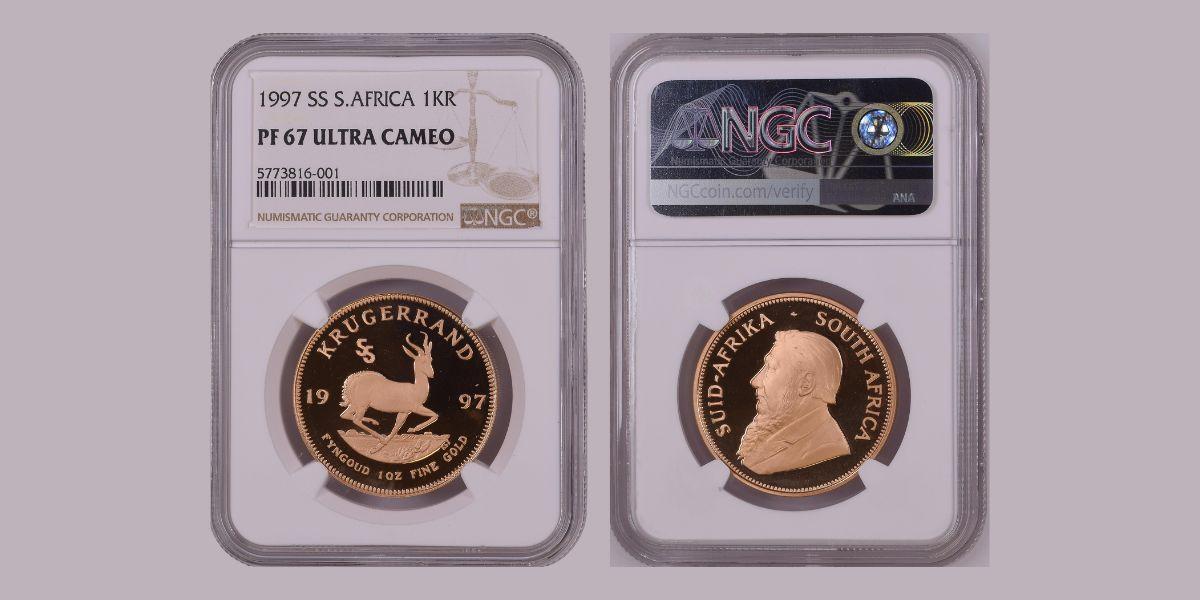
The 1997 Sabi-Sabi Krugerrand maintains the classic design elements that define all Krugerrands. The obverse features the right-facing portrait of Paul Kruger, with the inscription "SUID-AFRIKA" on the left and "SOUTH AFRICA" on the right. These dual-language inscriptions reflect South Africa's bilingual heritage during the period when the original design was created.
The reverse displays the springbok antelope in profile, captured mid-leap in an elegant pose that has become synonymous with South African coinage. The year "1997" appears as part of the design, and the coin's denomination and gold content are indicated as part of the inscriptions. The word "KRUGERRAND" appears prominently on the reverse.
The coin contains exactly one troy ounce of pure gold, with a gross weight of 1.0909 troy ounces due to the copper alloy that brings the fineness to 22 karats or 916.7 parts per thousand gold. This composition gives Krugerrands their distinctive reddish-gold appearance, different from the brighter yellow of 24-karat gold coins.
The diameter measures 32.77 millimeters, and the coin has a thickness of approximately 2.84 millimeters. The edge features reeding with 180 serrations that help with authentication and add aesthetic appeal. These specifications match standard one-ounce Krugerrands, making the Sabi-Sabi edition distinguishable only through documentation and packaging rather than the coin itself.
Authentication Considerations
Because the 1997 Sabi-Sabi Krugerrand shares the same physical characteristics as standard 1997 Krugerrands, authentication requires attention to provenance and original packaging. Legitimate examples were issued with special documentation connecting them to the Sabi-Sabi Private Game Reserve, and this documentation significantly affects value and collectibility.
Collectors should verify that any purported Sabi-Sabi Krugerrand includes original packaging materials, certificates, or other documentation that establishes its commemorative status. Without these elements, the coin would be indistinguishable from a standard 1997 bullion Krugerrand, which carries far less numismatic premium.
Third-party certification services can authenticate the coin's physical characteristics and confirm it is a genuine 1997 Krugerrand, but special designations or holder labels may be necessary to indicate the Sabi-Sabi provenance. Collectors should research whether major grading services recognize and designate this variety specifically.
Rarity, Mintage, and Availability
The 3,000-piece mintage of the 1997 Sabi-Sabi Krugerrand places it among the scarcest Krugerrand issues ever produced. To understand this rarity in context, standard bullion Krugerrand production has varied from hundreds of thousands to millions of pieces annually, depending on gold market conditions and investor demand.
Even compared to proof Krugerrands, which are produced in limited numbers for collectors, the Sabi-Sabi mintage stands out as exceptionally low. Many annual proof issues exceed 3,000 pieces, particularly in recent decades as collector demand for certified gold coins has increased. The Sabi-Sabi represents a true outlier in terms of production numbers.
Availability in the numismatic marketplace remains limited. Major auction houses and specialized dealers occasionally offer examples, but these appearances are infrequent compared to common-date bullion Krugerrands. Collectors seeking this coin may need patience and should be prepared to act decisively when examples appear.