

The 1793 Chain Cent: The Nation’s First Penny
Posted by Andrew Adamo - A certified ANA Professional Numismatist, Active member of ICTA, contributor to CoinWeek, Numismatic News, NGC and ANA on May 29th 2026
The 1793 Chain Cent: The Nation's First Penny
The 1793 Chain Cent represents America's first circulating one-cent coin, produced during the inaugural year of U.S. Mint operations. Values typically range from $4,000 to $15,000 in circulated grades, with exceptional examples commanding over $100,000! The highest-grade specimens have exceeded $1,500,000 at auction, reflecting this coin's status as a cornerstone of early American numismatics.
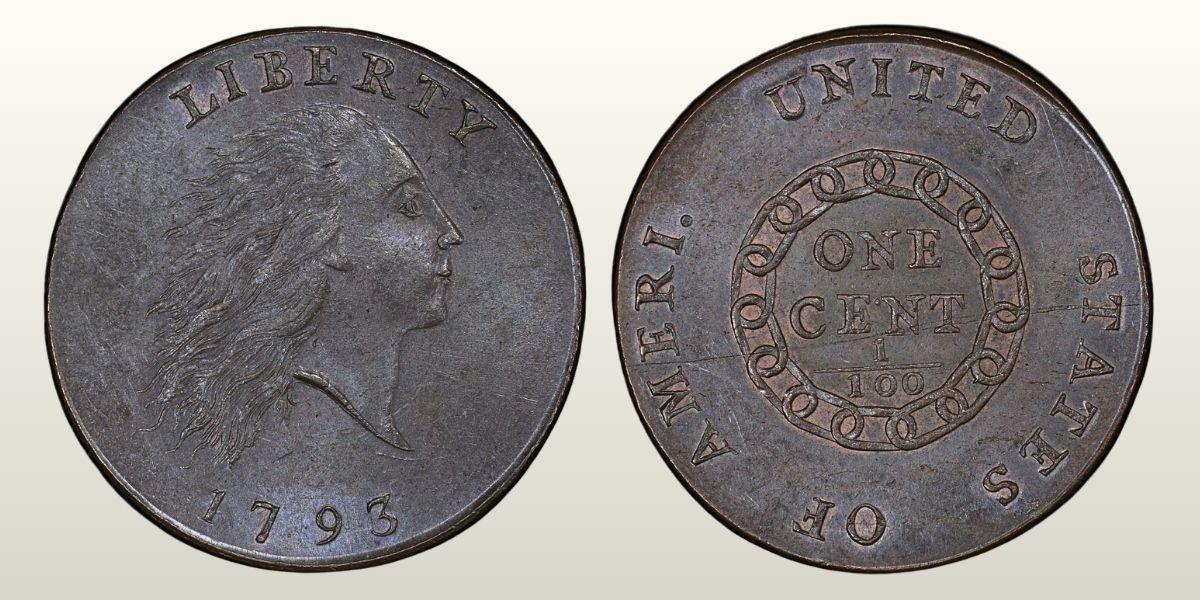
AUCTION RECORD: $1,500,000 • MS64+BN • 01-14-2019
Overview of the 1793 Chain Cent
The 1793 Chain Cent is the first one-cent coin struck by the newly established United States Mint. Produced in Philadelphia during the spring of 1793, this copper cent featured a controversial design that lasted only a few months before public outcry forced its replacement. Despite its brief production period, the Chain Cent established the one-cent denomination that continues today and represents the beginning of America's journey toward a unified national coinage system.
Collectors prize these coins not only for their historical importance but also for their striking visual presence. The obverse displays a profile portrait of Liberty with flowing hair, while the reverse shows fifteen interlocking chain links representing the states in the Union. The design, though meant to symbolize unity, sparked immediate controversy that shaped the future of American coin design and demonstrated the powerful cultural significance of national currency imagery.
Historical Background and Production Context
The Coinage Act of April 2, 1792 established the U.S. Mint and authorized the production of copper cents. By early 1793, Mint Director David Rittenhouse and Chief Coiner Henry Voigt oversaw the installation of equipment and preparation of dies necessary for cent production. The physical plant on Seventh Street in Philadelphia was still under construction when coining operations began, reflecting the urgent need to provide the young nation with its own circulating currency.
Production of the Chain Cent began in late February or early March 1793. The Mint delivered the first cents to Treasurer Nicholas Way on March 1, 1793, marking the beginning of regular U.S. copper coinage. The dies were prepared by an engraver whose identity remains uncertain, though some numismatic researchers attribute the work to Henry Voigt himself or possibly an outside contractor.
The design drew immediate criticism from the public and press. Contemporary observers objected to the chain imagery, viewing it as symbolic of slavery and bondage rather than unity. One widely circulated newspaper commentary described Liberty's portrait as appearing frightened, suggesting the chains on the reverse had terrified her. This negative reception prompted Mint officials to quickly redesign the cent, leading to the introduction of the Wreath Cent design in April 1793.
The brief production period resulted in a limited mintage. While exact figures remain debated by numismatic scholars, mint records and later estimates suggest approximately 36,103 Chain Cents were produced across two distinct varieties. This small production, combined with the coin's historical significance and the natural attrition from more than two centuries of circulation and loss, ensures that surviving examples remain scarce in today's marketplace.
Known Varieties of the 1793 Chain Cent
Numismatists recognize two major varieties of the 1793 Chain Cent, distinguished by the spelling of the word AMERICA on the reverse. These varieties reflect the challenges of early die production and the limited quality control measures available to the nascent Mint facility.
The AMERI. variety features a period after the abbreviated form of AMERICA on the reverse. This variety is considered slightly scarcer than its counterpart, though both types command strong collector interest. The period's presence suggests a die-cutting error or space limitation that prevented the full spelling of the word. Some numismatic researchers speculate the abbreviation may have been intentional, though contemporary mint records provide no definitive explanation.
The AMERICA variety displays the complete spelling without abbreviation or period. This variety represents the majority of surviving Chain Cents, though both types remain rare in absolute terms. Collectors pursuing complete type sets often seek examples of both varieties, while those focused on acquiring a single representative Chain Cent may choose based on availability, price, and condition rather than variety type.
Beyond these major varieties, individual die states, striking characteristics, and minor die variations provide additional areas of study for advanced specialists. Early die states typically show sharper detail in Liberty's hair and the chain links, while later impressions from worn dies display progressive weakness in these areas. Some examples show evidence of planchet preparation issues, including laminations, incomplete mixing of the copper alloy, or surface roughness from the rolling and cutting processes.
1793 Chain Cent “With Periods” Variety
The 1793 Chain Cent “With Periods” was not produced for a special commemorative reason. It was simply one of the hand-cut die varieties made during the U.S. Mint’s first large-cent coinage.
In 1793, dies were engraved by hand, not made from standardized master hubs the way modern coin dies are. Because of that, small differences appeared from die to die. On the variety collectors call “With Periods", Sheldon variety S-4, the obverse die has a period after LIBERTY and a period after the date 1793. That is what gives the variety its name.
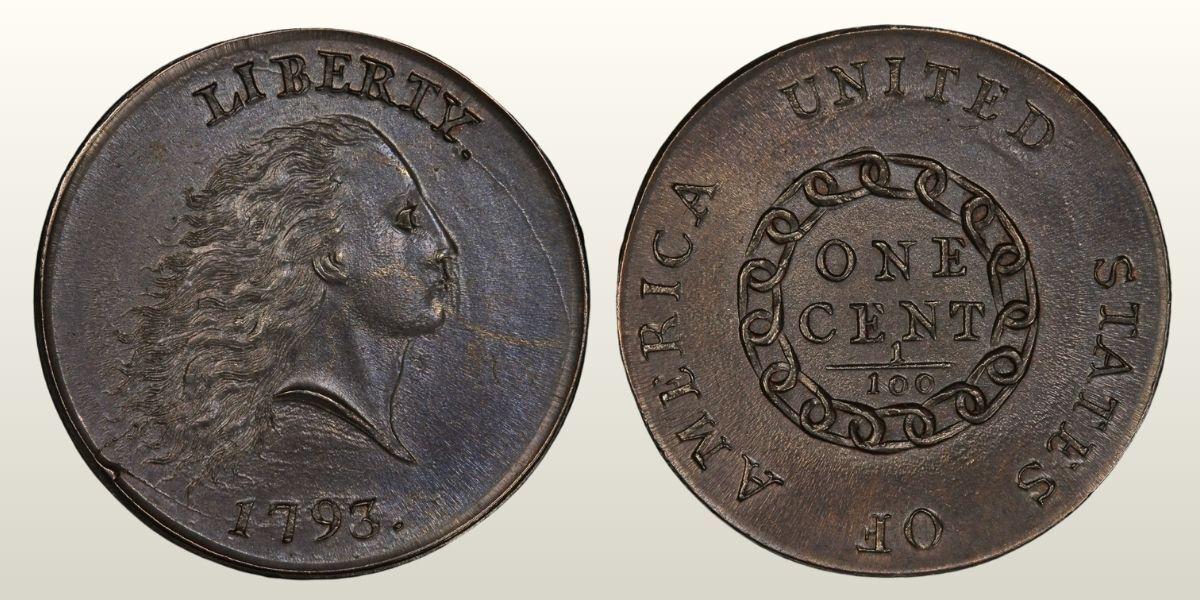
The broader Chain Cent design was produced because it was the first regular-issue U.S. cent from the new Philadelphia Mint. Its reverse used a chain of 15 links, meant to symbolize the 15 states then in the Union, not slavery or bondage.
1793 Chain Cent Reverse Varieties: AMERICA vs. AMERI.
One of the most recognizable differences among 1793 Chain Cents appears on the reverse, where the legend was struck as either “AMERICA” or the abbreviated “AMERI.” The AMERI. reverse is associated with the Sheldon-1 variety and represents the earliest reverse style, with the country’s name shortened and followed by a period. Later Chain Cent varieties, including Sheldon-2, Sheldon-3, Sheldon-4, and NC-1, used the fully spelled AMERICA reverse.
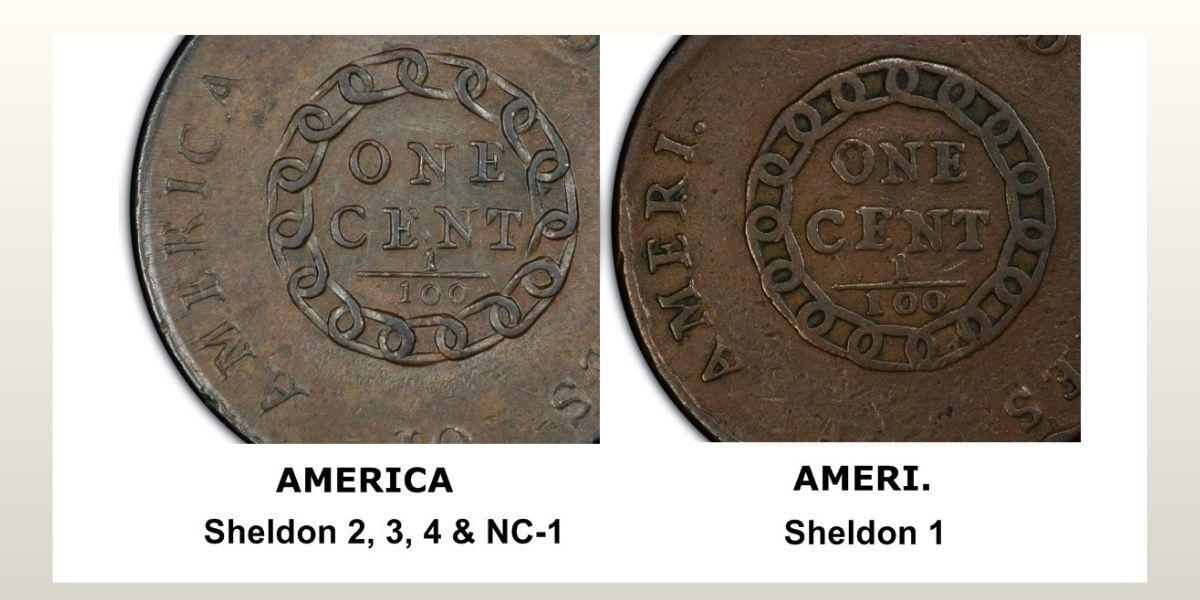
Imag source: PCGS
These differences were not random damage or later alterations, but the result of individual hand-engraved dies used at the early Philadelphia Mint. For collectors, the reverse wording is an important diagnostic feature that helps identify the exact die variety of a 1793 Chain Cent.
Why Collectors Pursue the 1793 Chain Cent
The appeal of the Chain Cent extends beyond simple scarcity. This coin represents multiple collecting motivations that drive sustained demand across different segments of the numismatic market. For type collectors assembling representative examples of major U.S. coin designs, the Chain Cent is essential as the first distinct type in the Large Cent series. Serious Large Cent specialists consider ownership of a Chain Cent a fundamental goal, regardless of grade.
Historical significance adds considerable weight to the coin's desirability. Owning a Chain Cent means possessing a tangible link to the earliest days of the U.S. Mint and the formation of America's monetary system. The coin predates the presidencies of John Adams and Thomas Jefferson, connecting collectors directly to the Washington administration and the Federalist era. This historical resonance attracts buyers beyond traditional numismatists, including American history enthusiasts and institutional collectors.
The controversial design story provides narrative appeal that enhances collector interest. The quick abandonment of the chain motif after public backlash makes these cents artifacts of early American political culture and public opinion. The design controversy demonstrates how currency imagery communicates national values and identity, adding interpretive depth that transforms the coin from mere collectible to historical document.
Market dynamics also sustain demand. The fixed supply of surviving Chain Cents creates natural scarcity in a collecting field with growing participation. As the numismatic market has matured and expanded, competition for available examples has intensified, particularly for problem-free specimens with attractive eye appeal. Certification services have brought greater transparency to the market, allowing collectors to evaluate condition with increased confidence and facilitating price discovery across grade levels.
Design Elements and Physical Specifications
The obverse design features a right-facing portrait of Liberty with flowing hair extending behind her head to the right edge of the coin. The word LIBERTY appears above her head, while the date 1793 is positioned below the portrait, separated by Liberty's shoulder and neck. The portrait style differs markedly from later, more refined Liberty depictions, appearing somewhat crude by comparison and contributing to contemporary criticisms of the design's artistic quality.
On the reverse, fifteen interlocking chain links form a circular pattern around the denomination ONE CENT, which appears at the center of the chain circle. The fraction 1/100 appears below, indicating the cent's proportional value relative to the dollar. The inscription UNITED STATES OF AMERICA encircles the outer edge of the reverse, running along the rim. The chain links vary slightly in size and appearance, creating an irregular but distinctive pattern.
The coin measures approximately 26 to 27 millimeters in diameter, though hand-fed planchet production and manual striking methods resulted in size variations between individual pieces. The composition consists of pure copper, giving the coins their characteristic reddish-brown color when new. Over time, environmental exposure has caused most surviving examples to develop darker brown or chocolate-colored patinas, though exceptional specimens retain reddish surfaces or attractive multicolored toning.
Weight specifications called for approximately 208 grains, equivalent to about 13.48 grams. In practice, planchet preparation methods of the era resulted in weight variations, and later circulation wear further reduced the mass of most surviving examples. Edge treatment is plain, without lettering or reeding, consistent with other copper coinage of the period.
Rarity Profile and Market Availability
The 1793 Chain Cent ranks among the more difficult early American coins to locate in today's market. The combination of limited original mintage, active circulation that destroyed many examples, and centuries of attrition through loss and environmental damage has reduced the surviving population to perhaps 2,000 to 3,000 pieces across all grades and varieties combined. This represents a survival rate well under ten percent of the original production, typical for eighteenth-century copper coins but still creating significant scarcity pressure.
Most surviving Chain Cents show evidence of circulation, exhibiting wear ranging from moderate to heavy. Problem-free examples in higher circulated grades such as Very Fine or Extremely Fine appear infrequently at auction and command substantial premiums over more worn pieces. Mint State examples exist but remain rare, with perhaps fewer than one hundred pieces across all Uncirculated grades. Even these finest-known specimens typically show evidence of the era's primitive striking technology, including planchet roughness, weak details in isolated areas, or minor surface disturbances.
Certification populations provide insight into relative availability across grade levels. The major third-party grading services have collectively certified several thousand Chain Cents over their operational histories, though this figure includes resubmissions and crossovers that inflate the apparent population. Genuine population figures suggest most certified pieces grade between Good and Fine, with decreasing numbers as grades improve. Very Fine and Extremely Fine examples together likely account for fewer than 500 certified pieces, while Mint State examples number substantially fewer.
Market availability fluctuates based on auction cycles and private sale activity. Major numismatic auctions typically offer one to several Chain Cents per sale, providing periodic opportunities for serious collectors. Specialized early copper auctions may feature multiple examples as collections are dispersed. Private treaty sales handled by established rare coin dealers account for a significant portion of transactions, particularly for higher-grade pieces where buyers prefer discrete negotiation over public auction exposure.
Grading Considerations and Condition Factors
Evaluating the condition of a 1793 Chain Cent requires understanding both the coin's design elements and the challenges inherent to early Mint production. Graders assess several factors when determining a numeric grade, including the amount of wear, surface preservation, strike quality, planchet integrity, and overall eye appeal. Due to the primitive production methods of 1793, even technically high-grade pieces may display characteristics that would be considered flaws on later coins.