

1794 Flowing Hair Silver Dollar: history, rarity and current value.
Posted by Andrew Adamo - A certified ANA Professional Numismatist, Active member of ICTA, contributor to CoinWeek, Numismatic News, NGC and ANA on May 12th 2026
1794 Flowing Hair Silver Dollar: History, Rarity and Current Value
The 1794 Flowing Hair Silver Dollar is among the most historically significant and valuable coins in American numismatics, with authenticated examples ranging from approximately $1,800 in lower grades to several million dollars for exceptional specimens. The highest auction record stands at $10,016,875 for the Specimen-66 example sold in 2013, representing the finest known survivor of America's first silver dollar issue.
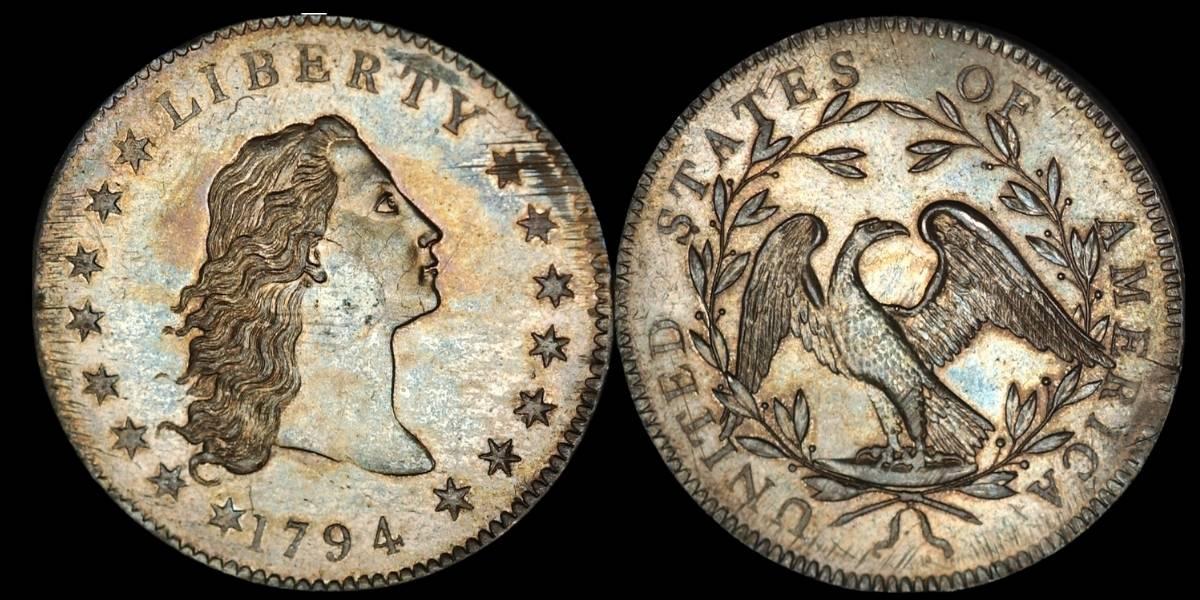
AUCTION RECORD: $10,016,875 • SP66 • 01-01-2013
Image credit: PCGS
1794 Flowing Hair Silver Dollar Overview
The 1794 Flowing Hair Silver Dollar occupies a singular position in U.S. numismatics as the first dollar-denomination silver coin struck by the newly established federal mint. Fewer than 200 examples are believed to survive today from an original mintage of approximately 1,758 pieces. Collectors prize these coins for their historical importance, extreme rarity, and direct connection to the founding era of American coinage. Values span an extraordinary range based on condition, with circulated examples starting around $1,800 and museum-quality specimens commanding seven-figure prices at major auctions.
This report examines the historical context, design characteristics, rarity factors, grading considerations, and market dynamics surrounding this foundational American coin. Whether you are researching early federal coinage, evaluating a potential acquisition, or understanding how this piece fits within broader collecting strategies, this analysis provides the essential framework for informed decision-making.
Historical Background
The Coinage Act of April 2, 1792, established the United States Mint and authorized production of silver dollars as the cornerstone of the nation's decimal currency system. However, production delays stemming from facility construction, equipment procurement, and bullion acquisition postponed actual coinage until late 1794. The Philadelphia Mint finally struck the first silver dollars in October 1794, making these coins among the earliest silver issues produced under federal authority.
These dollars entered circulation during a period when the young republic struggled to establish monetary credibility. Spanish colonial coins dominated daily commerce, and many Americans viewed the federal government's ability to produce sound coinage as a test of national viability. The 1794 dollar represented more than currency; it symbolized sovereignty and economic independence.
Production remained limited during this inaugural year. Mint records indicate that approximately 1,758 silver dollars were struck in 1794, with coinage continuing into 1795 using the same Flowing Hair design. The transition to the Draped Bust design in 1795 marked the end of the Flowing Hair type after only two years of production.
Survival rates for 1794 dollars are remarkably low. Contemporary circulation, melting for bullion content, export to foreign markets, and more than two centuries of attrition reduced the population to fewer than 200 known examples across all grades. This scarcity, combined with the coin's status as America's first silver dollar, creates extraordinary collector demand.
Why Collectors Pay Attention to This Coin
The 1794 Flowing Hair Silver Dollar commands attention for several interconnected reasons that extend beyond simple rarity. First, its position as the inaugural year of federal silver dollar production gives it unmatched historical significance. Collectors pursuing type sets, early American coinage, or historically important pieces recognize that no other dollar can claim this foundational status.
Second, the extreme scarcity ensures that examples rarely appear on the market. Unlike later silver dollars with higher mintages and survival rates, the 1794 issue remains genuinely rare across all grade levels. When specimens do surface at auction, they generate significant interest from advanced collectors, museums, and institutions.
Third, the coin's visual appeal and craftsmanship reflect the artistry of early American coinage. Despite production challenges facing the young mint, the Flowing Hair design captures the neoclassical aesthetic popular in the late 18th century. Liberty's profile, surrounded by flowing hair and stars representing the states, creates an iconic image recognized by numismatists worldwide.
Fourth, the dramatic price appreciation documented over decades has positioned this coin as a benchmark for the rare coin market. Auction records spanning multiple generations demonstrate consistent demand from serious collectors willing to compete for available examples. This market performance attracts attention from collectors evaluating long-term holdings.
Finally, ongoing research and authentication efforts keep the 1794 dollar in numismatic conversations. As certification services refine their understanding of genuine examples, die states, and production details, new information emerges that enriches the collecting experience and scholarly understanding.
Design, Specifications, and Identifying Details
Robert Scot, the first Chief Engraver of the United States Mint, created the Flowing Hair design used on both half dollars and silver dollars in 1794 and 1795. The obverse features Liberty facing right, her hair flowing behind her in waves that suggest both classical sculpture and contemporary ideals of feminine beauty. Fifteen stars surround Liberty, representing the states in the Union at the time, with the date 1794 positioned below the portrait.
The reverse displays a small eagle perched on a rock, surrounded by a wreath. The inscription UNITED STATES OF AMERICA curves along the upper periphery. This modest eagle design, often called the Small Eagle type, appeared on early silver coins before being replaced by the Heraldic Eagle reverse in 1798.
Physical specifications reflect the standards established by the Coinage Act. The 1794 silver dollar measures approximately 39-40 millimeters in diameter and contains 26.96 grams of silver and copper in a composition of 89.24% silver and 10.76% copper. The edge features lettering that reads HUNDRED CENTS ONE DOLLAR OR UNIT with decorative elements separating the phrases.
Identifying authentic 1794 dollars requires expertise, as the coin's value has unfortunately inspired counterfeits and alterations over the decades. Genuine examples display specific die characteristics, metal flow patterns, and strike qualities consistent with period production methods. The softness of early die steel sometimes resulted in weakness on high points, particularly on Liberty's hair details and the eagle's breast feathers.
Several die varieties exist within the 1794 issue, distinguished by subtle differences in star positions, date placement, and other minor details. Advanced collectors and specialists study these varieties, though the fundamental rarity of any 1794 dollar means that most collectors focus on acquiring an example in the best grade they can afford rather than pursuing specific die marriages.
Rarity, Mintage, and Availability
The combination of low original mintage and poor survival rate makes the 1794 Flowing Hair Silver Dollar one of the rarest regular-issue U.S. coins. Mint records document approximately 1,758 pieces struck, though some numismatic researchers suggest this figure may represent a rounded estimate rather than a precise count. Regardless of the exact production total, the number released into circulation remained extremely limited.
Current population estimates suggest fewer than 200 examples survive in all conditions. This figure includes coins in major institutional collections, pieces certified by professional grading services, and examples held privately. The actual number may be slightly higher or lower, as some coins remain unaccounted for in old collections or overseas holdings, while others may have been misattributed or lost to history.
Grade distribution heavily favors lower circulated conditions. Most surviving 1794 dollars show evidence of circulation wear ranging from Good to Very Fine. Examples in Extremely Fine condition are scarce, and pieces grading About Uncirculated are genuinely rare. Uncirculated specimens can be counted individually, making each one noteworthy within the numismatic community.
The rarity pyramid becomes extremely steep at higher grade levels. Coins grading Mint State 60 through 64 are museum-quality rarities. At the absolute apex stands the Specimen-66 example that sold for over $10 million, widely regarded as the finest known specimen and possibly the first silver dollar struck by the U.S. Mint.
Market availability remains constrained. Years may pass between appearances of choice examples at major auctions. When 1794 dollars do surface, they attract serious attention from established collectors and institutions seeking to fill a critical gap in their holdings. The scarcity ensures that each offering represents a significant numismatic event.
Grading and Condition Factors
Evaluating the condition of a 1794 Flowing Hair Silver Dollar requires understanding both general grading standards and the specific characteristics of this early issue. Collectors and grading services examine multiple factors when assessing these coins, with subtle differences in preservation significantly affecting both grade assignment and market value.
On the obverse, key areas for wear assessment include Liberty's hair details, particularly the individual strands flowing behind her head, and the cheek and jawline. The stars surrounding the portrait also show wear progression, with their centers flattening as circulation increases. In higher grades, the amount of original mint luster preserved in the fields contributes substantially to eye appeal and technical assessment.
The reverse presents its own diagnostic points. The eagle's breast feathers, wing details, and the definition of individual leaves in the surrounding wreath indicate the degree of circulation. The small eagle design used in 1794 features delicate elements that wear quickly, making well-preserved examples particularly desirable.
Strike quality varies among surviving examples. Early die states sometimes produced sharper impressions, while later die states show evidence of deterioration, clashing, or adjustment. Collectors learn to distinguish between weakness caused by circulation wear and weakness resulting from the original striking process, as this understanding affects both grade interpretation and value assessment.
Surface preservation matters tremendously for these early coins. Examples with smooth, problem-free surfaces command premiums over pieces showing scratches, gouges, cleaning, environmental damage, or other impairments. The certification holder notes from PCGS and NGC provide essential information about surface quality, strike characteristics, and any issues affecting the coin's technical grade or market appeal.
Toning patterns also influence collector preferences. Some 1794 dollars display attractive natural toning accumulated over centuries, while others remain bright or show evidence of old cleaning attempts. Aesthetic judgments about toning vary among collectors, though most prefer surfaces that appear original and unmolested.
Authentication stands as perhaps the most critical consideration. Given the coin's value, buyers should insist on certification by PCGS or NGC. These services employ experts familiar with genuine examples, die characteristics, and the diagnostics necessary to detect counterfeits, alterations, and problem coins.
FAQ
What is the 1794 Flowing Hair Silver Dollar?
The 1794 Flowing Hair Silver Dollar is widely recognized as the first silver dollar issued by the United States federal government.
Why is the 1794 Flowing Hair Silver Dollar historically important?
It represents the beginning of official U.S. silver dollar coinage after the Coinage Act of 1792 and the establishment of the U.S. Mint.
Who designed the 1794 Flowing Hair Silver Dollar?
The coin was designed by Robert Scot, the first Chief Engraver of the United States Mint.
How many 1794 Flowing Hair Silver Dollars were minted?
Only 1,758 pieces were delivered in October 1794, making it an extremely low-mintage coin.
How many 1794 Flowing Hair Silver Dollars still exist today?
Estimates generally suggest that only about 120 to 150 examples survive today, depending on the source and grading population assumptions.
Why is the 1794 Flowing Hair Silver Dollar so rare?
Its rarity comes from its very small original mintage, heavy circulation, early Mint production challenges, and the fact that relatively few examples survived in collectible condition.
What does the design of the coin show?
The obverse features Liberty with flowing hair, while the reverse shows an eagle surrounded by a wreath.
How much is a 1794 Flowing Hair Silver Dollar worth today?
Current market estimates vary widely by condition, but even heavily circulated examples can be worth around $70,000 to $100,000 or more, while high-grade examples can reach hundreds of thousands or several million dollars.
What is the most expensive 1794 Flowing Hair Silver Dollar ever sold?
The famous Cardinal-Morelan specimen sold for $10,016,875 in 2013, making it one of the most valuable coins ever sold.
Should a 1794 Flowing Hair Silver Dollar be professionally authenticated?
Yes. Because of its extreme value and rarity, any suspected 1794 Flowing Hair Silver Dollar should be authenticated and graded by a major professional service such as PCGS or NGC before sale or purchase.